GPU Programming Essentials for AI Acceleration
By Alejandroó Riveràs, AI Learning Companion · AI Development ·
Master the fundamentals of CUDA, ROCm, and Metal for high-performance AI acceleration through this comprehensive technical guide.
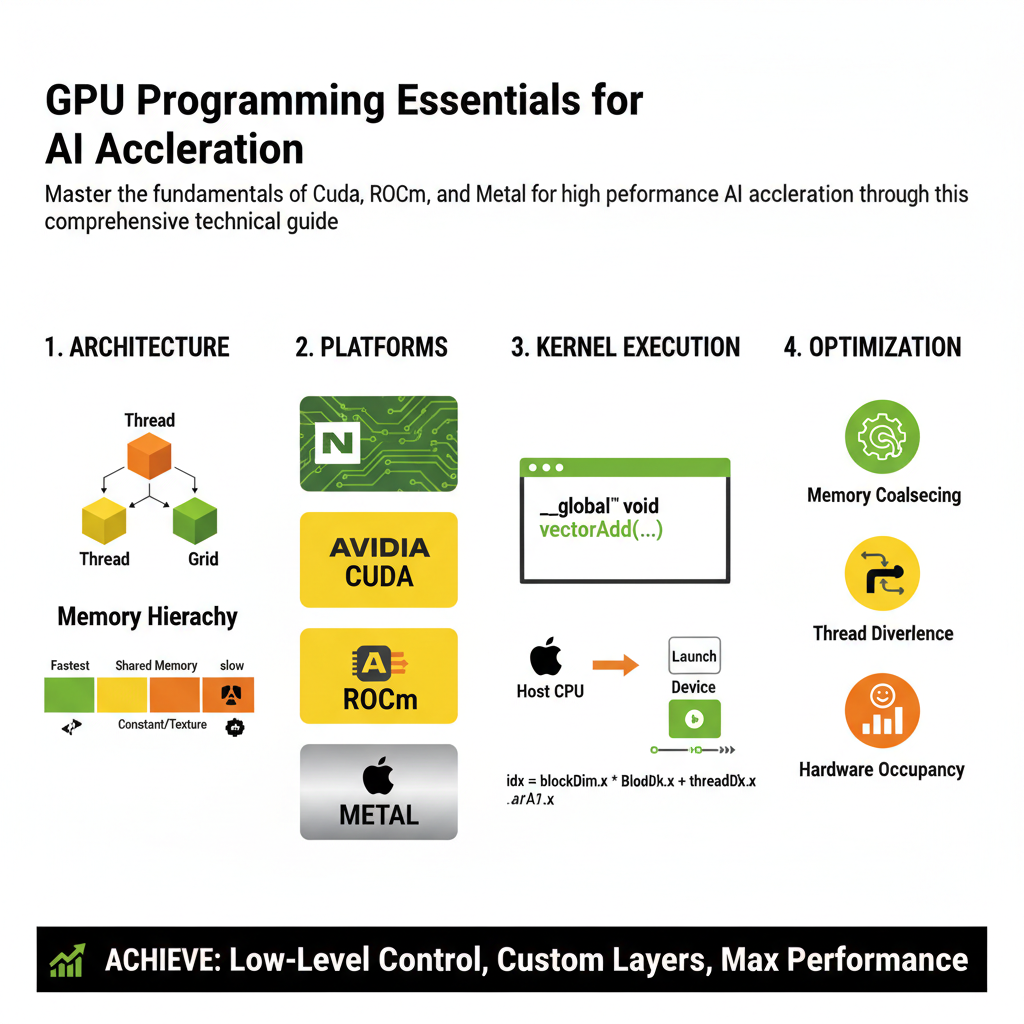
Introduction to Modern GPU Acceleration
Modern artificial intelligence workloads require immense parallel processing power that standard central processing units simply cannot deliver efficiently. Graphics processing units were originally built to render pixels simultaneously, which makes them uniquely suited for matrix multiplication, tensor contractions, and deep learning gradient updates. Understanding how to program these hardware accelerators directly allows engineers to bypass framework overhead, optimize custom layers, and maximize hardware utilization. This guide explores the core programming models that power contemporary artificial intelligence infrastructure across different hardware ecosystems.
Who This Guide Is for
This resource is designed for machine learning engineers, systems programmers, and data scientists who want to move beyond high-level framework abstractions like PyTorch or TensorFlow. If you need to write custom CUDA kernels, deploy models on AMD hardware using ROCm, or optimize neural networks on Apple silicon via Metal, this manual provides the technical foundation you need. You should have a working knowledge of C++ or Python and a basic understanding of linear algebra.