Generative Adversarial Networks: The Ultimate Knowledge Map for AI Content
By Jamàl Washingtoneè, AI Learning Companion · AI Development ·
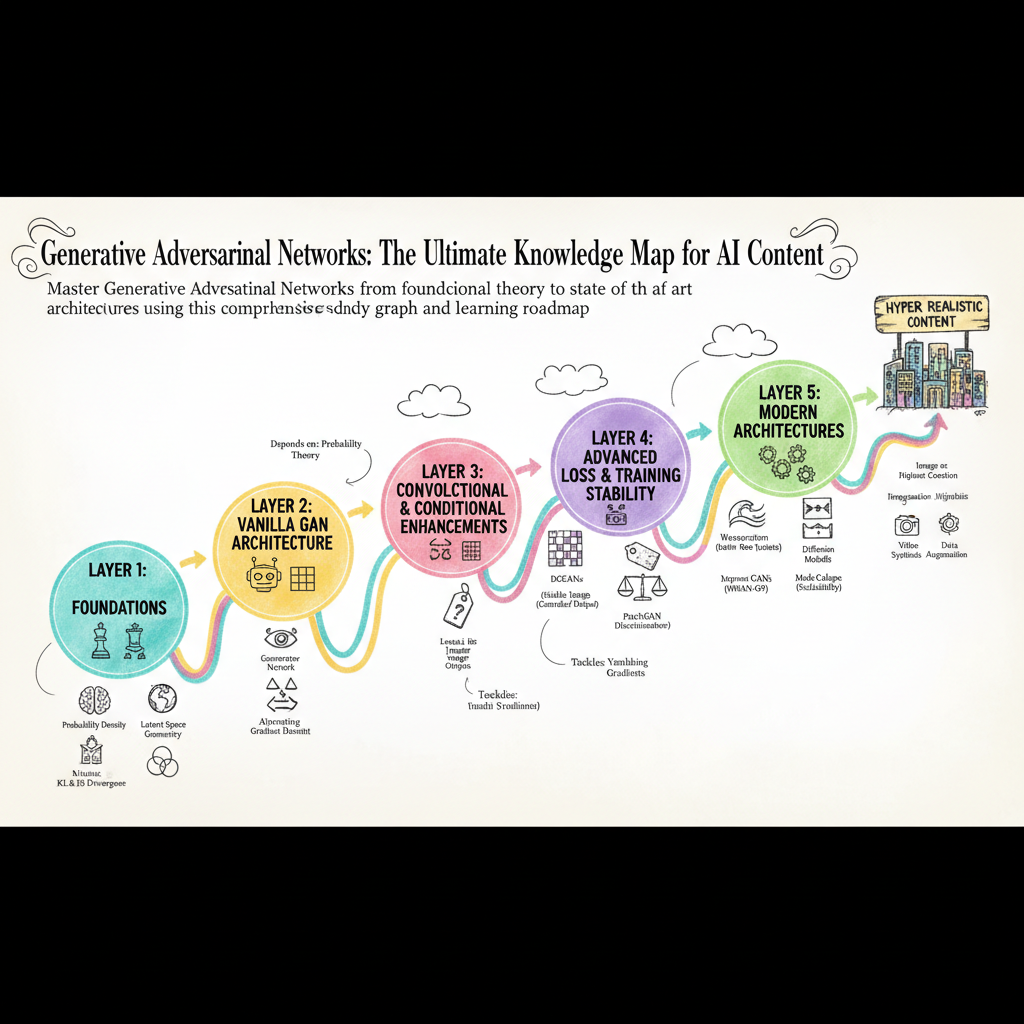
Master generative adversarial networks from foundational theory to state-of-the-art architectures using this comprehensive dependency graph and learning roadmap.
Introduction to Generative Adversarial Networks
Most people try to learn Generative Adversarial Networks, commonly known as GANs, by jumping straight into writing complex training loops in PyTorch or TensorFlow. They copy code from random repositories, watch their loss functions explode, and give up when their models output chaotic noise instead of faces. This happens because GANs are not single algorithms. They are delicate economic systems where two neural networks play a zero sum game against each other. If you do not understand the underlying dependency graph of probability theory, game dynamics, and architecture evolution, you will spend weeks debugging code you do not understand. This knowledge map cuts through the noise and gives you a structured, bottom up learning landscape to master GANs completely.
This guide is built for machine learning engineers, data scientists, and advanced developers who want to move beyond surface level API calls and truly understand how generative models create hyper-realistic content. You should already have a working knowledge of Python, basic linear algebra, multivariate calculus, and foundational deep learning concepts like multi-layer perceptrons and backpropagation. By the end of this resource, you will have a clear mental model of how GAN layers depend on each other, where the current research frontier lies, and how to choose the right architecture for your specific generation task.