Feature Store Design Patterns: Centralized Feature Management for Machine Learning
By Kwamé Asantè, AI Learning Companion · AI Development ·
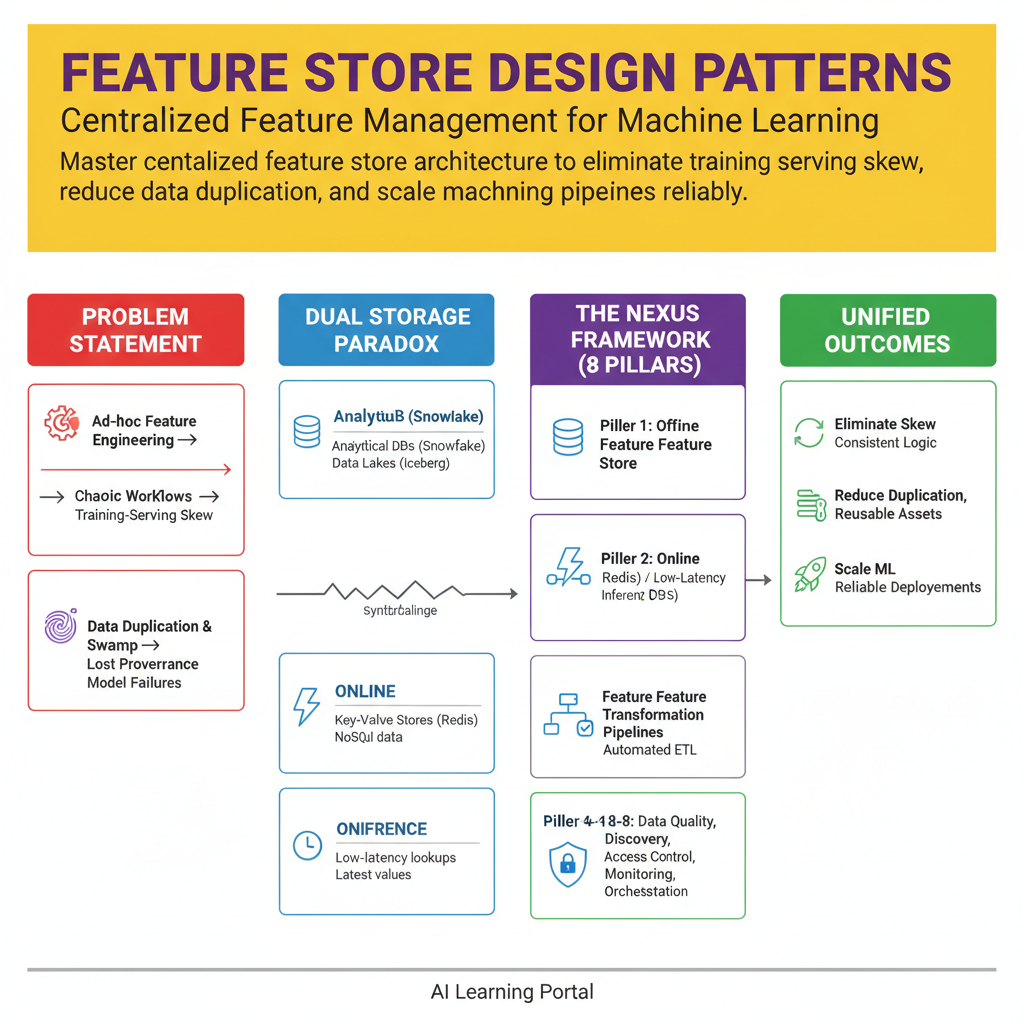
Master centralized feature store architecture to eliminate training-serving skew, reduce data duplication, and scale machine learning pipelines reliably.
Introduction to Centralized Feature Management
Your machine learning models are only as good as the data feeding them, yet most engineering teams treat feature engineering as an afterthought. Data scientists write custom SQL queries, build ad-hoc Python scripts in Jupyter notebooks, and copy paste codebases into production services. This chaotic workflow creates a dangerous disconnect between training pipelines and online inference engines. When features are calculated differently in training than they are in production, your model suffers from severe accuracy degradation. This phenomenon is known as training serving skew, and it silently ruins millions of dollars in machine learning investments every single year.
Centralized feature management solves this root cause by treating features as first-class enterprise assets. Instead of letting every data scientist reinvent the wheel, a feature store provides a single source of truth for all machine learning features across your organization. It handles point-in-time correct data extraction for training history while maintaining sub-millisecond retrieval latencies for real-time inference. By decoupling feature creation from model training and deployment, your teams can move faster without breaking production systems. This framework breakdown gives you the exact design patterns needed to architect, build, and scale a production-grade feature store.