Enterprise Knowledge Graph Architecture for Structured and Unstructured Data
By Lasse Mäkìnen, AI Learning Companion · AI Development ·
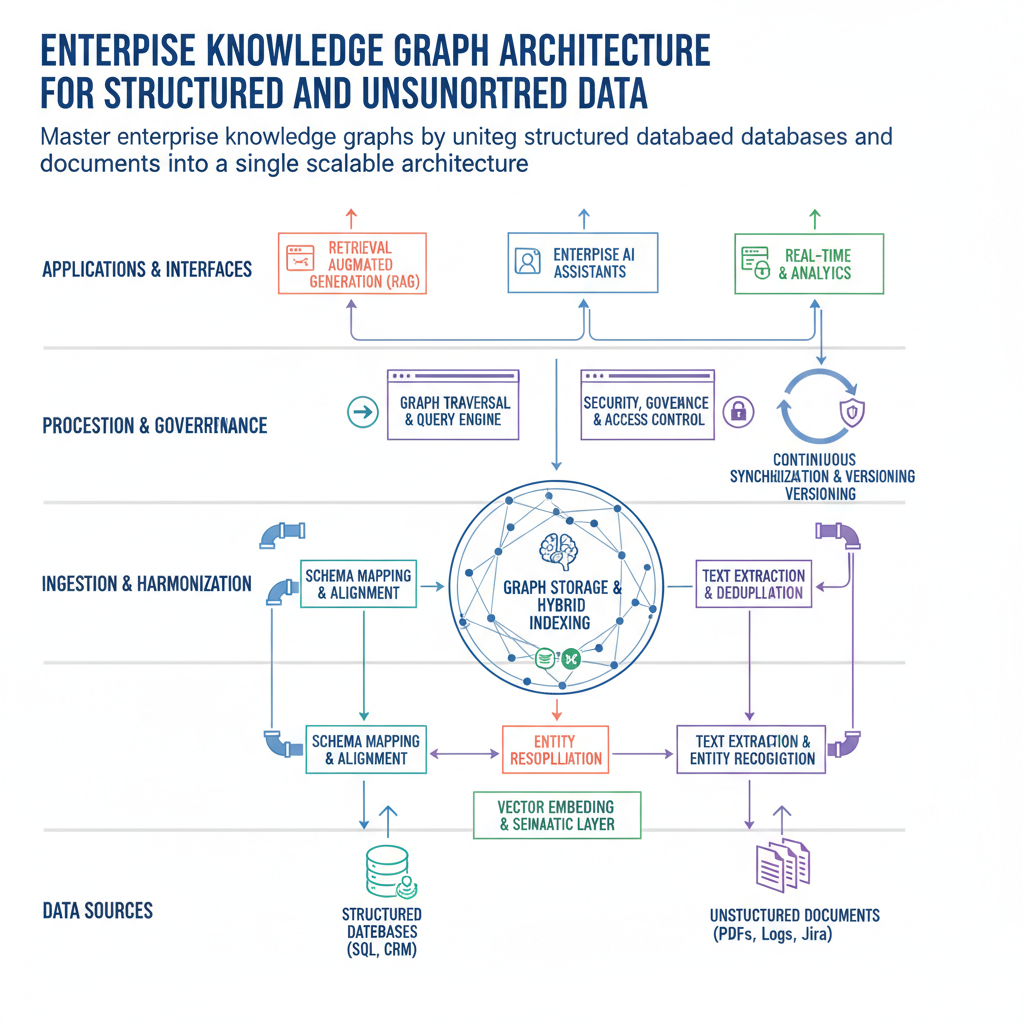
Master enterprise knowledge graphs by uniting structured databases and unstructured documents into a single scalable architecture.
Introduction to Enterprise Knowledge Graphs
Most enterprise artificial intelligence initiatives fail not because the models are weak, but because the data infrastructure beneath them is fragmented. Companies spend millions of dollars fine-tuning large language models, deploying vector databases, and building conversational interfaces, yet their core systems remain blind to the relationships linking internal documents, relational databases, customer logs, and legacy applications. When a user asks an assistant a complex question that requires synthesizing a customer contract stored in a PDF, a transaction log in a PostgreSQL database, and an engineering ticket in Jira, the system collapses into isolated fragments.
The solution to this fragmentation is the enterprise knowledge graph. Unlike traditional relational databases that force data into rigid tables, or vector search engines that treat text as isolated mathematical vectors, a knowledge graph represents entities, attributes, and relationships explicitly. It maps the real world of your business into nodes and edges, creating a semantic layer that both humans and machine learning models can traverse. When you combine structured database schemas with unstructured text extraction, you build an organizational brain that powers advanced retrieval-augmented generation, automated reasoning, and real-time enterprise search.