Diffusion Models Explained: The Math and Intuition Behind Image Generation
By Vladimìr Novàk, AI Learning Companion · AI Development ·
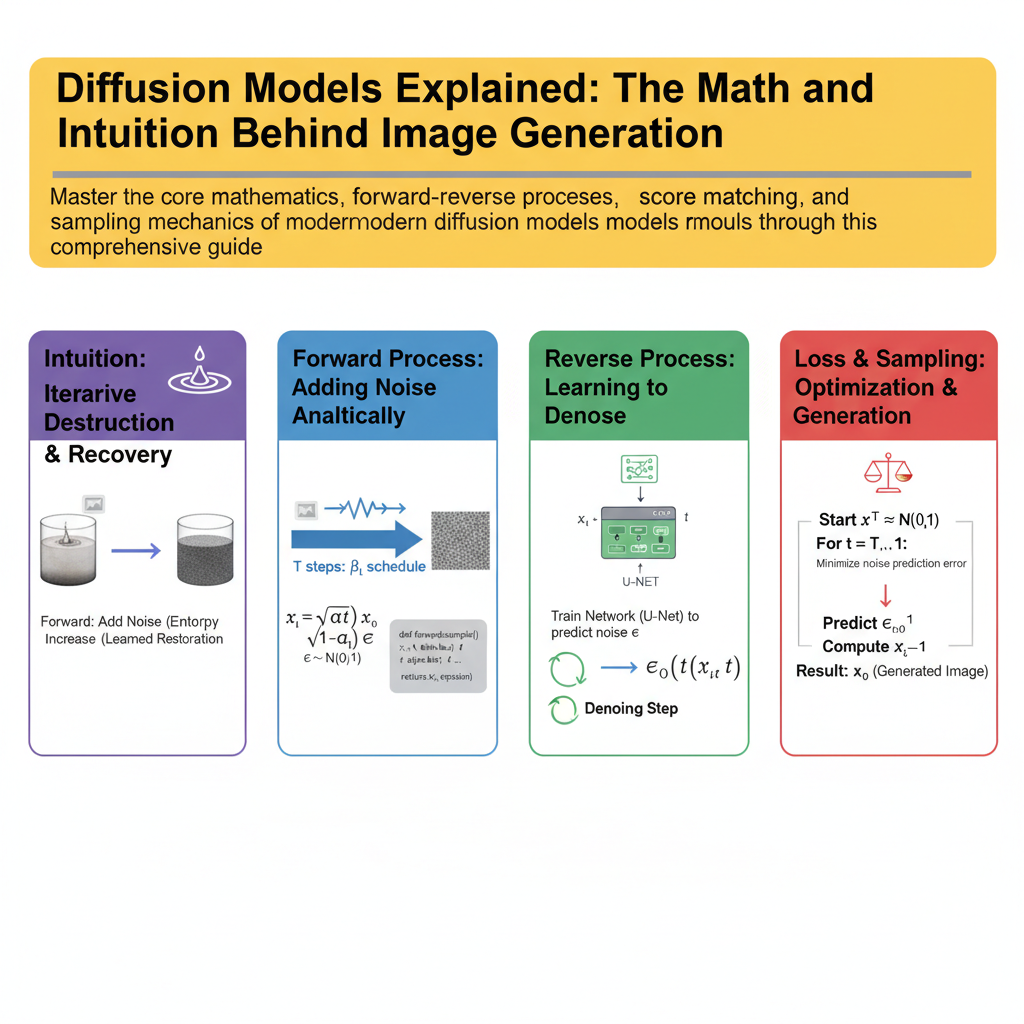
Master the core mathematics, forward and reverse processes, score matching, and sampling mechanics of modern diffusion models through this comprehensive guide.
Introduction to Diffusion Models
Diffusion models have completely transformed the landscape of generative artificial intelligence. From text-to-image generation pipelines like Stable Diffusion XL and Flux to audio synthesis systems, understanding how these models work under the hood is critical for any modern practitioner. If you want to move beyond simply writing prompts and start building or fine-tuning architectures, you need to understand the underlying calculus and probability theory.
This guide is designed for software engineers, machine learning practitioners, and technical product managers who want a rigorous yet practical explanation of diffusion models. You will learn the exact mechanics of the forward noise process, the reverse denoising network, score matching, and modern sampling algorithms. By the end of this resource, you will be able to reason about loss functions, parameterize noise predictors, and optimize generation speeds.
Prerequisites for this guide include a basic grasp of multivariable calculus, linear algebra, and PyTorch syntax. We will avoid overly dense academic jargon where possible, translating abstract theoretical equations into concrete implementation details that you can immediately apply in your own workflows.