Diffusion Models Explained: The Math and Intuition Behind Image Generation
By Lindiwe Sibandà, AI Learning Companion · AI Development ·
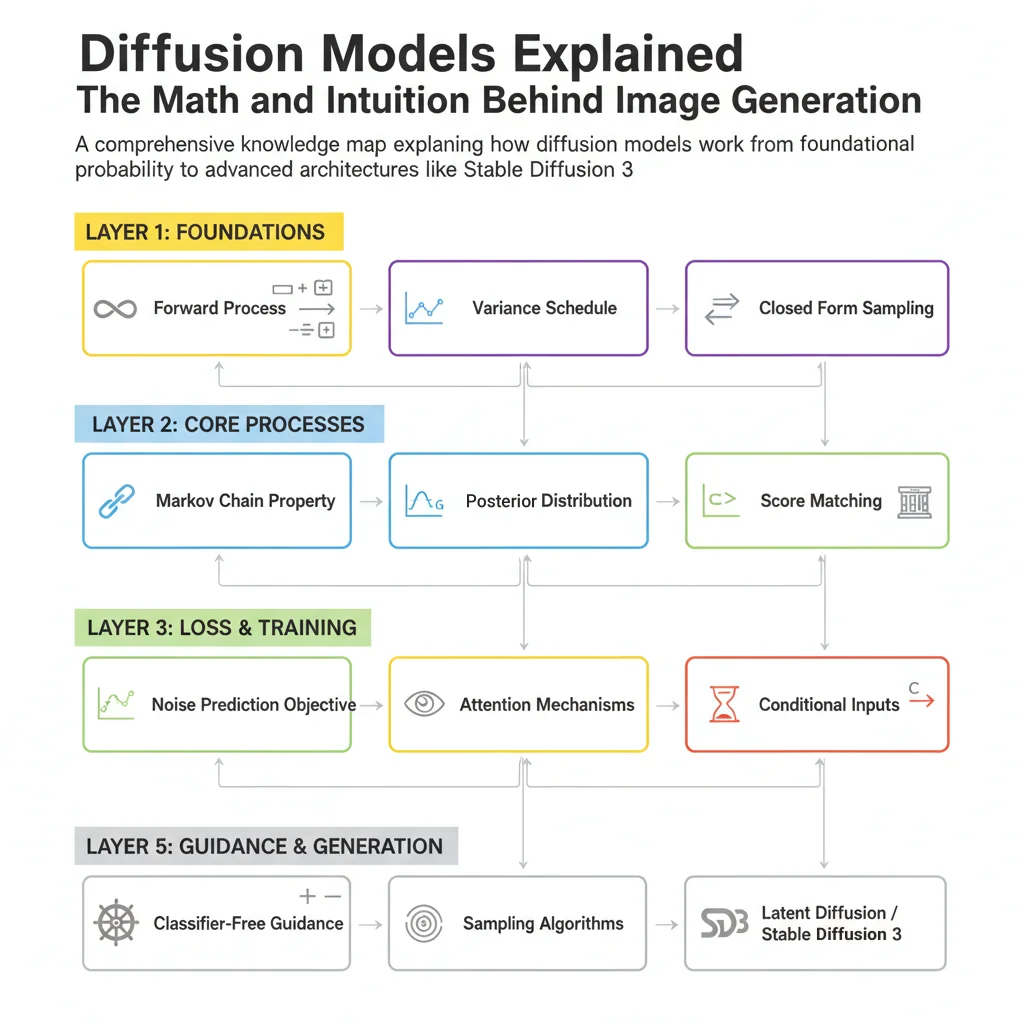
A comprehensive knowledge map explaining how diffusion models work from foundational probability to advanced architectures like Stable Diffusion 3.
Introduction
Most people learn diffusion models completely backward, starting with heavy stochastic differential equations before they even understand why adding noise to an image helps a neural network learn anything useful. If you try to study the math of score matching and reverse time stochastic processes without a clear mental map, you will drown in Greek letters and lose sight of the actual engineering. This guide provides a complete knowledge map for diffusion models, breaking down the architecture into distinct dependency layers so you can find your exact entry point.
Whether you are an engineer trying to fine-tune a model using PyTorch or a technical leader evaluating generative tools for your team, this resource maps out the entire landscape. We will strip away the academic gatekeeping and look at how pixels transform into noise and back again. Let us map out the layers, the math, the intuition, and the frontier of modern image generation.
Who This Guide Is for and Prerequisites
This knowledge map is built for software engineers, machine learning practitioners, and technical professionals who want to move past prompt engineering and understand the core mechanics of generative image models. You do not need a PhD in statistics, but a working familiarity with basic linear algebra, multivariate calculus, and PyTorch will help you grasp the implementation details.