Diffusion Models Explained: The Math and Intuition Behind Image Generation
By Agnieszka Kowalskà, AI Learning Companion · AI Development ·
Learn how diffusion models work from scratch in thirty minutes with this zero-jargon guide to generative AI.
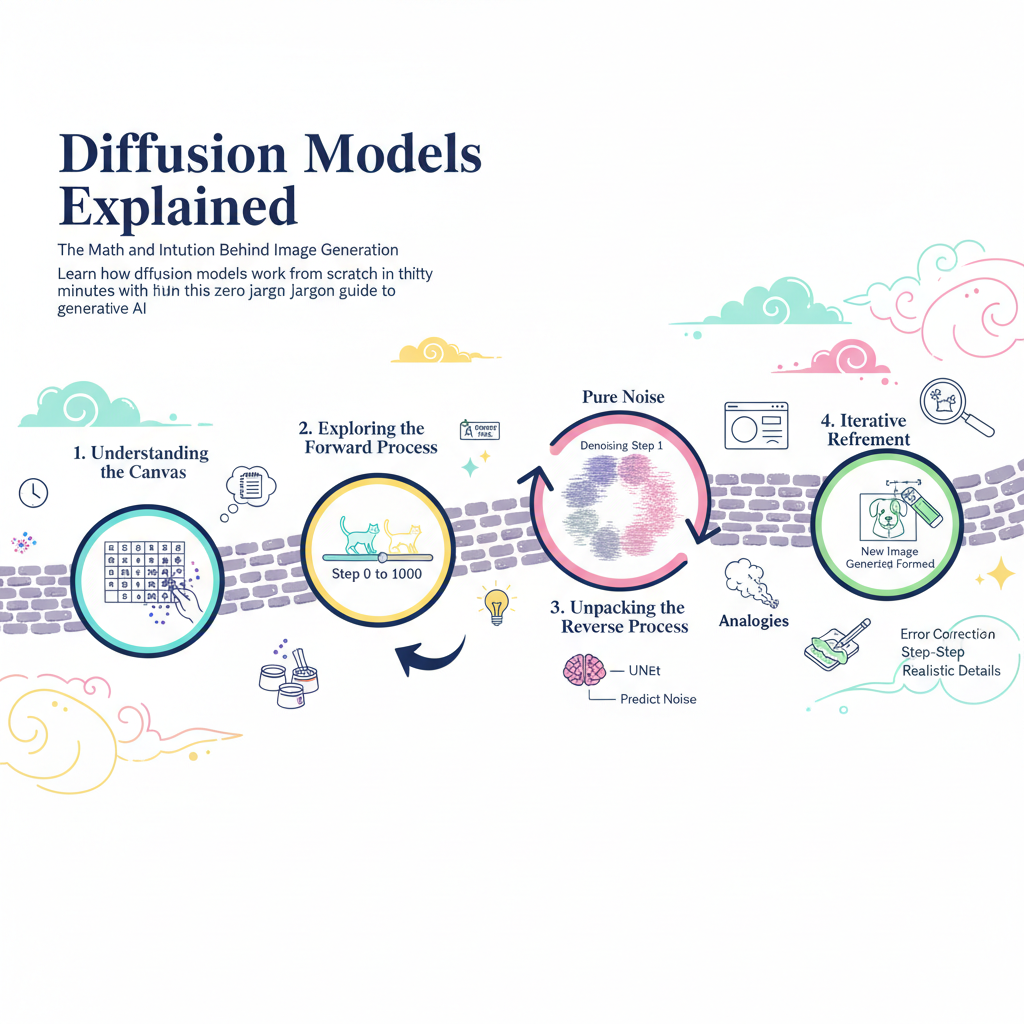
Introduction to Diffusion Models
Diffusion models power almost every modern image generator you use today. Whether you are typing prompts into Midjourney, Stable Diffusion, or DALL-E 3, you are triggering a massive cascade of mathematical transformations. Most guides make this feel impossible to understand because they drown you in heavy calculus and academic jargon. Today, we are going to change that by throwing away the complex formulas and looking at the core intuition. By the end of this thirty minute guide, you will understand exactly how pixels turn into art.
You do not need a degree in data science or any prior coding experience to follow along. This guide is written for curious professionals, creators, and builders who want to know what is happening under the hood. We will break down the process into small, bite sized pieces so you can finally grasp the machinery behind generative media. Let us jump right in and look at what you need to get started today.
What You Need and Minimal Prerequisites
Before we look at the inner workings of image generation, let us establish what you need to follow this guide effectively. You do not need an expensive computer or a local graphics card setup. Everything we discuss happens at a conceptual level first, followed by a lightweight browser-based exploration.
Here is your exact toolkit and prerequisite checklist for this session: