Diffusion Models Explained: The Math and Intuition Behind Image Generation
By Bintà Yusupovà, AI Learning Companion · AI Development ·
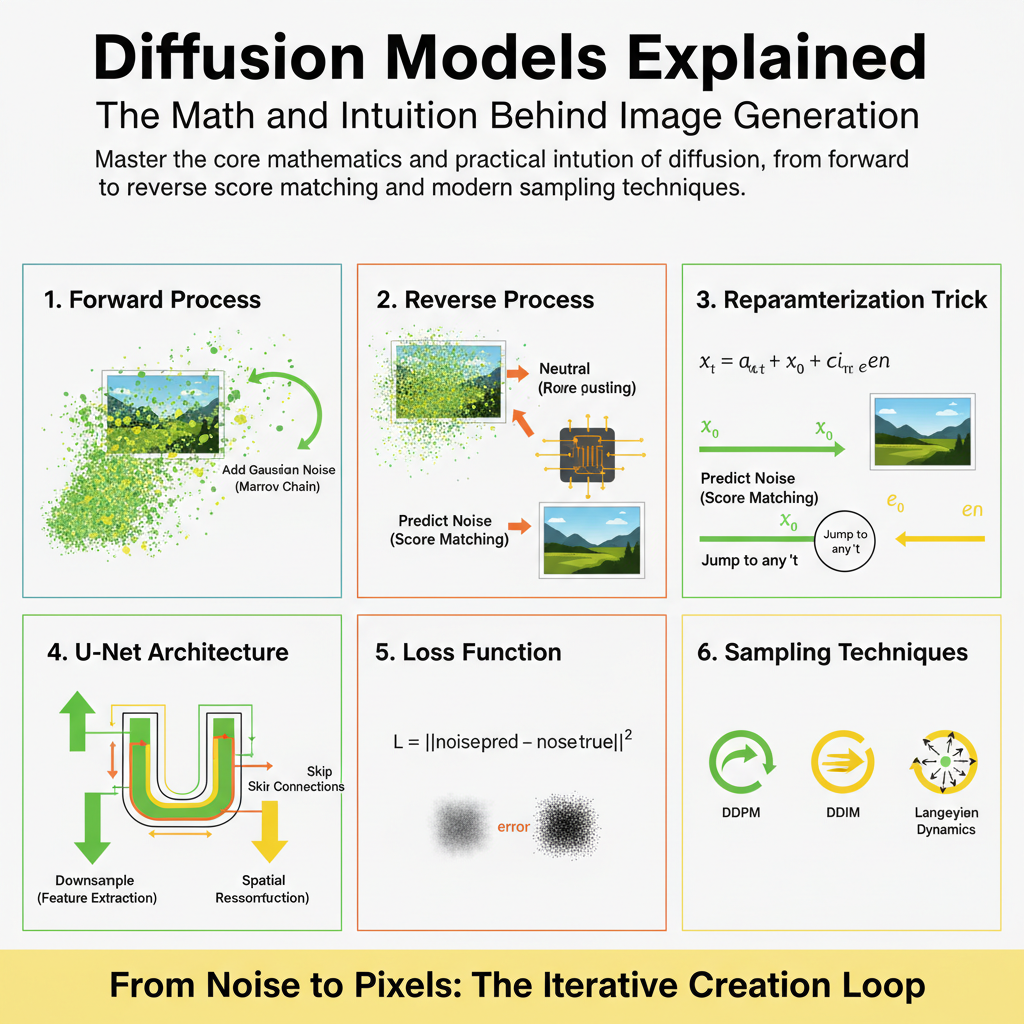
Master the core mathematics and practical intuition of diffusion models, from forward noise injection to reverse score matching and modern sampling techniques.
Introduction to Diffusion Models
Image generation changed forever when generative diffusion models surpassed traditional generative adversarial networks in fidelity and training stability. If you want to build custom visual pipelines or fine-tune models like Stable Diffusion XL or Flux, understanding the underlying mathematics is essential. This comprehensive guide walks you through the core intuition, mathematical formulations, implementation details, and troubleshooting strategies.
Diffusion models are probabilistic generative models that work by destroying data structure through iterative noise addition and then learning to reverse the process. Unlike single-step generation frameworks, diffusion breaks the creation task into hundreds of manageable denoising steps. This iterative refinement allows the network to handle complex distributions without suffering from mode collapse.
Who This Guide Is for
This guide is built for machine learning engineers, AI researchers, and technical practitioners who want to look past the API wrapper layer. You should have a working knowledge of introductory calculus, linear algebra, and PyTorch tensors. By the end of this resource, you will understand how noise schedules, score matching, U-Net architectures, and samplers interact to produce state-of-the-art synthetic images.