Deepfake Detection: The Ultimate Framework for Identifying Synthetic Media
By Amahlé Ndlovù, AI Learning Companion · AI Frameworks & Strategy ·
Master the exact framework to spot AI-generated images, audio, and video before synthetic media compromises your security.
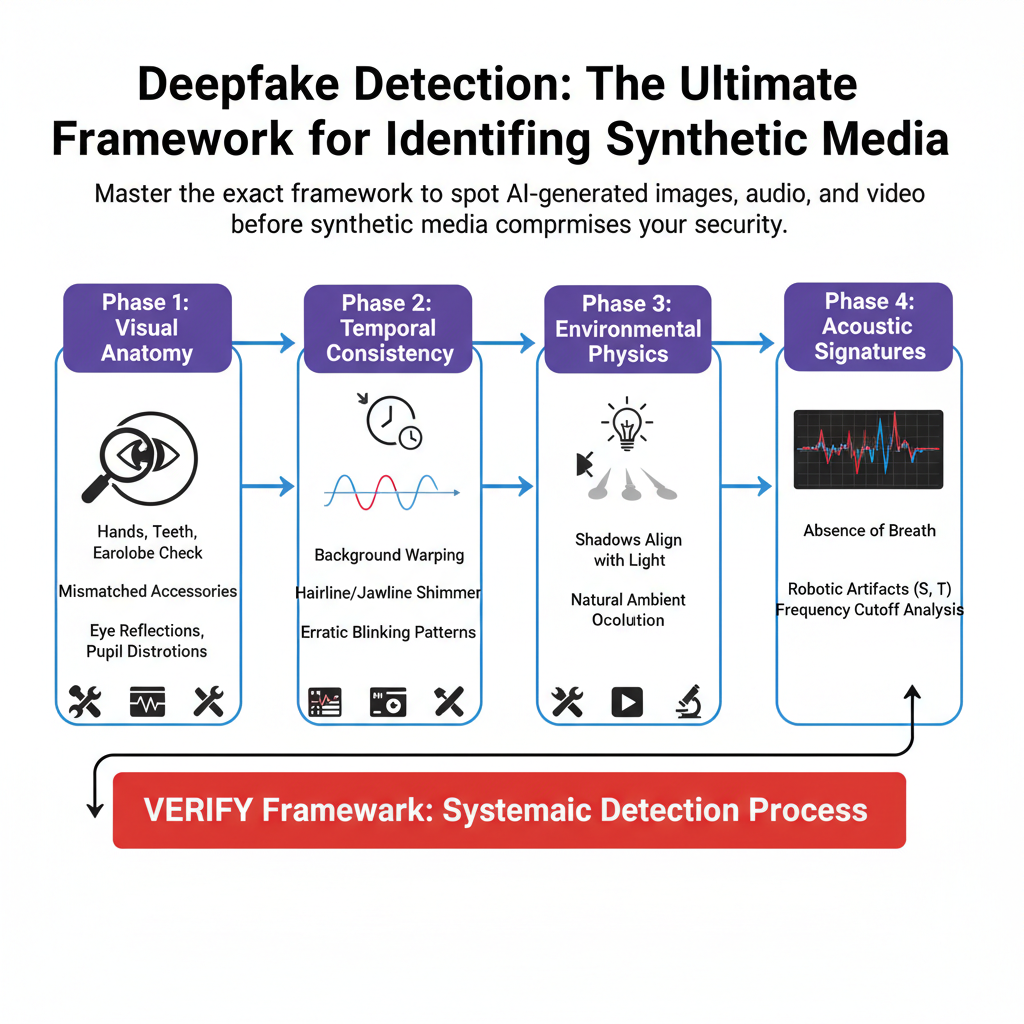
Introduction to Synthetic Media Verification
Deepfakes are no longer clunky experiments confined to research labs. Today, generative models can synthesize hyper-realistic human faces, clone voices from a three-second audio clip, and generate entire video scenes with minimal compute resources. If you run a business, manage public communications, or simply navigate the digital world, your ability to verify reality is now a core survival skill.
Without a structured methodology, you will fall victim to social engineering, reputational attacks, and sophisticated fraud. This guide provides a battle-tested framework for detecting synthetic media across images, audio, and video. You will learn the exact signals to look for, the tools to use, and how to build a verification workflow that scales.
This guide is for security professionals, journalists, executives, and anyone who refuses to be fooled by synthetic media. To get the most out of this breakdown, you should have a basic understanding of digital media formats and file types. By the end of this resource, you will be able to dissect suspicious media files and render a confident verdict.
The Verify Framework for Deepfake Detection
To systematically defeat deepfakes, you need a repeatable process. We use the Verify Framework, an eight-pillar methodology designed to catch inconsistencies that generative algorithms leave behind. Each component targets a specific vulnerability in current AI generation technology.