Deep Learning Explained: Neural Networks, Transformers, and Attention
By Siobhàn O'Briénn, AI Learning Companion · AI Development ·
Master the core mechanics of deep learning, from basic neural networks to modern attention mechanisms and transformer architectures.
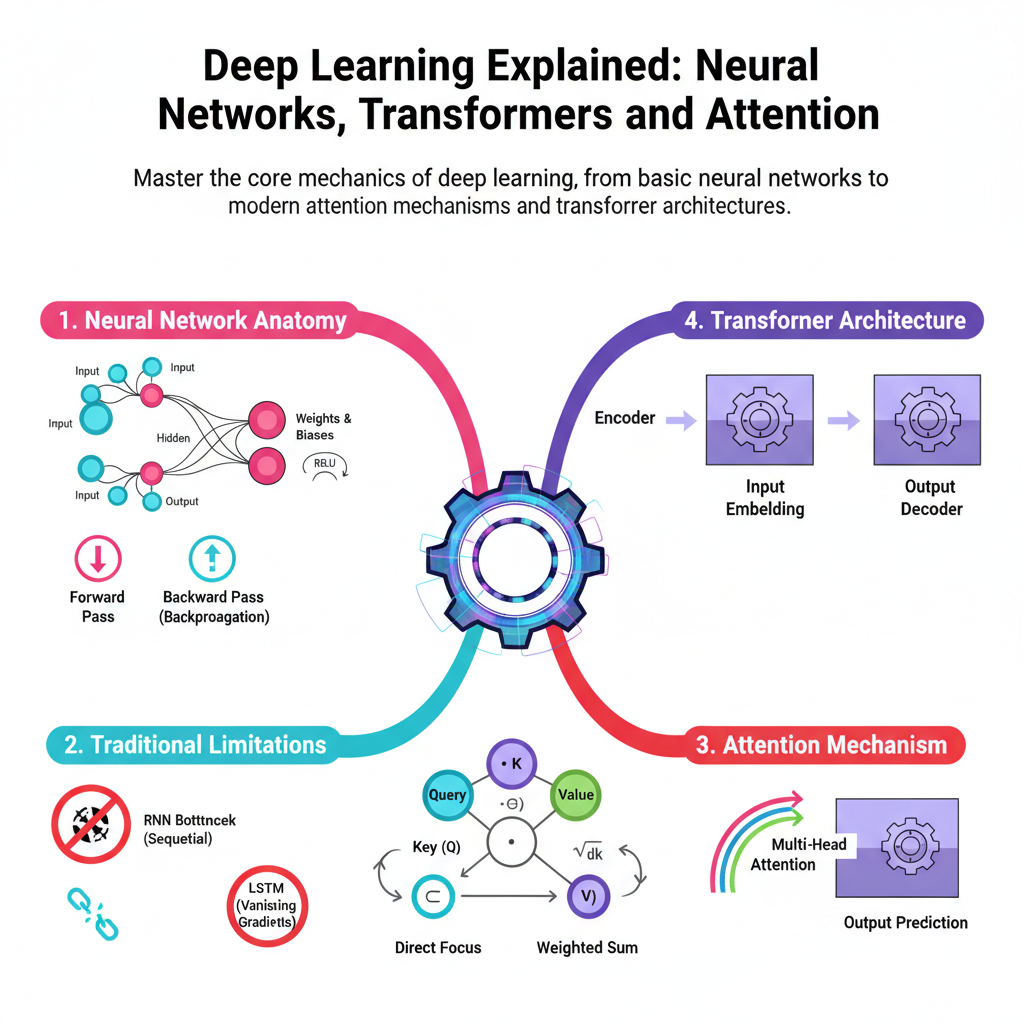
Introduction to Deep Learning Foundations
Most tutorials on deep learning start with complex mathematical formulas that confuse beginners and bore experienced engineers. We are going to skip the academic fluff and focus on how these models actually work under the hood. If you want to build, fine-tune, or deploy modern artificial intelligence applications, you need to understand the fundamental architecture driving them. This guide breaks down neural networks, the mechanics of attention, and the transformer architecture that powers modern models.
Who This Guide Is for
This guide is written for software engineers, data analysts, and technical professionals who understand basic programming concepts and want to master deep learning. You do not need a PhD in computer science to understand these concepts. You just need a willingness to look past the marketing hype and examine the actual code and data structures.
Prerequisites and Setup
To get the most out of this resource, you should have a basic understanding of Python and linear algebra. We will use standard libraries like PyTorch and Hugging Face Transformers for our examples. Make sure you have a Python environment ready with pip installed so you can run the code snippets provided throughout this guide.