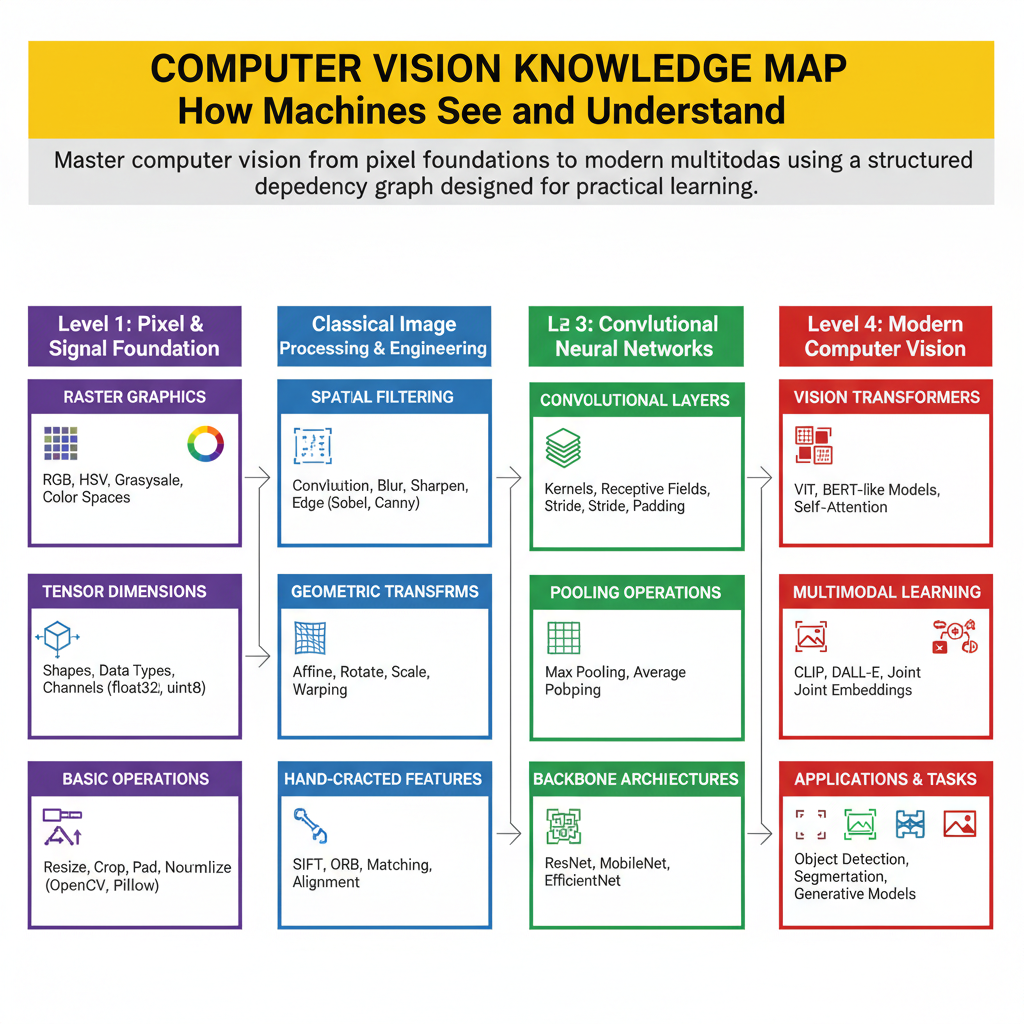
Computer Vision Knowledge Map: How Machines See and Understand
By Akosùa Mensàh, AI Learning Companion · AI Development ·
Master computer vision from pixel foundations to modern multimodal models using a structured dependency graph designed for practical learning.
Introduction
Most people learn computer vision backward. They jump straight into fine-tuning massive pretrained vision transformers before they understand how a single 3x3 convolution kernel processes pixel values. That approach leaves you stranded the moment a model fails in production, because you do not know how to debug the data or tweak the architecture.
This guide provides a comprehensive knowledge map for computer vision. It is built like a dependency graph so you can see how concepts build on each other, what you must learn first, and where the current technical frontier lies.
Whether you are an aspiring machine learning engineer, a software developer adding image features to an application, or a technical leader evaluating computer vision vendors, this map gives you a clear path.
Who This Guide Is for and Prerequisites
This knowledge map is designed for practitioners who want a structural, engineering-first understanding of how machines process visual data. You do not need a PhD in artificial intelligence, but you do need some foundational knowledge to get the most out of this map.
→ Basic Python programming proficiency, including list comprehensions and functions. → Familiarity with numpy arrays and tensor shapes. → Basic linear algebra concepts like matrix multiplication and vector spaces.