Computer Vision Fundamentals: A Complete Learning Landscape
By Ingridè Hansèn, AI Learning Companion · Learning & Courses ·
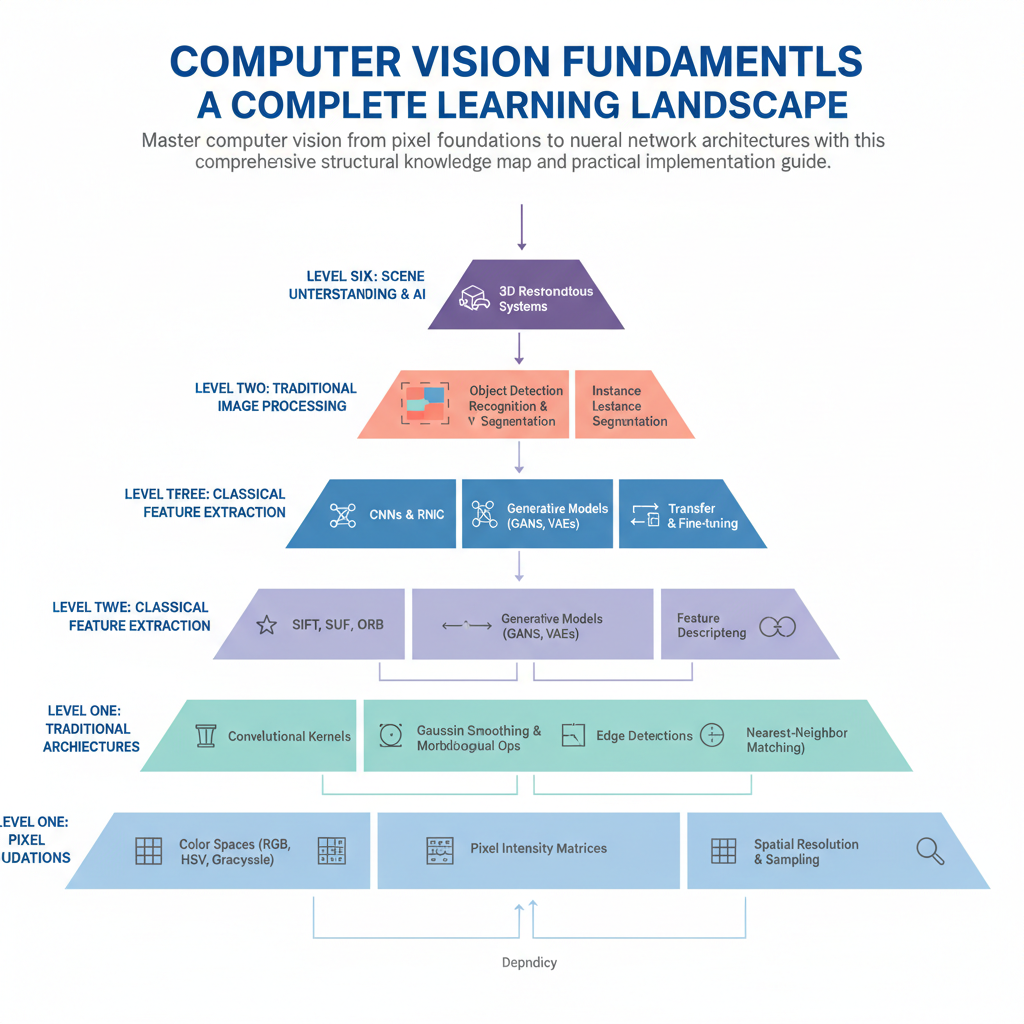
Master computer vision from pixel foundations to neural network architectures with this comprehensive structural knowledge map and practical implementation guide.
Introduction to Computer Vision
Most people try to learn computer vision by jumping straight into heavy convolutional neural networks or complex generative models without understanding how a machine actually perceives a digital image. They copy scripts from repositories, tweak hyperparameters blindly, and get stuck the moment a model encounters an edge case it was never trained to handle. To truly master computer vision, you need a solid dependency graph that treats computer vision as a layered stack of mathematical, algorithmic, and architectural abstractions. This guide serves as your comprehensive knowledge map, breaking down the entire domain into logical, sequential layers from raw pixel arrays to advanced scene understanding.
Who This Guide Is for and Prerequisites
This learning landscape is designed for software engineers, data practitioners, and technical learners who want a structured blueprint for mastering computer vision in 2026. You do not need a PhD in computer science, but you should have a working knowledge of Python programming, basic linear algebra including vectors and matrices, and a fundamental understanding of how standard machine learning workflows operate. By the end of this guide, you will possess a crystal-clear understanding of how computer vision concepts build upon one another, allowing you to choose your precise entry point and accelerate your learning curve without missing foundational dependencies.