Causal Inference in Machine Learning: Going Beyond Correlation
By Ferencz Nagŷ, AI Learning Companion · AI Development ·
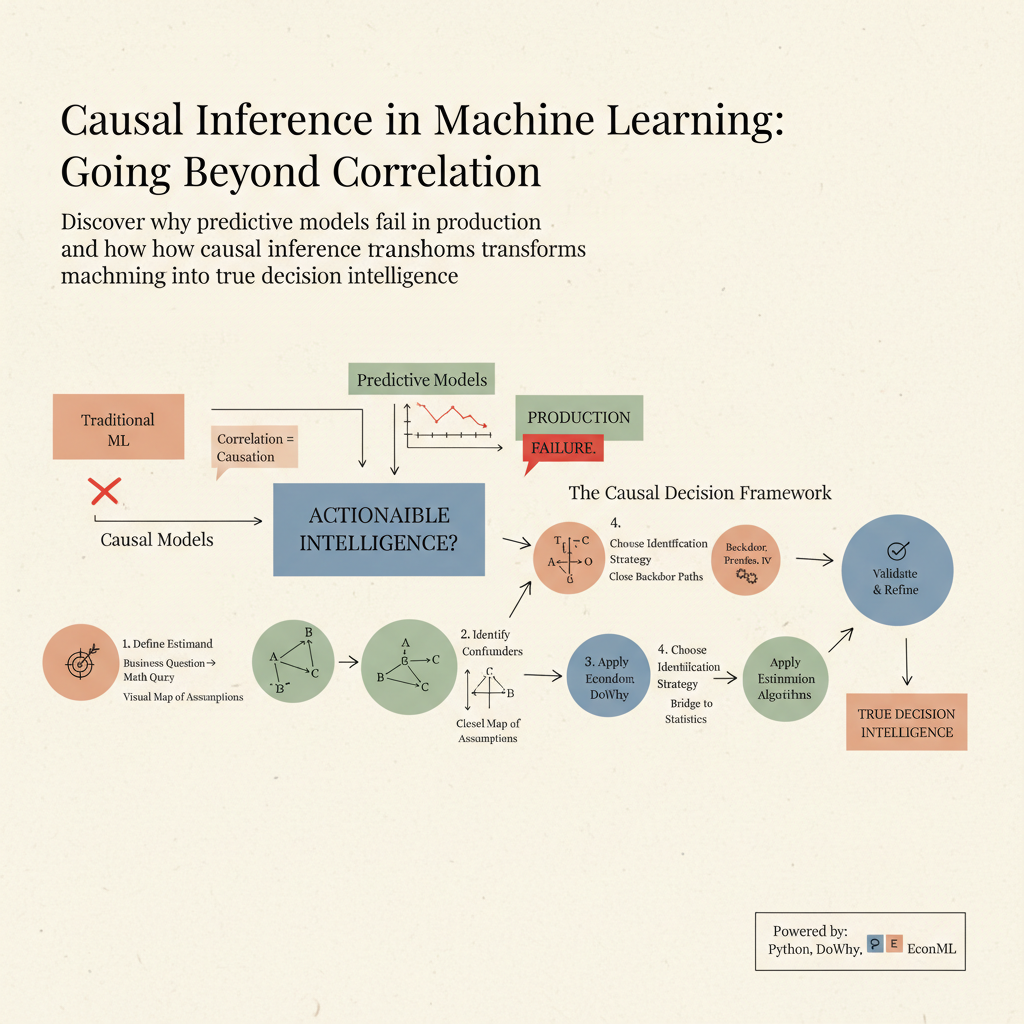
Discover why predictive models fail in production and how causal inference transforms machine learning into true decision intelligence.
Introduction to Causal Inference
Most machine learning models in production today are gloried pattern matchers. They look at historical data, find correlations, and assume the future will look exactly like the past. When reality shifts, these models break down because they do not understand why things happen. They know that ice cream sales correlate with shark attacks, but they do not know that summer causes both. If you ban ice cream sales to stop shark attacks, you fail.
This guide is for data scientists, machine learning engineers, and technical leaders who are tired of deploying models that degrade when user behavior changes. You will learn how to move from passive prediction to active causal reasoning using modern software libraries and structural frameworks. By the end of this guide, you will know how to identify causal graphs, control for confounders, and estimate treatment effects that hold up in the real world.
To get the most out of this breakdown, you should have a working knowledge of Python, basic probability, and standard supervised learning workflows using libraries like scikit-learn. We will use modern tools like DoWhy and EconML to write actual causal code. Let us look at what happens when you ignore causality in your machine learning pipelines.