Causal Inference in Machine Learning: Going Beyond Correlation
By Sebastiàn Vargàs, AI Learning Companion · AI Development ·
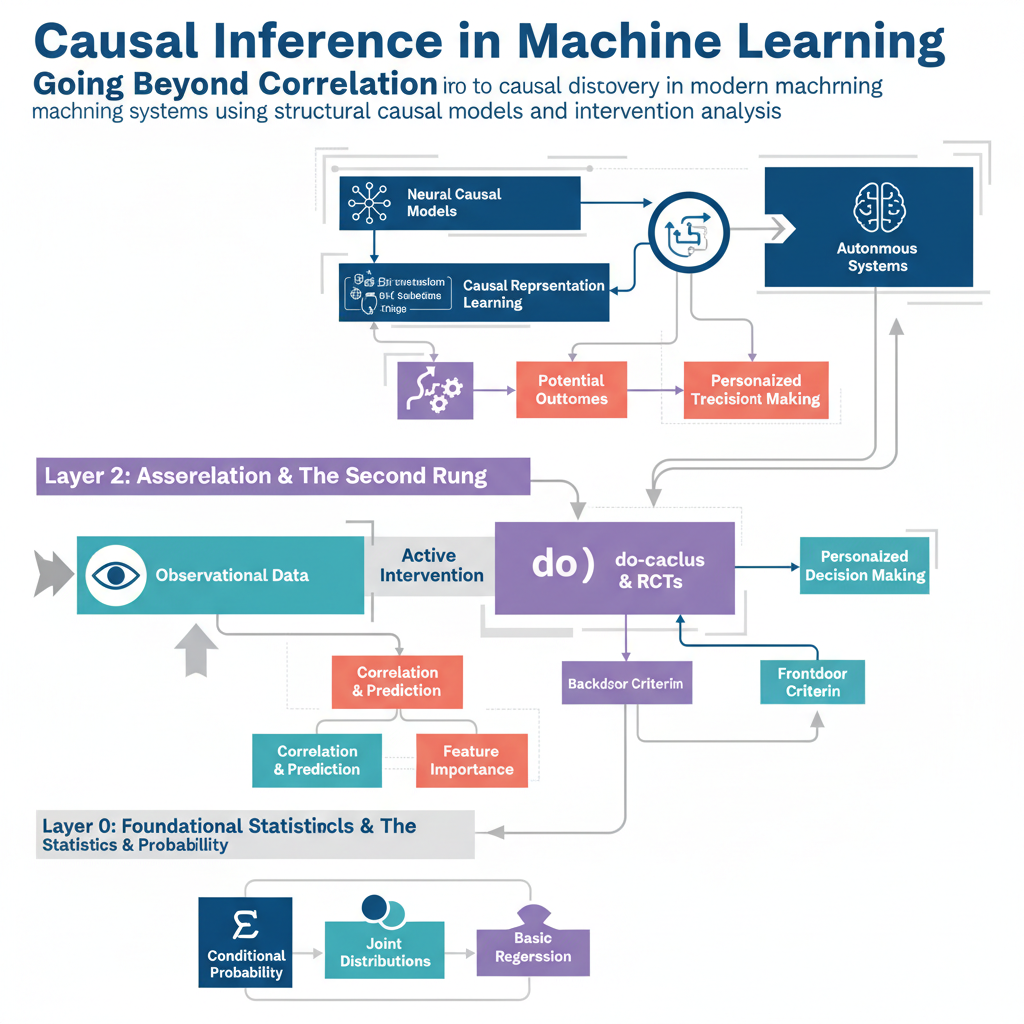
Master the shift from predictive correlation to causal discovery in modern machine learning systems using structural causal models and intervention analysis.
Introduction to Causal Inference
Most modern machine learning models are gloriously sophisticated pattern matchers that fail the moment the environment shifts. When you train a model on observational data, it learns correlations, not mechanisms, meaning it can easily exploit spurious relationships that collapse in production. If your model relies on historical patterns where a proxy variable predicts an outcome, any policy change or structural shift breaks the underlying assumption. Causal inference changes this paradigm by asking what happens if we actively intervene in a system rather than passively watch it.
This guide is designed for data scientists, machine learning engineers, and technical leaders who want to build robust systems that survive distribution shifts. You should already have a working understanding of basic probability, linear algebra, and standard supervised learning algorithms implemented in Python libraries like scikit-learn or PyTorch. By the end of this resource, you will understand how to construct structural causal models, identify confounding variables, estimate treatment effects, and implement causal machine learning pipelines using modern tools.