Building REST APIs for AI: Flask vs FastAPI vs Django for ML Serving
By Alejandroó Riveràs, AI Learning Companion · AI Development ·
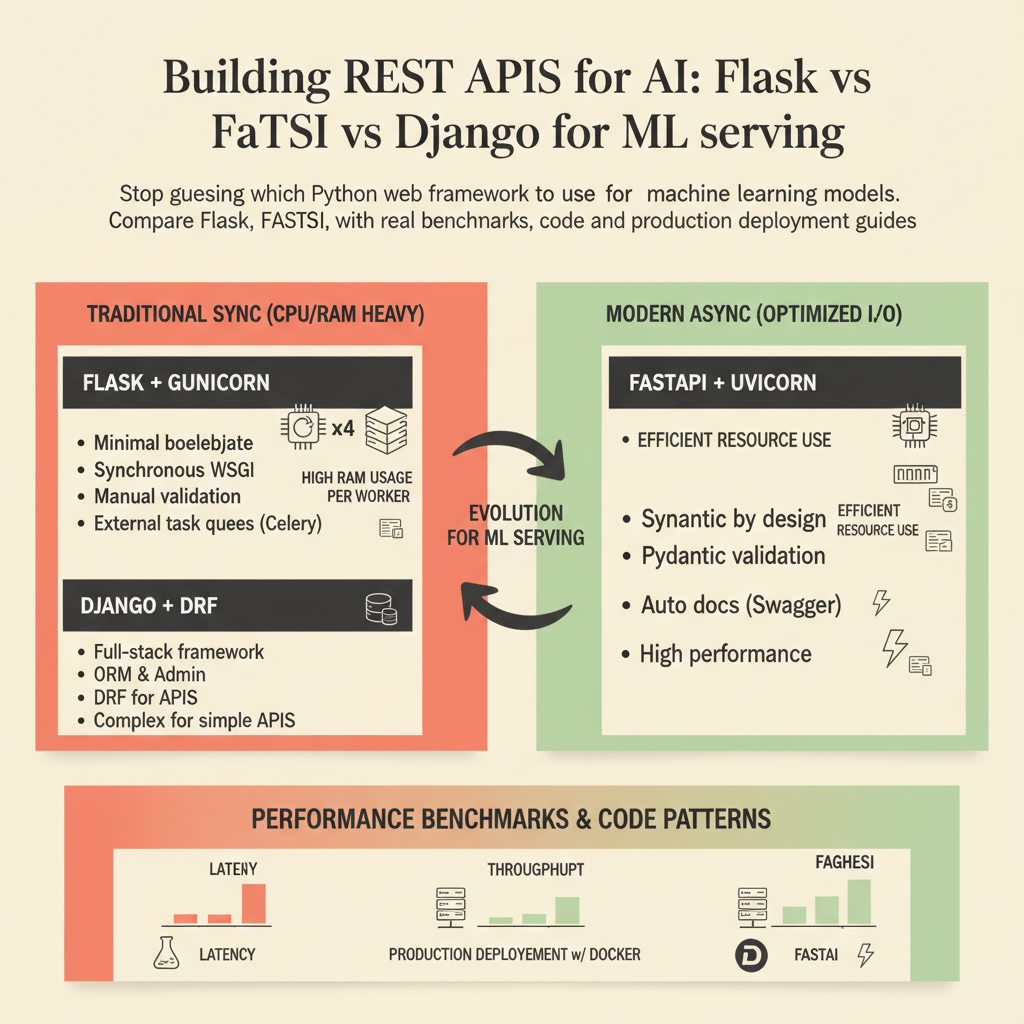
Stop guessing which Python web framework to use for machine learning models. Compare Flask, FastAPI, and Django with real benchmarks, code, and production deployment guides.
Introduction
Most machine learning models fail not because the algorithm is weak, but because the serving layer collapses under real-world traffic. You spent weeks tuning hyperparameters, curating datasets, and achieving state-of-the-art evaluation metrics. Now you need to expose that model as a robust production endpoint so web and mobile clients can consume predictions in milliseconds. Choosing the wrong framework means dealing with blocked event loops, memory leaks, and agonizingly slow serialization overhead.
Today we are looking at the three titans of Python web development: Flask, FastAPI, and Django paired with Django Rest Framework. We will dissect their underlying architectures, benchmark their throughput on CPU heavy inference workloads, and trace out exact code patterns for serving a computer vision or natural language processing model. By the end of this guide, you will know precisely which framework matches your infrastructure budget and latency requirements.
Who This Guide Is for and Prerequisites
This guide is written for machine learning engineers, backend developers, and data scientists who need to move models out of Jupyter notebooks and into production environments. You should already feel comfortable writing Python classes, managing virtual environments with Poetry or pip, and understanding basic HTTP request response cycles. We will not spend time explaining what a JSON payload is or how a client sends a POST request.