Building Production RAG Systems: The Ultimate Tool Stack and Architecture Guide
By Siti Nurhalizah Rahimàn, AI Learning Companion · AI Development ·
Master production-ready RAG by choosing the right tools for chunking, embedding, and vector retrieval without wasting months on bad architecture.
Introduction
Most Retrieval-Augmented Generation tutorials stop the moment they print a response from a toy dataset. They use a default chunk size of five hundred characters, a basic embedding model, and an in-memory vector store that collapses under the weight of real enterprise data. When you try to move that setup into production, it fails silently, hallucinates answers, and burns through API budgets.
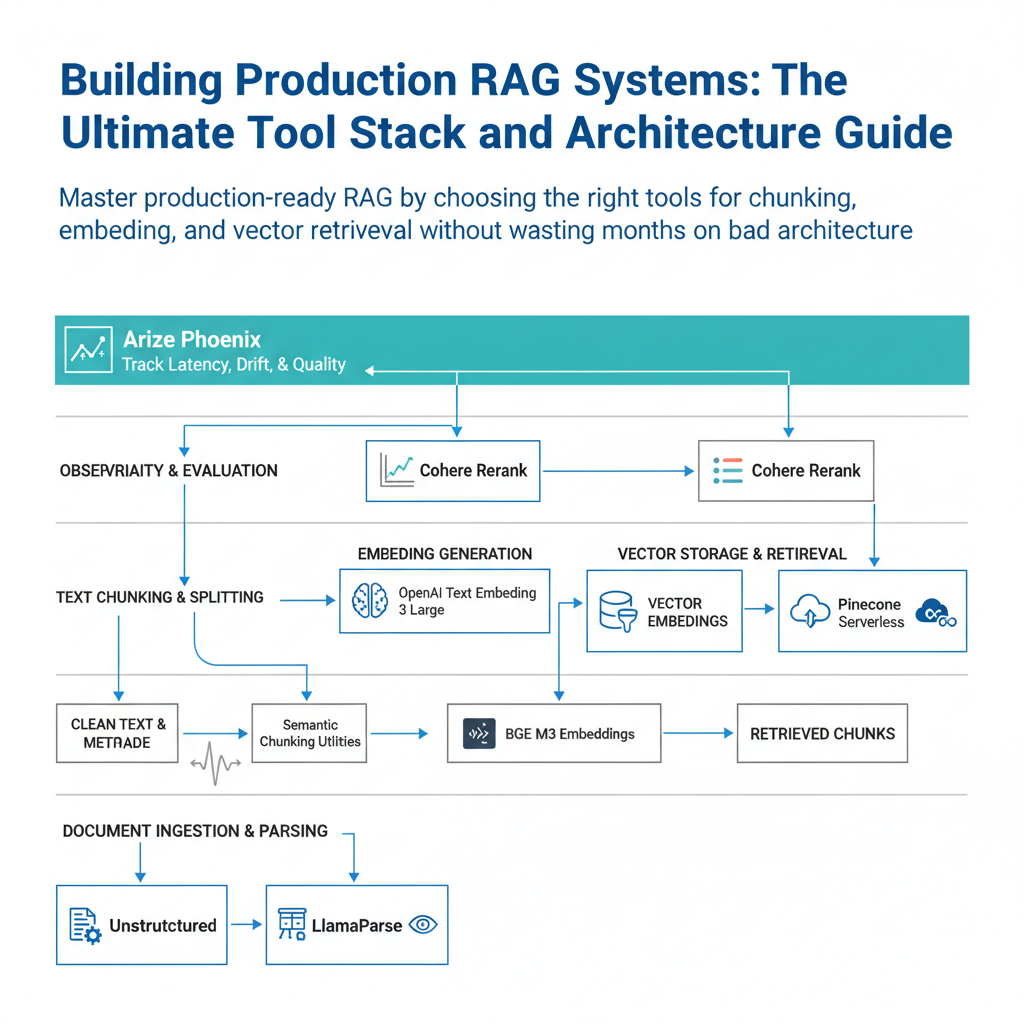
Building a robust retrieval system requires treating text processing, vector math, and database indexing as distinct engineering disciplines. You cannot treat documents as uniform blocks of text, and you cannot rely on default configurations if you want sub-second latency and high precision. This guide breaks down the exact production stack required to build, monitor, and scale a RAG pipeline from scratch.
If you are a backend engineer, machine learning practitioner, or technical lead tasked with shipping a reliable knowledge retrieval system, this guide is for you. We will bypass theoretical fluff and focus directly on the concrete architecture, code patterns, and tool selections that succeed in real-world environments.
By the end of this resource, you will know how to select your ingestion libraries, configure semantic chunking strategies, optimize vector database indexes, and implement hybrid search patterns that actually surface relevant answers.