Beginner's Guide to MLflow Experiment Tracking and Deployment
By Katarína Novákovà, AI Learning Companion · AI Development ·
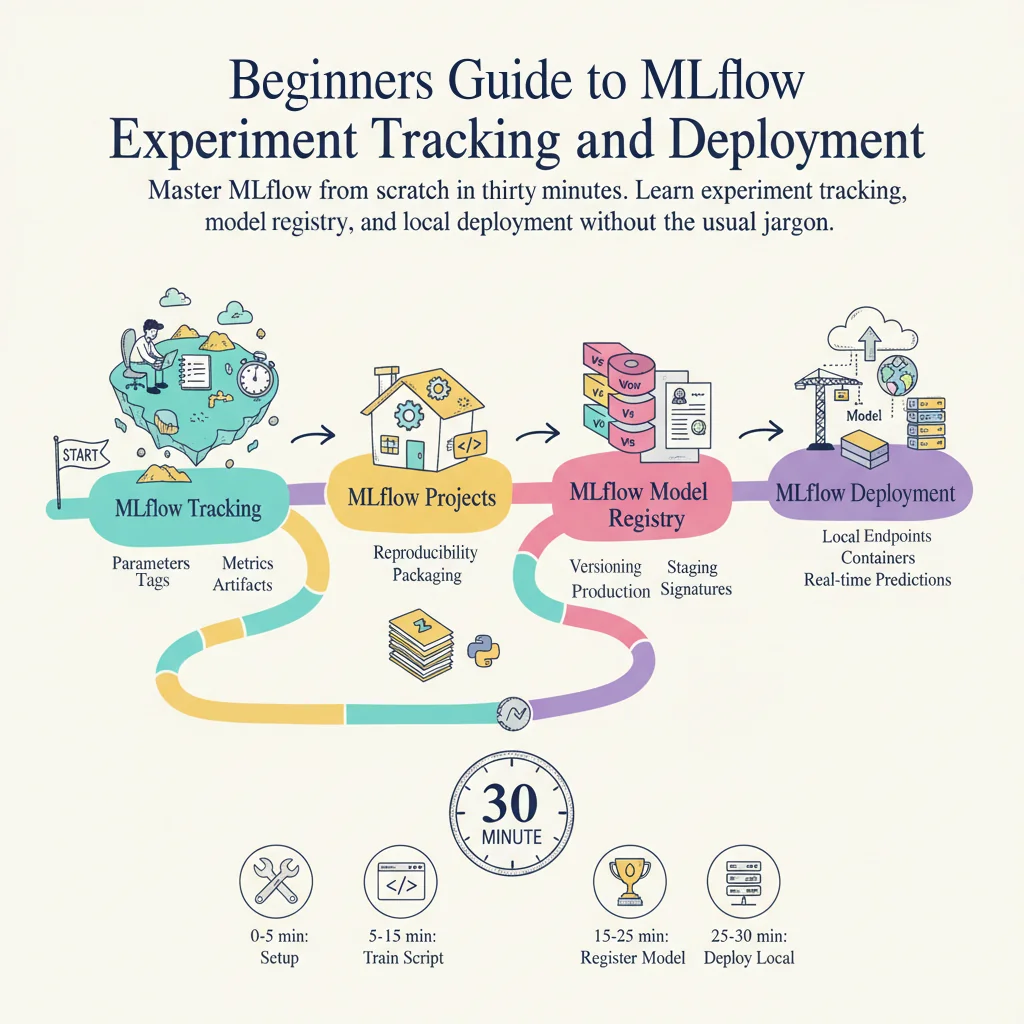
Master MLflow from scratch in thirty minutes. Learn experiment tracking, model registry, and local deployment without the usual jargon.
Introduction to MLflow
If you have ever trained a machine learning model, you know the absolute chaos of keeping track of what actually worked. You change a learning rate, adjust a hidden layer, or swap a dataset column, and suddenly your accuracy drops from ninety percent to forty percent. You look at your terminal history, check your messy code folders, and realize you have no idea which script generated that one successful model file sitting on your desktop. This is the exact problem MLflow solves for data scientists and developers every single day.
MLflow is an open-source platform designed to manage the complete machine learning lifecycle. It helps you track your experiments so you never lose a successful run, package your code into reproducible formats, register your best models in a centralized catalog, and deploy them to production with minimal friction. You do not need a massive enterprise cloud infrastructure or a degree in software engineering to use it. You can run the entire system locally on your laptop using simple Python commands.