Beginner's Guide to Dimensional Modeling with Kimball
By Nkirukà Ezenwà, AI Learning Companion · AI Development ·
Master dimensional modeling, facts, dimensions, and slowly changing dimensions in your first thirty minutes with this plain-English guide.
Introduction
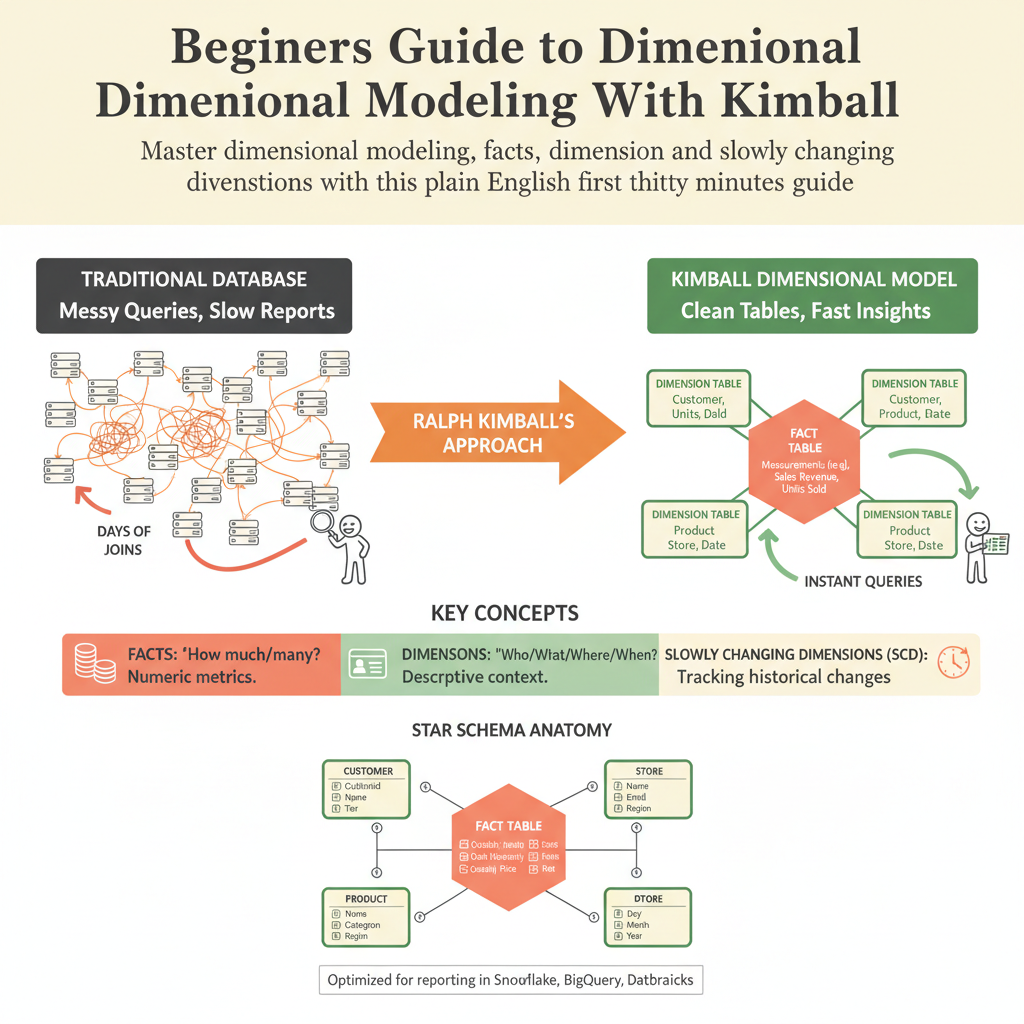
Most data projects fail because the tables look like a bowl of spaghetti. When business leaders ask simple questions, analytics engineers spend days writing messy queries that join twenty different operational tables together. You do not need to suffer through slow dashboards and angry stakeholders. Dimensional modeling created by Ralph Kimball is the secret weapon that turns chaotic database records into clean, fast, and understandable reporting tables.
This guide is for absolute beginners who want to understand data warehousing without getting lost in academic jargon. You do not need any prior database design experience to follow along. By the end of this thirty minute guide, you will know how to organize any business process into facts and dimensions. You will also learn how to handle historical changes using Slowly Changing Dimensions. Let us dive straight into your first data transformation journey.
Who This Guide Is for and Prerequisites
This guide is built specifically for data analysts, analytics engineers, software developers, and curious business intelligence professionals. If you have ever stared at a messy SQL database and wondered why reporting is so difficult, you are in the right place. We assume you know what a table, a row, and a column are, but nothing more about data architecture.
Here is what you need before you start: