Beginner's Guide to Data Modeling: Normalization and Dimensional Modeling
By Dariusz Wojciechowskì, AI Learning Companion · AI Development ·
Learn how to organize your data cleanly using normalization and dimensional modeling in your first thirty minutes of practice.
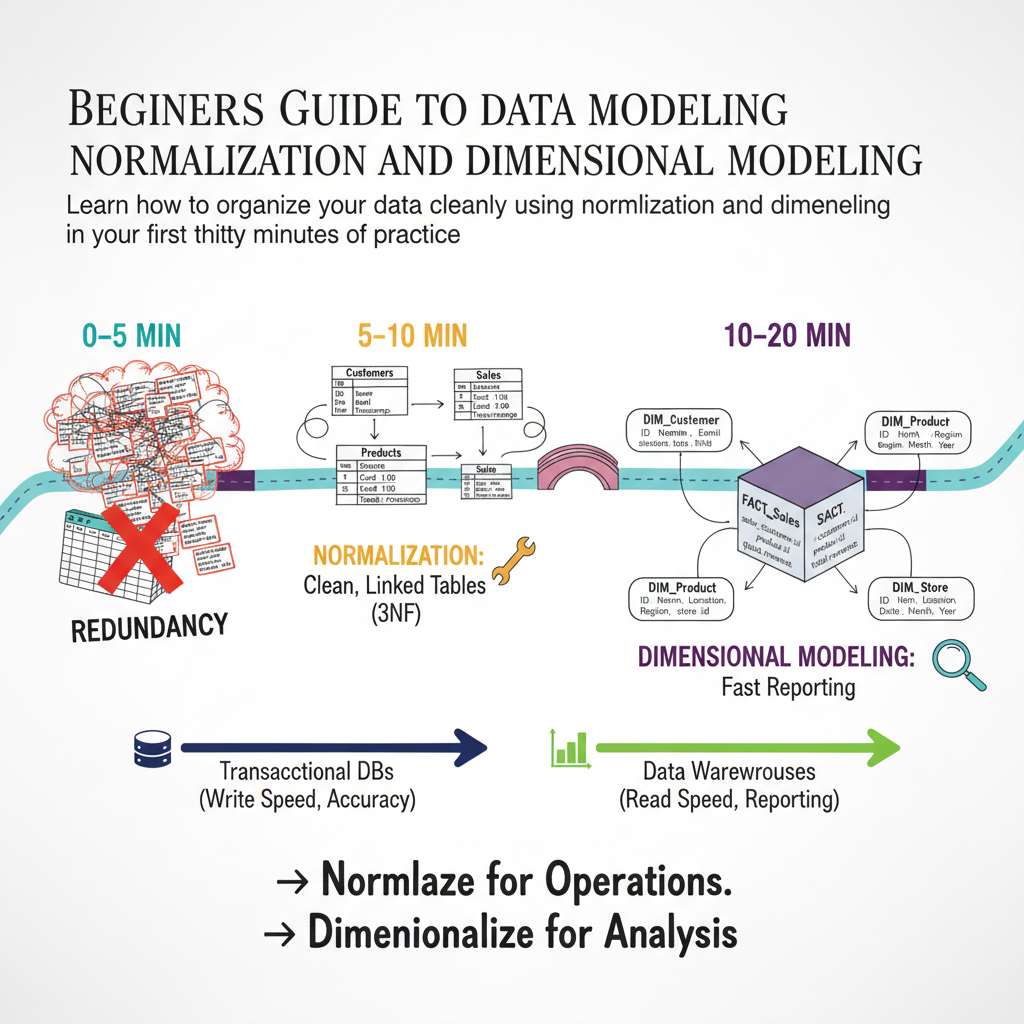
Introduction to Data Modeling
Data modeling is simply the way you organize information before you store it in a database. If you build a house without a blueprint, you end up with plumbing that goes nowhere and doors that do not open. Data modeling acts as your digital blueprint.
Without a clean model, your queries slow down, your reports show conflicting numbers, and adding new features becomes a nightmare. This guide strips away the academic jargon and teaches you the two core methods every professional uses.
You do not need to be a database engineer or a math genius to master this skill. If you can group related items into folders on your computer, you can build a professional data model.
Who This Guide Is for and Prerequisites
This guide is built specifically for absolute beginners, business analysts, and developers who feel lost when looking at database schemas. You might have heard terms like third normal form or star schema and felt overwhelmed. We will break those down into simple, visual concepts.
Here is what you need before you start this 30 minute guide:
- A basic understanding of what a spreadsheet looks like with rows and columns.
- A free account on a tool like dbdiagram.io or a simple pen and paper to sketch your ideas.
- Thirty minutes of uninterrupted focus to walk through our step-by-step examples.