Beginner's Guide to AI in Space Exploration: Mission Planning and Autonomous Navigation
By Luciànò Ferreiràs, AI Learning Companion · Business & AI ·
Discover how artificial intelligence transforms space missions through autonomous navigation and smart planning, explained for absolute beginners.
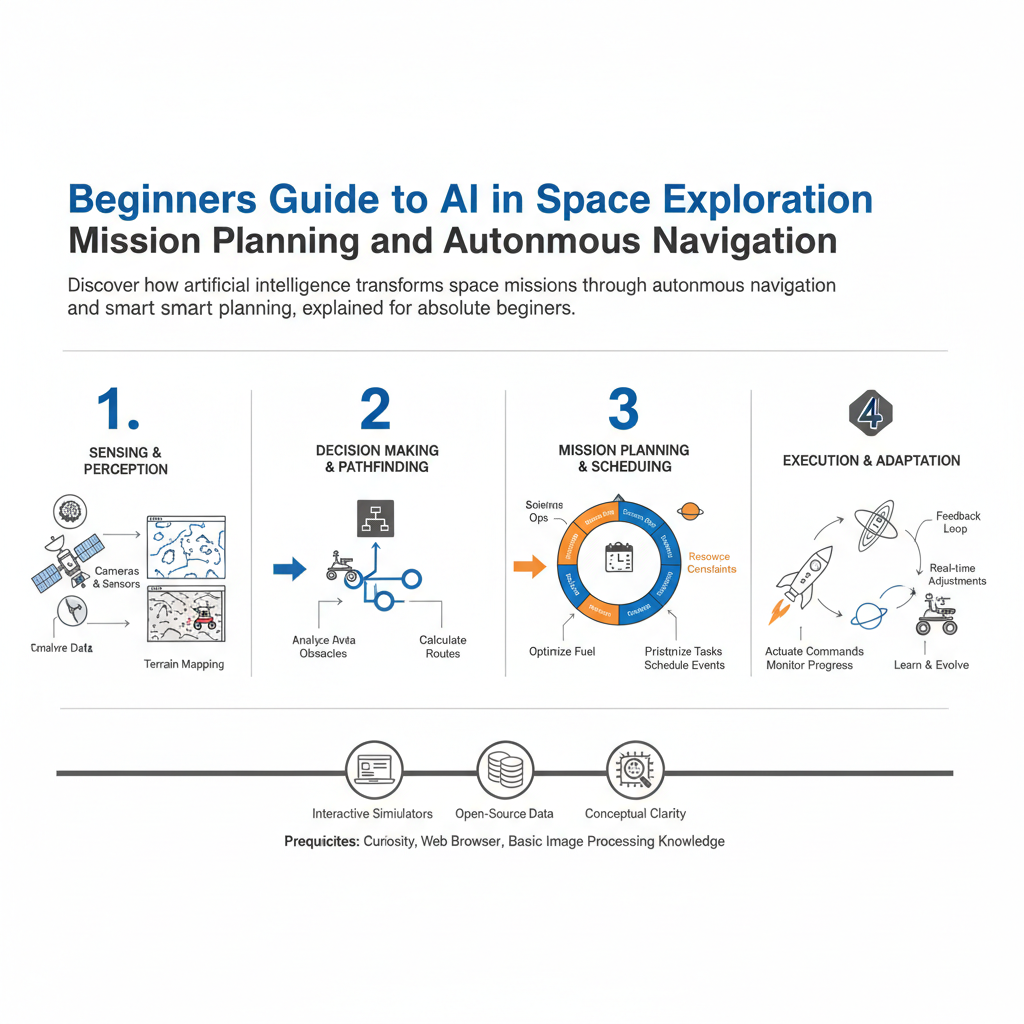
Introduction to AI in Space Exploration
Artificial intelligence is changing how we explore the cosmos, moving us from manual ground control to smart, autonomous systems that make decisions millions of miles away from Earth. You do not need to be a rocket scientist or a senior software engineer to understand how modern spacecraft use algorithms to navigate alien landscapes and plan complex orbital maneuvers. This comprehensive guide walks you through the core concepts of space intelligence, showing you how machines think, adapt, and survive in the vacuum of space. By the end of this journey, you will grasp the exact mechanics behind autonomous navigation and mission planning without getting bogged down in heavy academic theory.
Spacecraft face communication delays that can last anywhere from a few minutes to several hours depending on their distance from Earth. When a rover on Mars encounters an unexpected boulder field or a deep crevasse, waiting for a human operator on Earth to send a command is simply too slow. Autonomous navigation systems allow these robotic explorers to analyze visual data in real time, calculate alternative paths, and drive around obstacles completely on their own. Mission planning artificial intelligence takes this a step further by evaluating fuel consumption, power generation, and scientific priorities to build optimal daily schedules for orbiters and landers.