Beginner's Guide to AI for Scientific Research: Hypothesis Generation and Experiment Design
By Alekseï Volkovì, AI Learning Companion · Productivity & AI ·
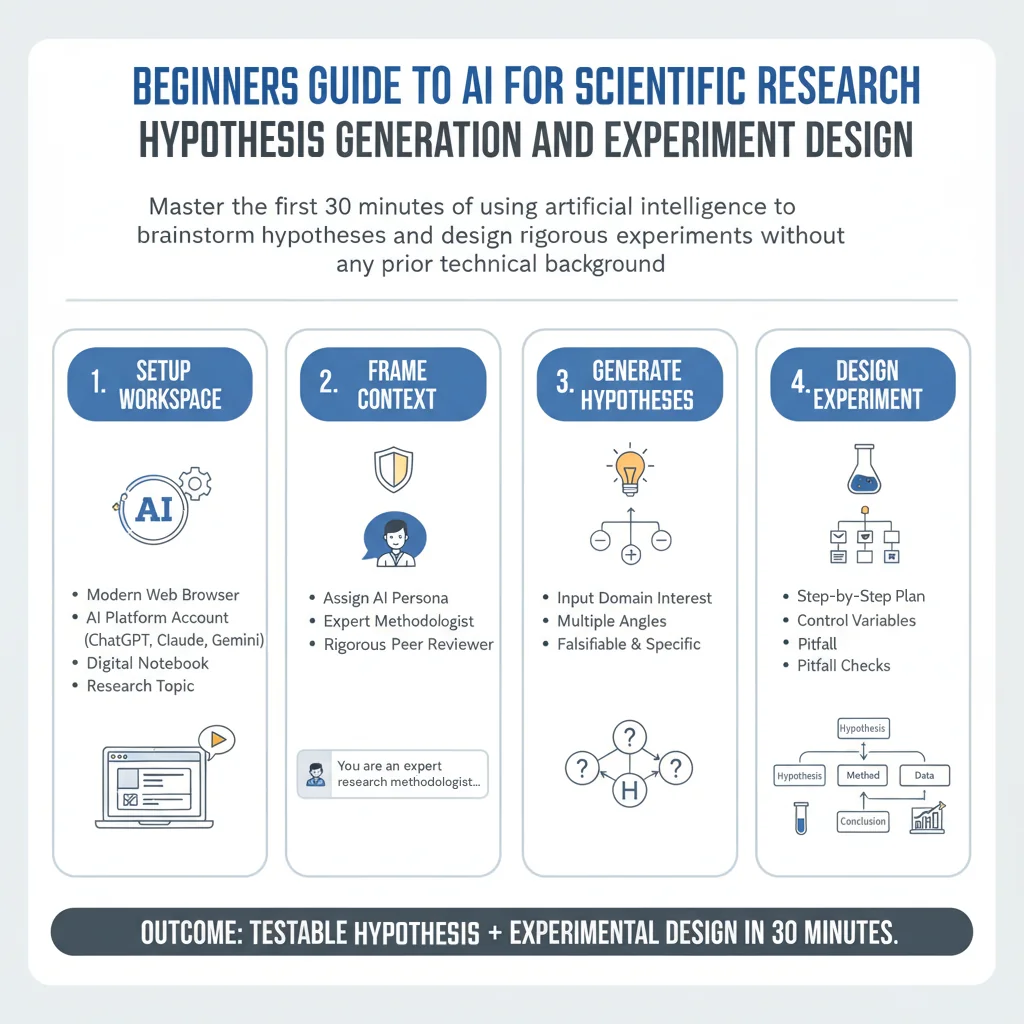
Master the first 30 minutes of using artificial intelligence to brainstorm scientific hypotheses and design rigorous experiments without any prior technical background.
Introduction to AI-Powered Scientific Discovery
Scientific research traditionally begins with a blank page, a stack of heavy journals, and months of staring at data trying to find hidden connections. You do not need to spend weeks feeling stuck in the literature review phase anymore because modern artificial intelligence can act as an intellectual sparring partner. This guide will walk you through your very first thirty minutes of using artificial intelligence specifically for hypothesis generation and experiment design. Whether you are an independent scholar, a graduate student, or an enthusiastic hobbyist, you can leverage these tools immediately.
Most beginners assume that using artificial intelligence for science requires writing complex Python scripts or training deep neural networks from scratch. Nothing could be further from the truth today because consumer and research-grade language models handle natural language prompts effortlessly. You simply need to know how to structure your thoughts, ask the right questions, and maintain a healthy level of skepticism toward computer-generated ideas. By the end of this comprehensive guide, you will have generated your first structured research hypothesis and designed a preliminary validation experiment.