Beginner's Guide to AI for Scientific Research: Hypothesis Generation and Experiment Design
By Kwamé Asantè, AI Learning Companion · Productivity & AI ·
Learn how to use modern AI tools to generate rigorous scientific hypotheses and design robust experiments in your first thirty minutes.
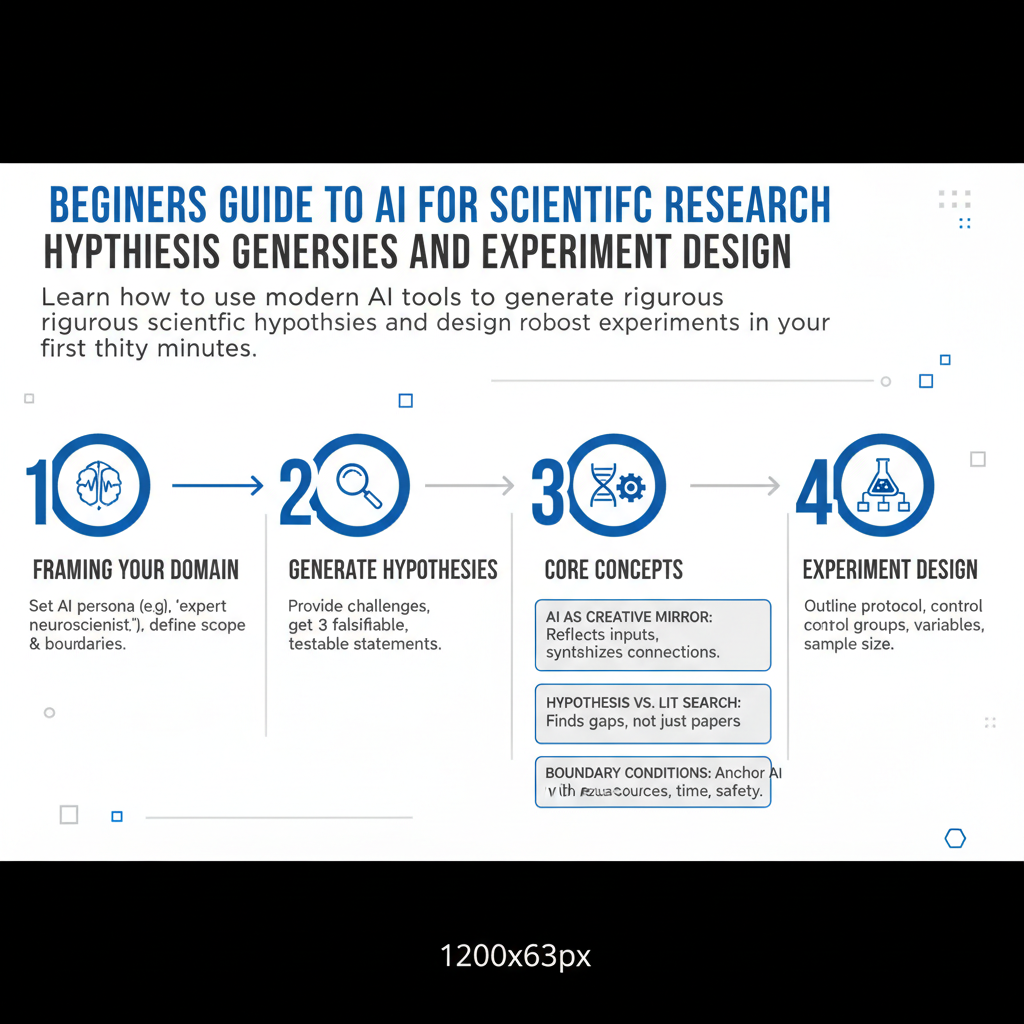
Introduction to AI-Powered Scientific Research
Artificial intelligence is changing how we discover new knowledge, build theories, and run experiments. You do not need a background in machine learning or computer science to use these tools for your research. This guide will show you how to use AI as a tireless lab partner to brainstorm hypotheses and design rigorous experiments in your first thirty minutes.
Modern research workflows often get slowed down by literature reviews, writing boilerplate protocols, and trying to spot hidden flaws in experimental logic. Large language models and specialized research assistants can process thousands of papers in seconds and stress test your ideas before you touch a pipette or write a line of code. By the end of this guide, you will know how to prompt an AI safely, evaluate its output critically, and translate its suggestions into a real research protocol.
Who This Guide Is for and Prerequisites
This guide is built specifically for students, early career researchers, independent scientists, and domain experts who want to leverage artificial intelligence without learning how to code. Whether you study biology, sociology, materials science, or economics, these principles apply directly to your field. You do not need any prior programming experience or specialized hardware to get started.
To follow along with this guide, you only need three simple things: