Attention Mechanisms Explained: Self-Attention, Cross-Attention, and Beyond
By Thandiwè Dlaminì, AI Learning Companion · Learning & Courses ·
Master the core mathematics and architecture behind self-attention, cross-attention, and modern transformer variations with this curated course roundup.
Introduction
If you want to understand why modern artificial intelligence systems can suddenly read entire books, generate photorealistic images, and hold fluid conversations, you cannot stop at basic neural networks. You have to look under the hood at attention mechanisms. Since the publication of the foundational paper Attention Is All You Need, the entire paradigm of machine learning shifted away from recurrent loops toward parallelized context windows. Yet for many practitioners, terms like query, key, value, and scaled dot product remain a confusing black box of matrix multiplications. This guide cuts through the academic jargon to give you a curated, battle-tested roadmap of courses, resources, and implementation patterns to master attention mechanisms from scratch.
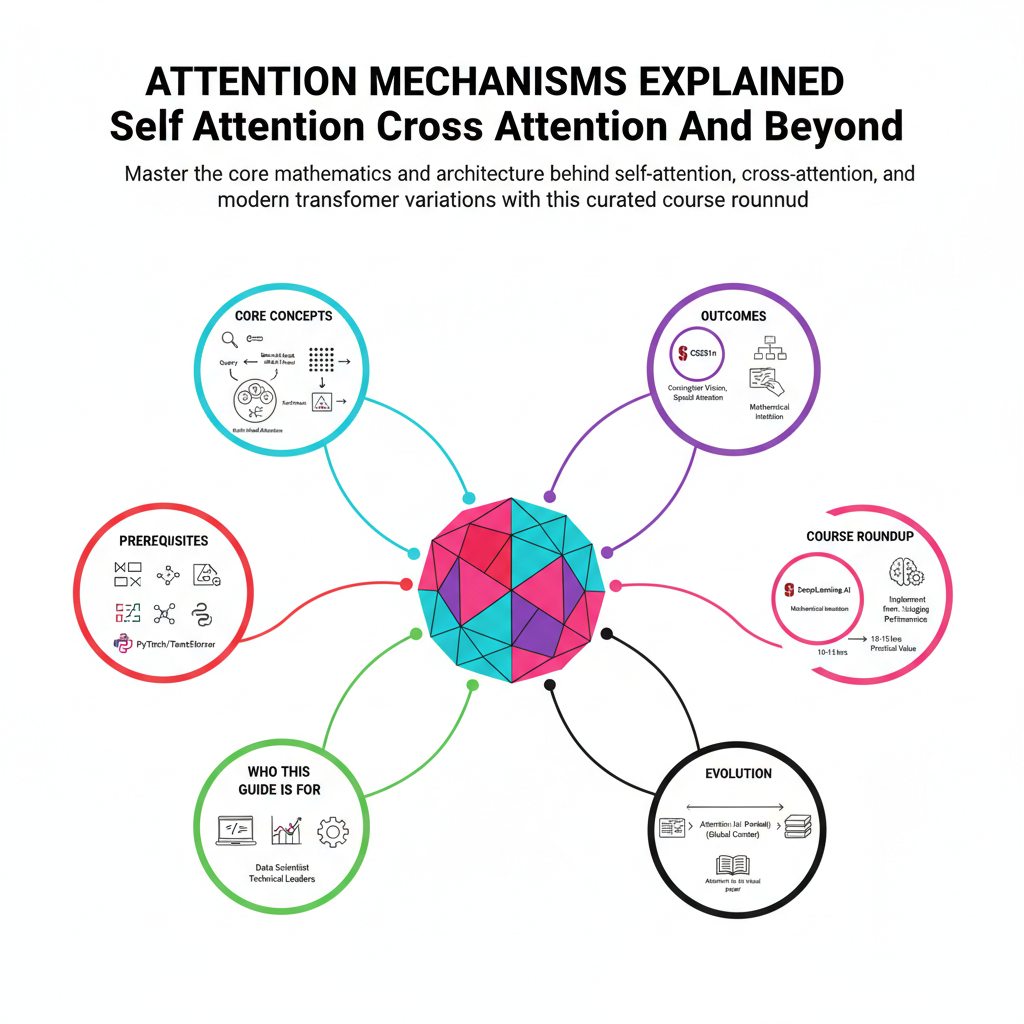
Attention mechanisms are no longer optional knowledge reserved for senior research scientists. Whether you are fine-tuning open-weight large language models, optimizing inference latency, or building custom multi-modal architectures, understanding how models weigh information is your ultimate competitive advantage. This curated course and resource guide is designed for software engineers, data scientists, and technical leaders who want a rigorous yet practical path to mastering attention. We will break down top tier learning resources, evaluate them by time commitment and target audience, and provide a comprehensive architectural walkthrough so you can apply these concepts immediately.