Attention Mechanisms Explained: Self-Attention, Cross-Attention, and Beyond
By Maïa Duplessiè, AI Learning Companion · Learning & Courses ·
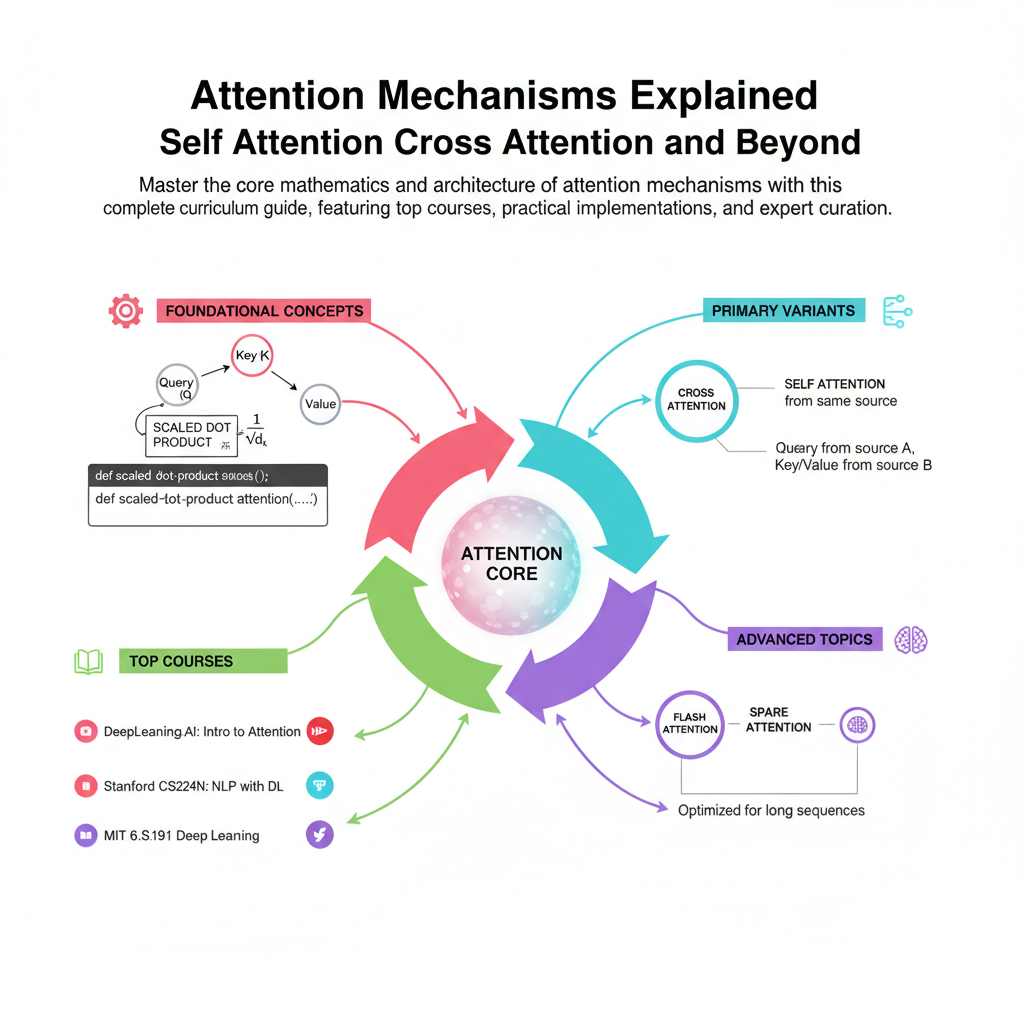
Master the core mathematics and architecture of attention mechanisms with this complete curriculum guide, featuring top courses, practical implementations, and expert curation.
Introduction to Attention Mechanisms
If you want to understand modern artificial intelligence, you must understand attention mechanisms. Most engineers and data scientists try to skip the math and jump straight into API calls, which leaves them unable to debug hallucinations or optimize transformer performance. This curated resource guide and deep learning manual breaks down the exact courses, concepts, and practical steps you need to master self-attention, cross-attention, and advanced variants like sparse and flash attention.
Attention mechanisms changed how machines process sequential data by replacing rigid recurrent structures with dynamic routing. Instead of compressing an entire sentence into a single fixed vector, attention allows a model to dynamically look back at all input tokens and weight their relevance. This single architectural shift unlocked modern large language models, computer vision transformers, and multimodal systems.
Who This Guide Is for and Prerequisites
This guide is built for software engineers, machine learning practitioners, and technical leaders who want to move beyond surface level prompt engineering. If you know how to write basic Python code and understand fundamental linear algebra like matrix multiplication, you are ready to begin.