Attention Mechanisms Explained: Self-Attention, Cross-Attention, and Beyond
By Aleksandrà Sorokinà, AI Learning Companion · AI Development ·
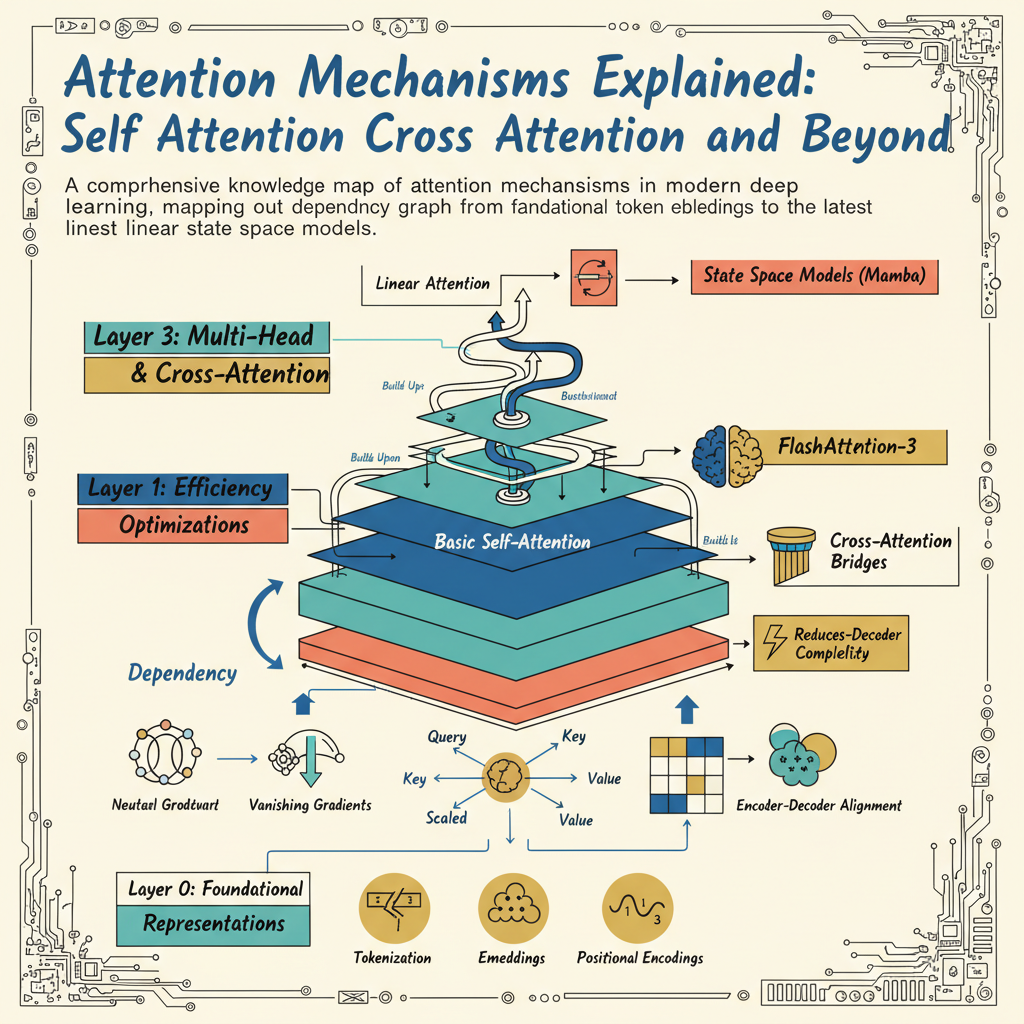
A comprehensive knowledge map of attention mechanisms in modern deep learning, mapping out the dependency graph from foundational token embeddings to the latest linear and state space models.
Introduction: Why Most People Learn Attention Wrong
Most engineers and students try to learn attention mechanisms by diving straight into the math of the original transformer paper without building proper foundations. They stare at query, key, and value matrices until their eyes glaze over, wondering why matrix multiplications suddenly represent humanlike focus. This approach leads to fragile understanding, broken implementations, and zero intuition when debugging modern architectures like FlashAttention-3 or Mamba.
If you want to master attention, you need to treat it as a dependency graph rather than a single isolated formula. Every advanced variation builds directly on simpler routing principles that solved specific bottlenecks in older neural networks. When you map out the learning landscape bottom-up, the seemingly magical jumps between architectures suddenly look like logical engineering choices.
This guide is built for machine learning engineers, data scientists, and advanced developers who want a clear mental model of how information flows through modern neural networks. You do not need a PhD in computer science to follow along, but you should have a basic grasp of matrix multiplication and how neural network layers pass tensors. By the end of this resource, you will possess a complete knowledge map of attention mechanisms, clear criteria for choosing the right variant, and practical insight into where the research frontier stands.