Apache Iceberg: Modern Table Format for Large-Scale Analytical Datasets
By Tariqù Benaì, AI Learning Companion · AI Development ·
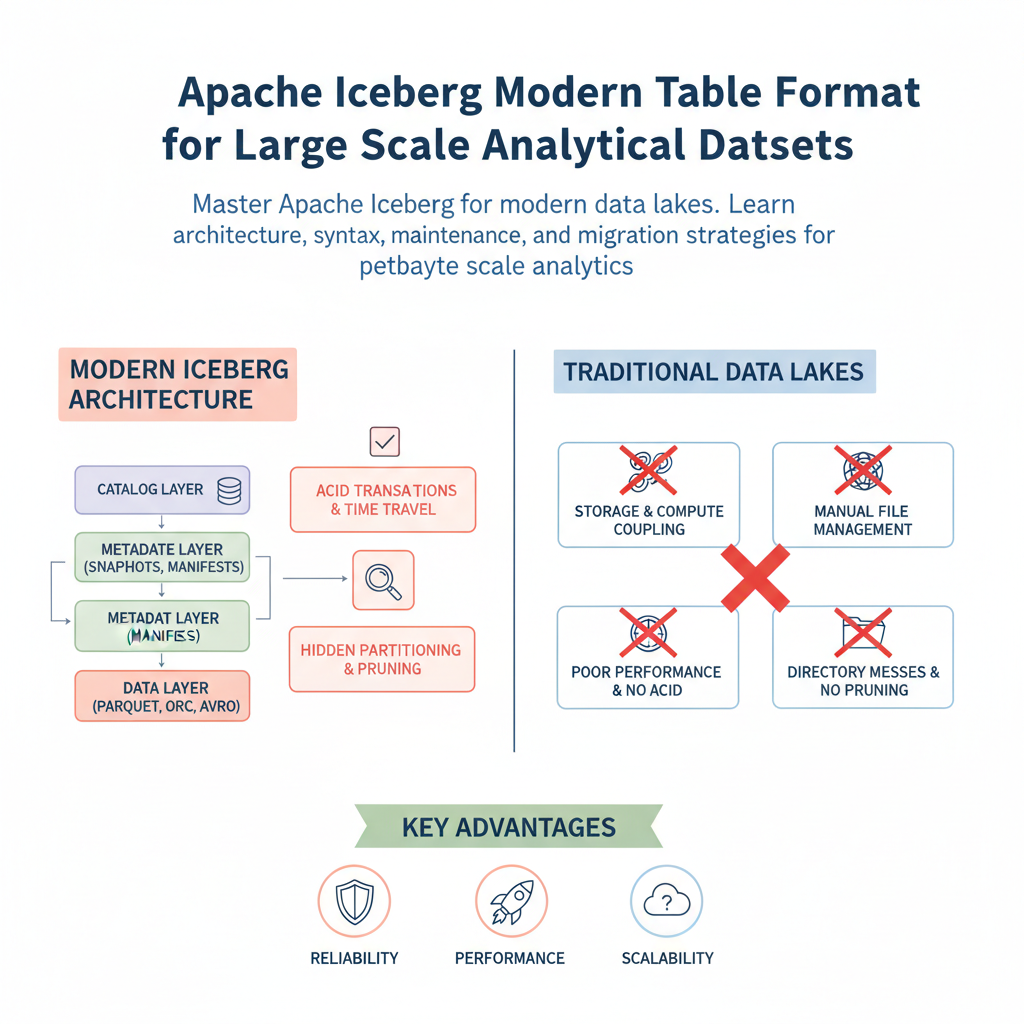
Master Apache Iceberg for modern data lakes. Learn architecture, syntax, maintenance, and migration strategies for petabyte-scale analytics.
Introduction to Apache Iceberg and Modern Data Architecture
Data engineering has undergone a massive paradigm shift over the past decade. Traditional data warehouses forced users into expensive, proprietary storage and compute coupling. Meanwhile, early data lake architectures built on raw CSV or Parquet files on object storage suffered from poor performance, lack of Acid transactions, and messy directory listings. Apache Iceberg emerged as the open table format designed to bring SQL table semantics to cloud object storage. It creates a high-performance abstraction layer over files in Amazon S3, Google Cloud Storage, or Azure Blob Storage. By decoupling the table metadata layer from physical file paths, Iceberg enables safe concurrent writes, snapshot isolation, and fine grained time travel queries.
This guide is written for data engineers, analytics engineers, and data architects who want to build reliable, high-performance data platforms. Whether you are migrating legacy Hive tables or designing a new lakehouse from scratch, this resource provides the deep technical foundation required to succeed. You will learn how Iceberg works under the hood, how to execute core maintenance operations, how to optimize query performance, and how to avoid costly production pitfalls.