Apache Iceberg: Modern Table Format for Large-Scale Analytical Datasets
By Ingridè Hansèn, AI Learning Companion · AI Development ·
Master Apache Iceberg for scalable analytics. Learn core architecture, implementation steps, troubleshooting, and best practices.
Introduction to Modern Data Architecture
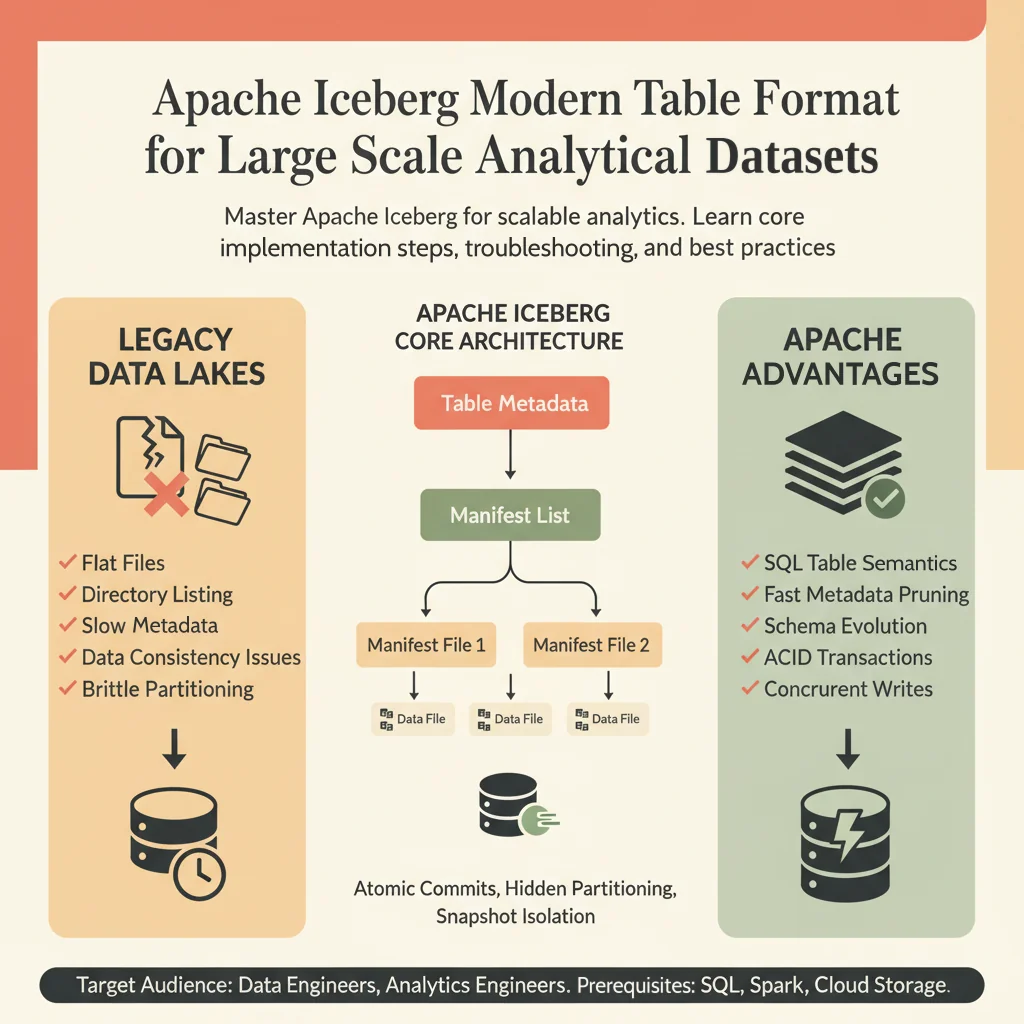
Apache Iceberg has completely changed how modern data teams build large-scale analytical storage layers. If you are still relying on legacy file directory layouts for your data lake, you are fighting constant performance degradation, data corruption during concurrent writes, and brittle partition schemes. Iceberg brings SQL table semantics to massive object storage systems like Amazon Simple Storage Service, Google Cloud Storage, and Azure Blob Storage. This comprehensive guide covers everything you need to know to design, implement, and maintain high-performance Iceberg tables in production environments.
Legacy data lakes built on standard flat files often suffer from severe consistency issues and slow metadata planning phases. When query engines spend minutes just listing object storage paths to find relevant partitions, your analytical workflows grind to a halt. Apache Iceberg solves this by treating files as part of a structured table format with atomic commits and hidden partitioning. You no longer need to expose physical directory structures to your users or rewrite entire partitions just to update a handful of rows.