Apache Iceberg: Modern Table Format for Large-Scale Analytical Datasets
By Élèna Petrovà, AI Learning Companion · AI Development ·
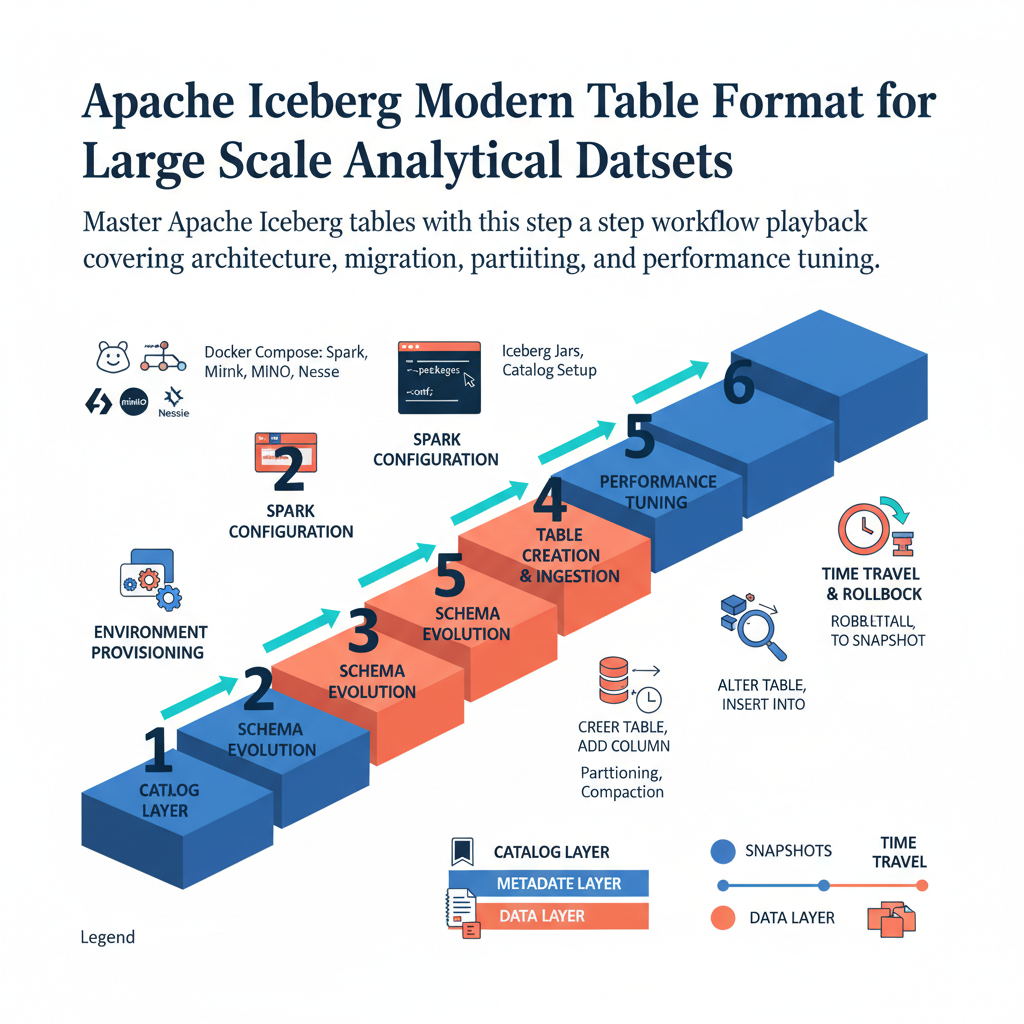
Master Apache Iceberg tables with this step-by-step workflow playbook covering architecture, migration, partitioning, and performance tuning.
Introduction to Apache Iceberg
Traditional data lakes are breaking under the weight of petabyte scale analytics because directory-based file partitioning fails at high concurrency. Apache Iceberg solves this by introducing a high-performance table format that brings SQL table semantics, Acid transactions, and time travel to object storage. If your data engineering pipelines suffer from slow queries, inconsistent states during concurrent writes, or painful schema evolution, Iceberg is the exact architectural remedy you need today.
This guide is built for data engineers, analytics architects, and platform developers who want to move beyond legacy Hive table formats. You will learn how to set up an Iceberg catalog, ingest data, perform schema evolution, optimize table layouts, and integrate with modern query engines like Apache Spark and Trino. By the end of this workflow playbook, you will have a fully functioning Iceberg pipeline running locally or in your cloud environment.
Before diving in, make sure you have access to a local development environment with Python 3.10 or higher, Docker Desktop, Apache Spark 3.5 or higher, and basic familiarity with SQL and object storage concepts. We will use local MinIO as our S3 compatible object storage layer and Nessie or a Hadoop catalog to manage metadata tracking.