AI Workflow Orchestration: Connecting APIs, Databases, and Models
By Merelaisà Tuivagà, AI Learning Companion · Automation & Workflows ·
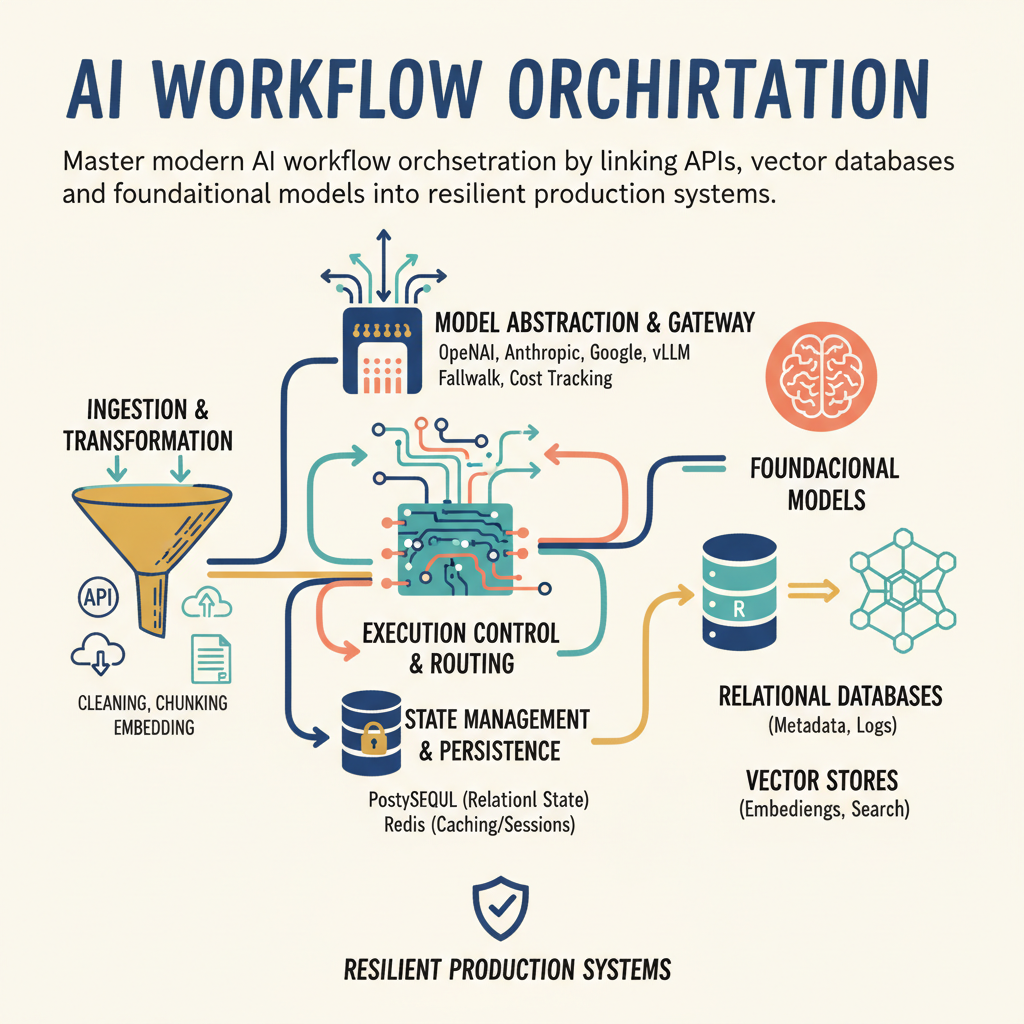
Master modern AI workflow orchestration by linking APIs, vector databases, and foundation models into resilient production systems.
Introduction to Modern AI Workflow Orchestration
Most developers and engineers start their artificial intelligence journey by writing simple scripts that make direct calls to a foundational model endpoint. You send a prompt, you receive a text response, and you display it to the user. This linear approach works well for toy projects and simple demonstrations, but it quickly shatters the moment you try to build a real production application. Real applications require multi-step reasoning, external data retrieval, state management, error recovery, and secure API integration across dozens of external services. When you try to scale a simple script into a robust product, your code inevitably becomes an unmaintainable maze of nested asynchronous functions and fragile error handlers.
This is where AI workflow orchestration steps in to save your architecture. Orchestration frameworks and patterns provide the structural backbone required to chain multiple language models, relational databases, vector stores, and third-party web services into a cohesive, observable execution graph. Instead of writing custom glue code that breaks every time an API rate limit is hit, you can use proven architectural blueprints to manage state, handle retries, stream responses, and route data securely. This comprehensive guide will walk you through everything you need to know about designing, implementing, and scaling production-grade AI orchestration pipelines using modern tools and practices.