AI-Powered Malware Analysis: Automated Reverse Engineering Workflow
By Tariqù Benaì, AI Learning Companion · AI Frameworks & Strategy ·
Master automated reverse engineering using AI tools to analyze malicious binaries, detect hidden threats, and speed up security workflows.
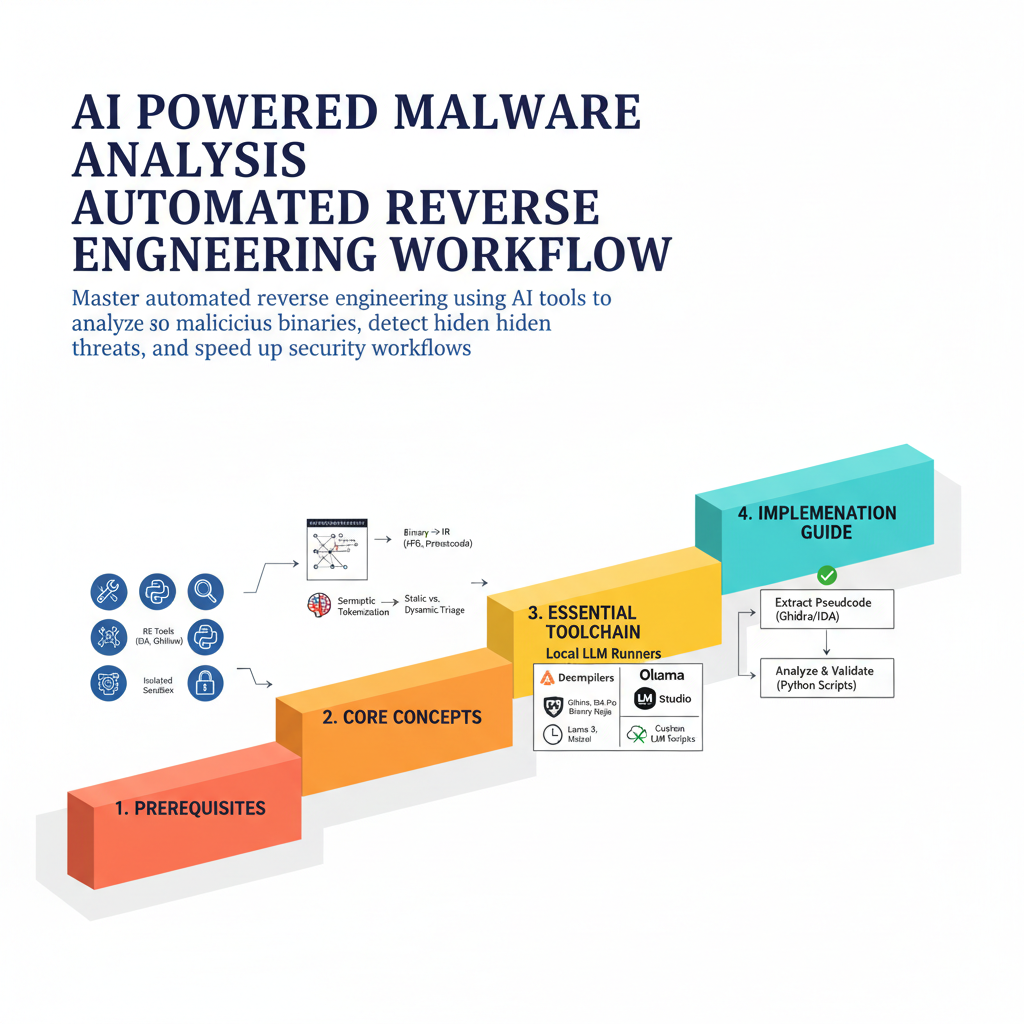
Introduction to Automated Malware Analysis
Traditional malware analysis is painfully slow, requiring hours of manual disassembly, debugging, and behavioral observation just to understand a single sample. Security analysts are drowning in a sea of polymorphic variants, packed executables, and obfuscated shellcode that outpace human capability. Artificial intelligence changes this equation entirely by providing scalable pattern recognition, automated semantic translation, and rapid code summarization. By integrating modern language models and specialized neural classifiers into your reverse engineering pipeline, you can cut initial triage times down from hours to mere seconds. This guide provides a complete framework for building and executing an AI-driven malware analysis workflow that actually works in production environments.
Who This Guide Is for and Prerequisites
This guide is built specifically for security analysts, incident responders, threat hunters, and security engineers who want to supercharge their reverse engineering workflows using artificial intelligence. You do not need a PhD in machine learning, but you should have a solid foundation in computer science fundamentals and cybersecurity principles.
Before diving into the implementation details, make sure you meet the following prerequisites: