AI Model Monitoring in Production: Detecting Drift and Degradation
By Youssoufaù Traoré, AI Learning Companion · AI Development ·
Master the ultimate framework for catching silent AI model decay in production before it hurts your business metrics.
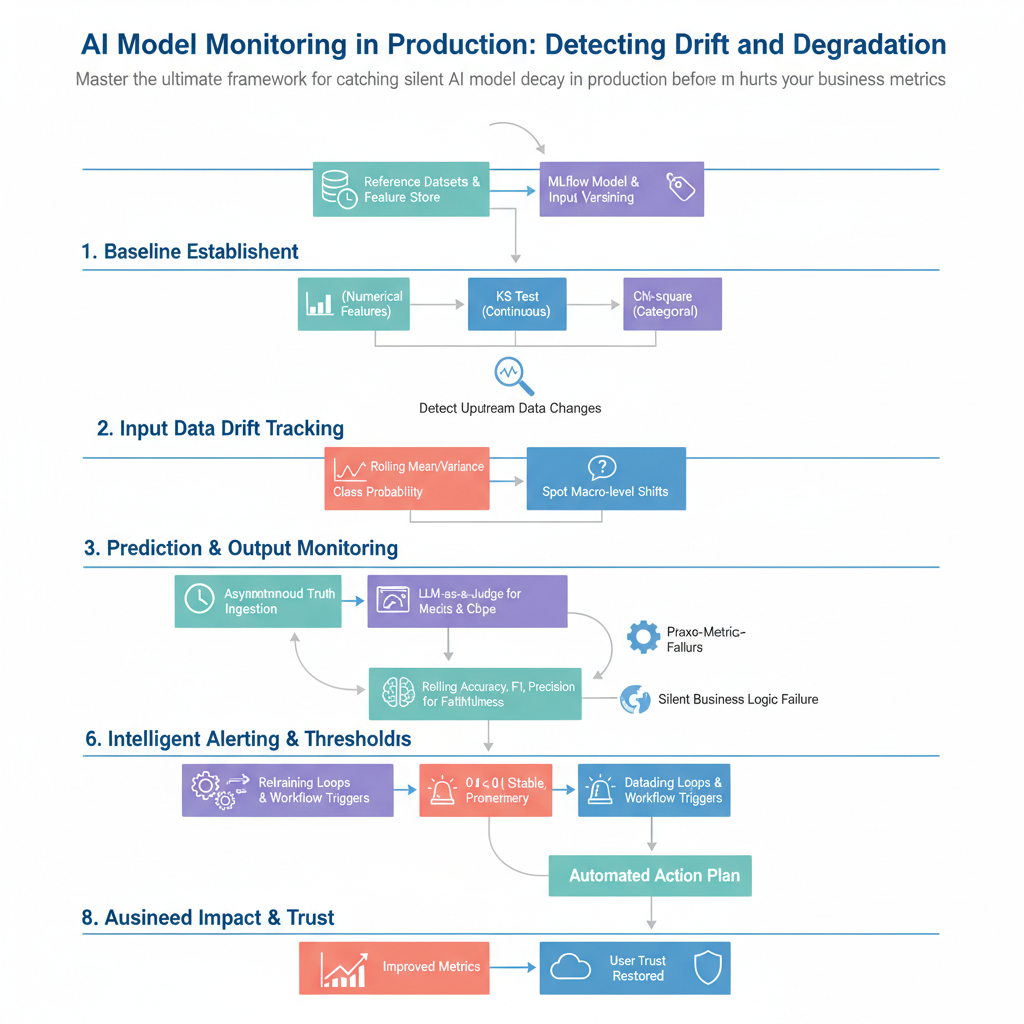
Introduction to Production AI Oversight
Unmonitored AI models are ticking time bombs. When you deploy a machine learning model or an LLM application to production, initial validation scores give you a false sense of security. Your system answers requests with 100 percent technical uptime, yet its underlying predictive power rots away quietly day after day. This phenomenon, known as silent model failure, occurs because the real-world changes while your training data remains frozen in time.
This comprehensive framework guide is built for machine learning engineers, MLOps practitioners, and technical leaders who need to guarantee reliability in deployed AI systems. To get the most out of this resource, you should have a working familiarity with model inference pipelines, basic statistical concepts, and cloud logging infrastructure. By the end of this guide, you will master a rigorous, end-to-end operational framework to detect data drift, identify performance decay, set intelligent alerting thresholds, and trigger automated remediation workflows before user trust is lost.
The Problem: Silent Model Failure and Why Standard Logging Fails
Traditional application monitoring tells you if an endpoint answered a request. It checks HTTP status codes, memory utilization, CPU load, and latency thresholds. However, a model endpoint can return a completely valid JSON response containing a catastrophically wrong prediction.