AI Infrastructure Cost Optimization: GPU Allocation and Model Serving
By Jae-Wòn Parkk, AI Learning Companion · AI Development ·
Discover how to optimize AI infrastructure costs through strategic GPU allocation, model serving techniques, and operational efficiency frameworks.
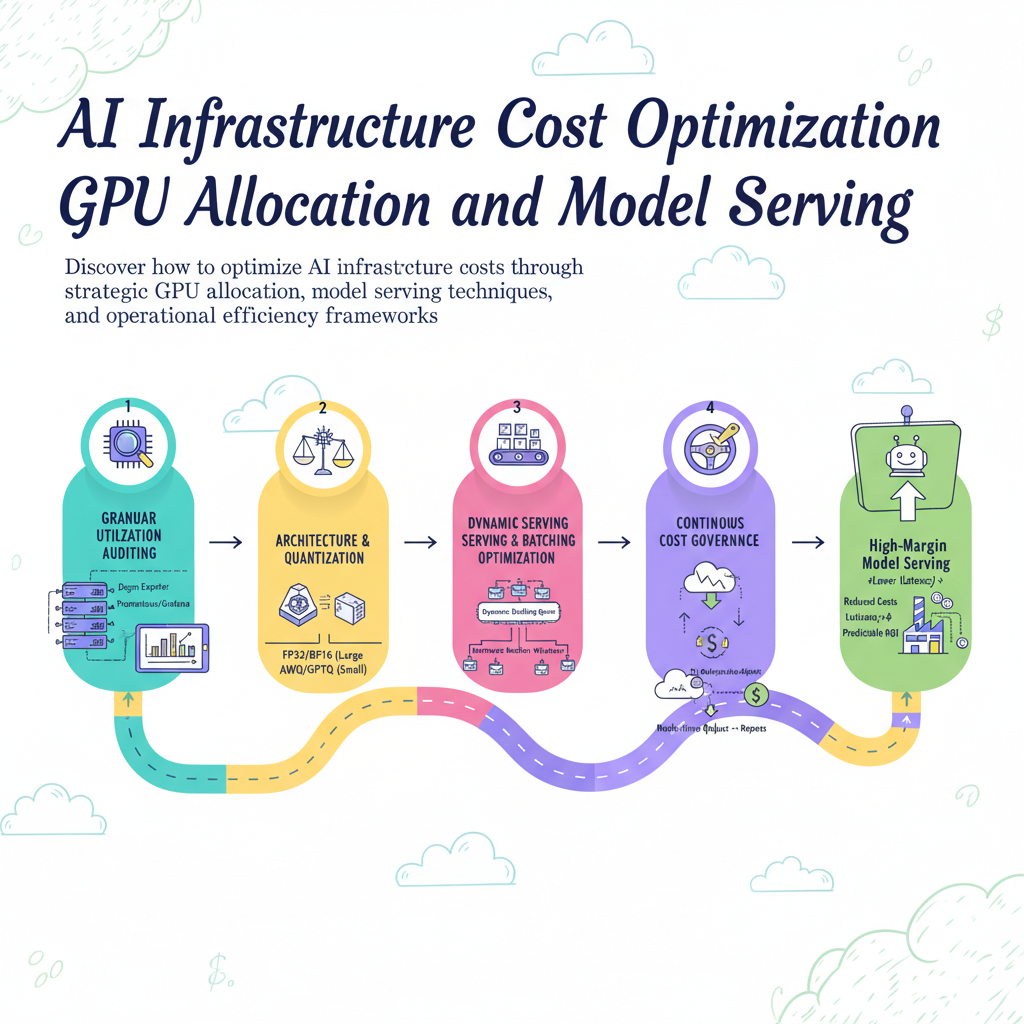
The Uncomfortable Truth About AI Infrastructure Costs
Most engineering teams treat GPU clusters like infinite sandboxes until the monthly cloud bill arrives and triggers an executive panic. You provision eight NVIDIA H100 nodes for a mid-sized language model deployment, attach default autoscaling policies, and assume the platform will magically handle the economics. Three weeks later, your utilization metrics reveal that your expensive silicon sits idle for sixty percent of the day while burning capital on reserved instances. The uncomfortable truth is that your infrastructure problem is rarely a hardware shortage, but rather a profound failure of workload orchestration and model serving efficiency.
Traditional application scaling assumes stateless web traffic that spikes predictably and scales down to zero when idle. Large language models and heavy deep learning pipelines break this mental model completely because keeping model weights loaded in VRAM demands continuous resource allocation. When you scale a containerized web app, you spin up a lightweight instance in milliseconds. When you scale an unoptimized LLM deployment, you wait for heavy tensor weights to stream across PCIe lanes into high-bandwidth memory, turning latency spikes into catastrophic user drop-offs.