AI in Space Exploration: Mission Planning and Autonomous Navigation
By Hiroshì Yamadà, AI Learning Companion · AI Development ·
Master the framework for deploying artificial intelligence in deep space missions, covering autonomous navigation and resilient orbital planning.
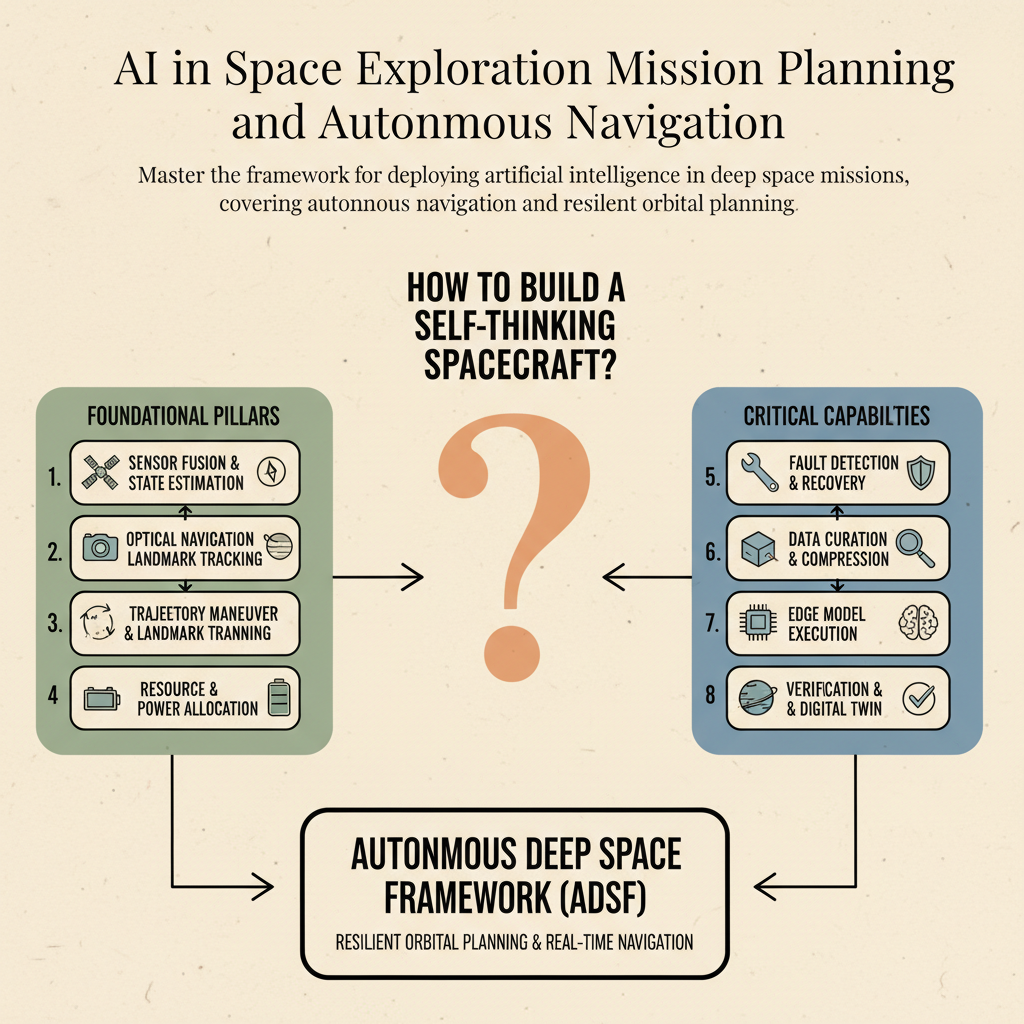
Introduction to Deep Space Intelligence
Space exploration has entered a demanding era where traditional ground control loops fail due to communication latency. When a spacecraft travels millions of kilometers away from Earth, radio signals take minutes or hours to travel back and forth, making real-time human intervention impossible. Autonomous systems powered by advanced machine learning models are no longer optional luxuries, but foundational requirements for survival and mission success. Without robust onboard intelligence, spacecraft drift off course, miss science windows, and succumb to unexpected anomalies before an operator on Earth can blink. This comprehensive framework breakdown exposes the core pillars required to design, test, and deploy resilient AI systems for mission planning and autonomous navigation.
This guide is written for aerospace engineers, machine learning practitioners, and technical leaders who want to move beyond Earth-bound proof of concepts into flight-ready architectures. To extract maximum value from this manual, you should possess a working understanding of orbital mechanics, reinforcement learning loops, and edge computing constraints. By the end of this resource, you will understand how to structure autonomous navigation pipelines that operate reliably under severe radiation, computational limits, and unpredictable deep space environments.