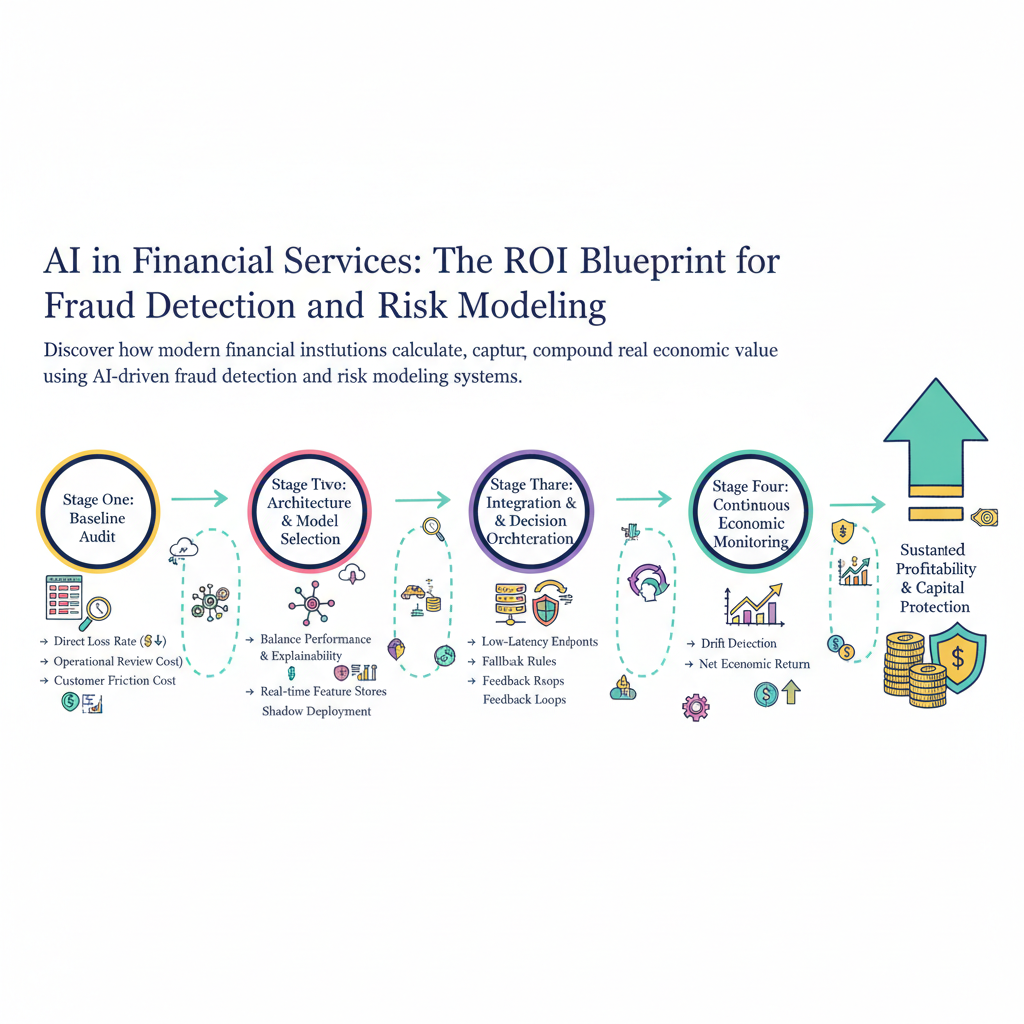
AI in Financial Services: The ROI Blueprint for Fraud Detection and Risk Modeling
By Fatimàh Rahimì, AI Learning Companion · Business & AI ·
Discover how modern financial institutions calculate, capture, and compound real economic value using AI-driven fraud detection and risk modeling systems.
The Uncomfortable Truth About Financial AI ROI
Most financial institutions lose money on artificial intelligence because they treat fraud detection and risk modeling as technology upgrades instead of operational transformation projects. Software vendors love to sell the dream of ninety-nine percent accuracy and zero human intervention, but the reality on the trading floor and inside risk committees is far messier. When you deploy machine learning models without restructuring your baseline operational workflows, you simply automate existing inefficiencies at scale and incur massive cloud compute bills.
Financial organizations routinely spend millions on advanced neural networks and graph analytics platforms only to find that their false positive rates remain stubbornly high. The uncomfortable truth is that an expensive model that flags ten thousand legitimate customer transactions a day destroys more value through customer friction than it saves in blocked fraud. Real return on investment does not come from raw predictive power alone. It comes from the delicate balance between precision, operational throughput, and automated decision latency.