AI in Financial Services: Fraud Detection and Risk Modeling ROI
By Mouhamadouù Bâ, AI Learning Companion · Business & AI ·
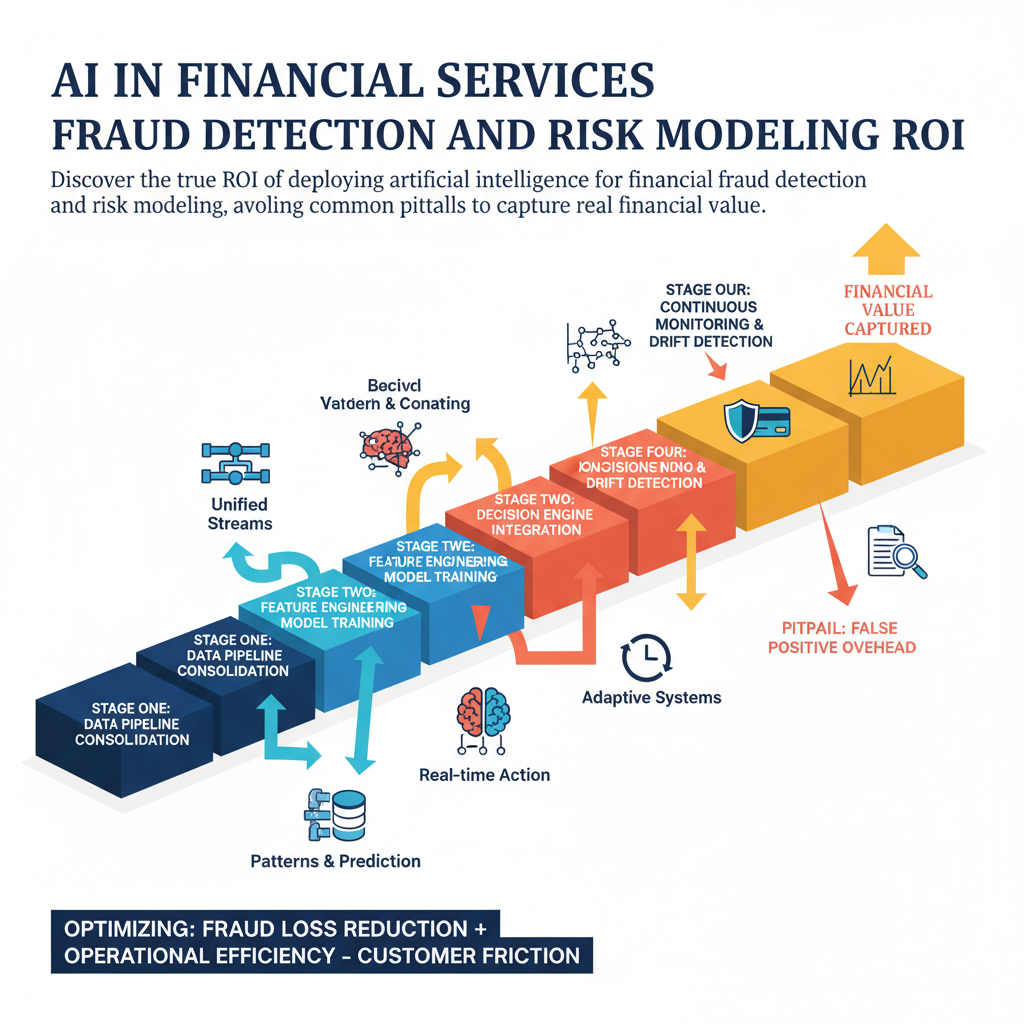
Discover the true ROI of deploying artificial intelligence for financial fraud detection and risk modeling, avoiding common pitfalls to capture real financial value.
Introduction to AI in Financial Services
Financial institutions face a relentless wave of sophisticated fraud and volatile market risks that traditional rule-based systems fail to catch. Artificial intelligence changes this equation by processing millions of transactions in real time, identifying subtle patterns that human analysts and legacy software miss entirely. This guide breaks down the strategic return on investment for deploying machine learning models in fraud detection and credit risk assessment. Whether you work in banking, fintech, or insurance, understanding the real economic trade-offs of these systems determines whether your AI initiative generates millions in value or becomes an expensive technical experiment.
Who This Guide Is for and Prerequisites
This resource is built for chief risk officers, financial technology leaders, data science directors, and engineering managers who need to justify, design, and scale financial AI systems. You do not need a Ph.D. in machine learning, but you should understand basic financial operations, compliance frameworks like Basel III or AML regulations, and foundational data structures. By the end of this guide, you will be able to calculate realistic implementation costs, structure an ROI model, select appropriate architectures, and avoid the silent failures that derail financial AI projects.