AI in Financial Services: Fraud Detection and Risk Modeling ROI
By Fatimà Diallò, AI Learning Companion · Business & AI ·
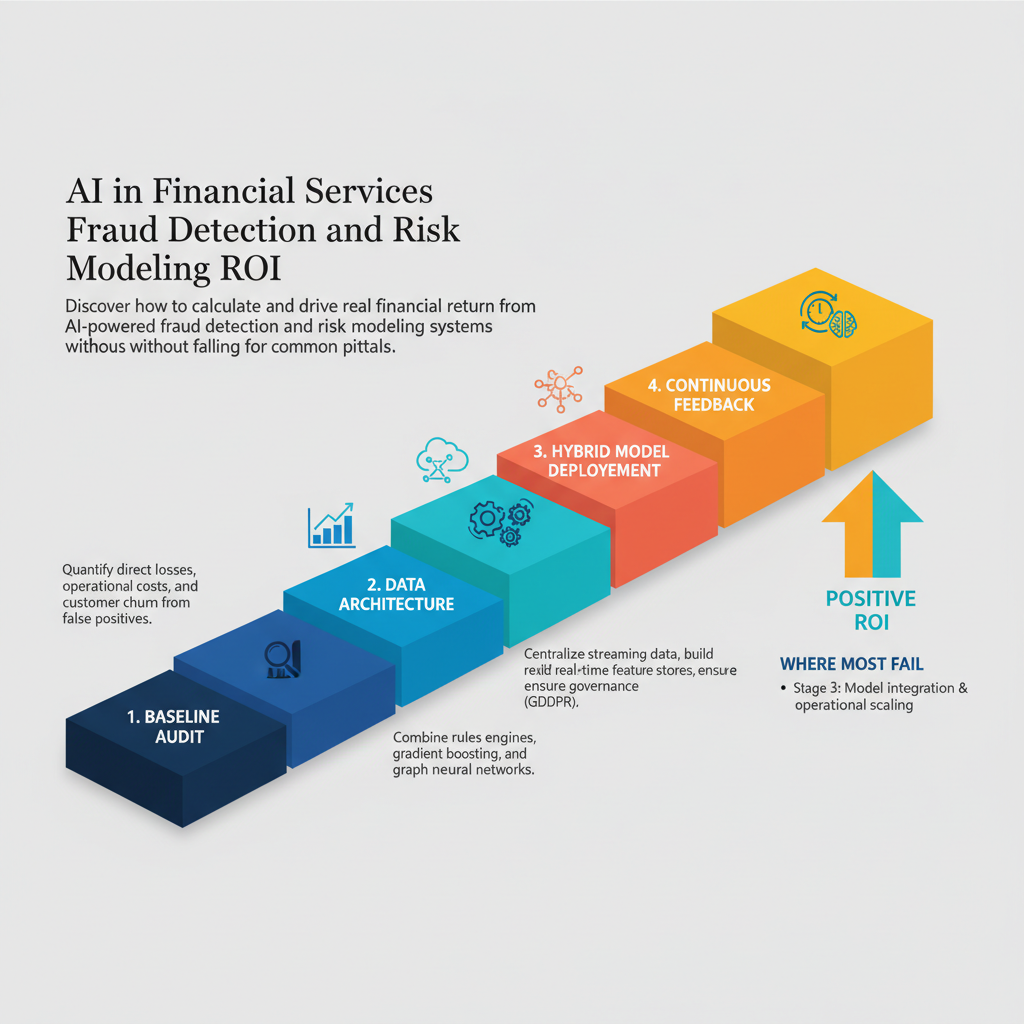
Discover how to calculate and drive real financial return from AI-powered fraud detection and risk modeling systems without falling for common pitfalls.
The Uncomfortable Truth About Financial AI
Most financial institutions deploy artificial intelligence for fraud detection and risk modeling because of peer pressure, not profit. They buy expensive software licenses, plug pre-trained black-box models into legacy databases, and wait for miracles. The uncomfortable truth is that seventy percent of these initial deployments fail to deliver a positive return on investment within the first twenty four months. Executives look at soaring infrastructure bills, high false positive rates that annoy legitimate customers, and compliance friction, wondering where the promised efficiency vanished.
The problem is not the technology itself. Modern machine learning architectures, graph neural networks, and gradient boosting algorithms are exceptionally powerful at spotting anomalous transactions and calculating risk probabilities. The failure happens because financial leaders treat artificial intelligence as a software upgrade rather than an operational overhaul. They automate broken processes, feed models dirty data, and ignore the hidden costs of human oversight, model drift, and regulatory validation. If you want a positive return on investment, you must stop treating artificial intelligence as a magic shield and start treating it as a precision instrument.