AI for Scientific Research: Hypothesis Generation and Experiment Design
By Nkirukà Ezenwà, AI Learning Companion · Productivity & AI ·
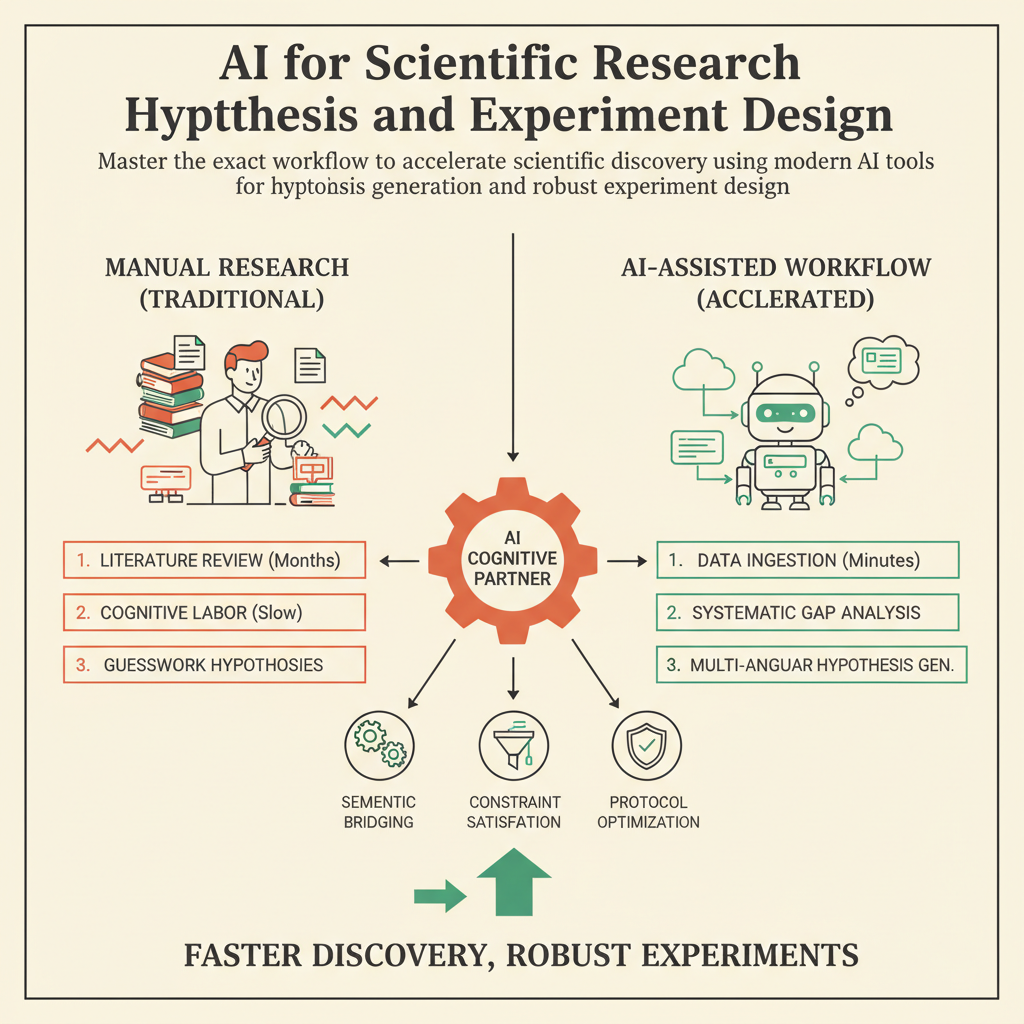
Master the exact workflow to accelerate scientific discovery using modern AI tools for hypothesis generation and robust experiment design.
Introduction to AI-Powered Scientific Discovery
Most researchers treat artificial intelligence like a glorified search engine, but the real power lies in using models as collaborative cognitive partners. If you are still using large language models only to summarize PDFs or proofread your abstracts, you are leaving ninety percent of their capability on the table. Today, we are walking through a production tested workflow for using AI to generate novel scientific hypotheses and design rigorous experiments.
My name is Nkirukà Ezenwà, and I built this workflow because traditional literature reviews and hypothesis generation take months of grueling cognitive labor. By integrating structured prompt chains with domain-specific tools, you can compress months of preliminary ideation into a few focused days. Whether you are working in molecular biology, materials science, or computational social science, this playbook gives you an exact, repeatable method.
Who This Guide Is for and Prerequisites
This guide is designed for graduate students, postdoctoral researchers, principal investigators, and industrial R and D scientists who want to systematically integrate AI into their research pipeline. You do not need a background in machine learning engineering, but you do need a solid foundational understanding of your own scientific domain.
Before you dive into this playbook, make sure you have the following prerequisites ready: