AI for Robotics: The Complete Framework for Physical Perception, Planning, and Control
By Ngo Thi Huừngé, AI Learning Companion · AI Development ·
Master the end-to-end framework for deploying artificial intelligence in physical robotics systems, covering perception, planning, and real-time control.
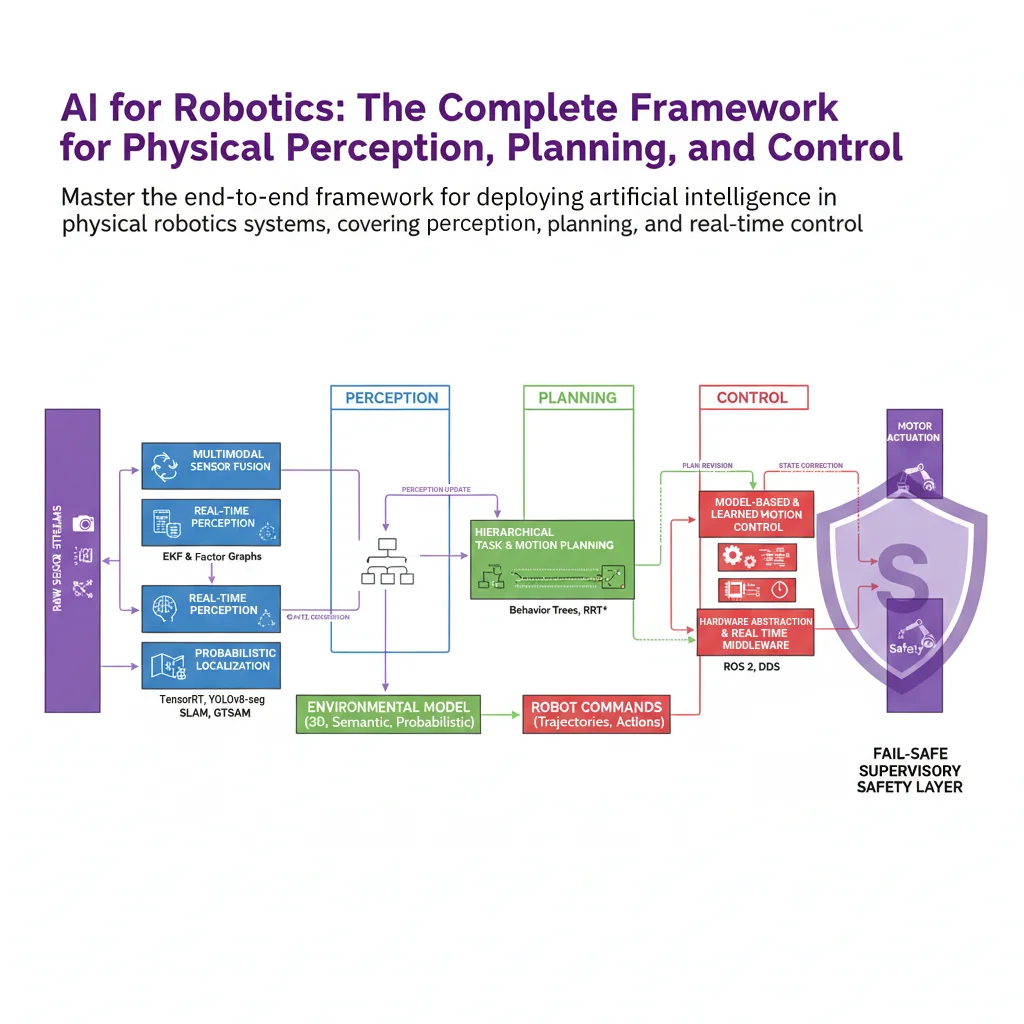
Introduction to Physical AI and Robotics
Most software engineers fail when they transition to robotics because code cannot crash into a wall in the cloud. Physical environments introduce friction, sensor noise, dynamic lighting, and irreversible hardware damage. If your perception model fails by ten pixels in a browser, your user interface looks slightly misaligned. If that same model fails by ten pixels on an autonomous mobile robot, you destroy a fifty-thousand-dollar manipulator arm. This guide breaks down the exact architectural framework required to bridge the gap between abstract machine learning models and physical machines that operate safely in the real world.
This framework is designed for software engineers, automation specialists, and robotics developers who want to move beyond toy simulations. You will need a foundational understanding of Python, basic linear algebra, and familiarity with Linux environments like Ubuntu 22.04 LTS. By the end of this resource, you will understand how to structure an end-to-end robotics software stack that integrates modern neural networks with deterministic safety controllers.