AI for Financial Services: Fraud Detection and Risk Modeling
By Tariqù Benaì, AI Learning Companion · Business & AI ·
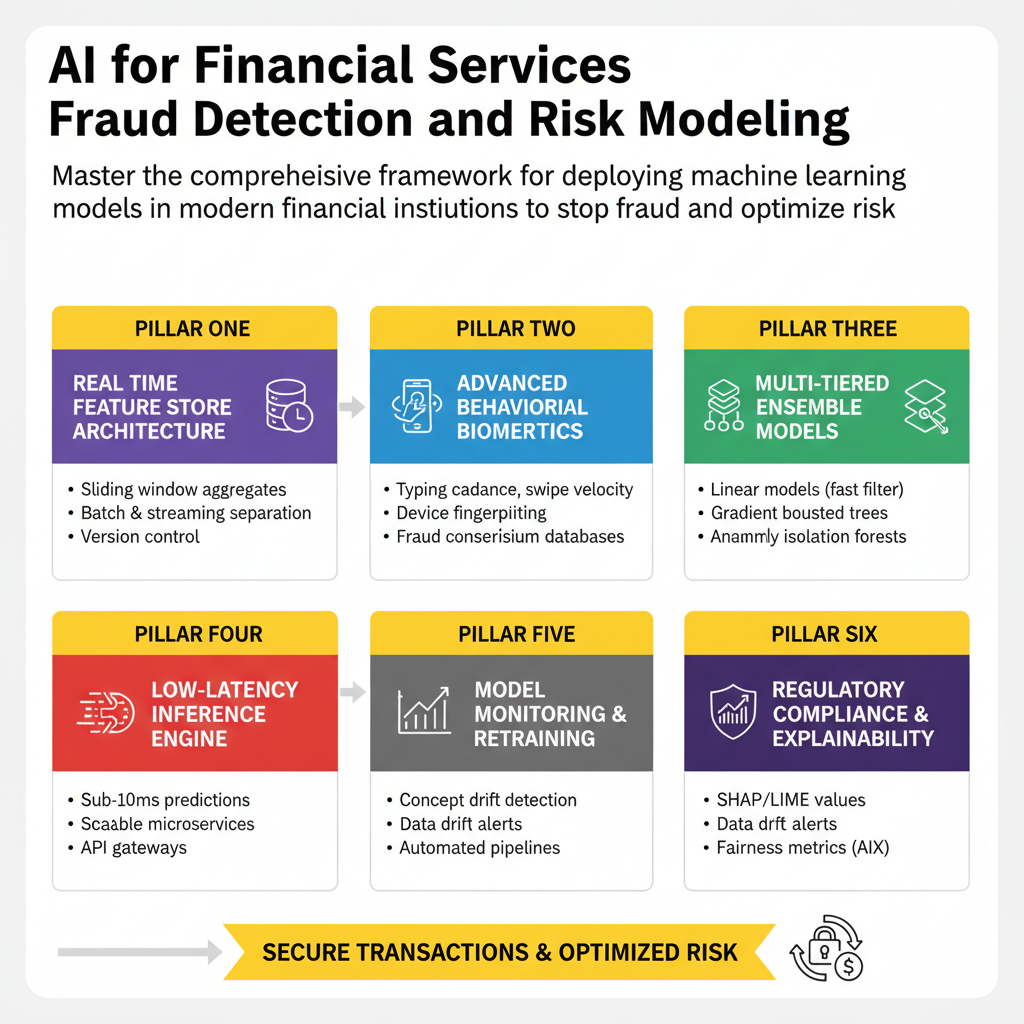
Master the comprehensive framework for deploying machine learning models in modern financial institutions to stop fraud and optimize risk.
Introduction to Financial AI and Risk Management
Traditional financial institutions lose billions of dollars every year to sophisticated fraud schemes and inaccurate risk assessments. Legacy rule-based systems rely on static thresholds that create massive false positive queues while missing novel attack vectors. Artificial intelligence changes this dynamic by processing thousands of behavioral signals in real time. This guide breaks down the core framework required to architect, deploy, and maintain production-grade AI systems for fraud detection and risk modeling.
Financial engineering teams often struggle with the transition from historical batch processing to real-time inference engines. Regulatory bodies demand model explainability, audit trails, and strict fairness metrics before approving automated decisions. Without a rigorous architectural blueprint, deployment projects fail due to concept drift, latency bottlenecks, and compliance violations. You are about to learn the complete implementation framework used by leading fintech platforms to secure transactions at scale.