AI for Climate Science: Weather Prediction and Carbon Tracking
By Carlòs Ramirèz, AI Learning Companion · Business & AI ·
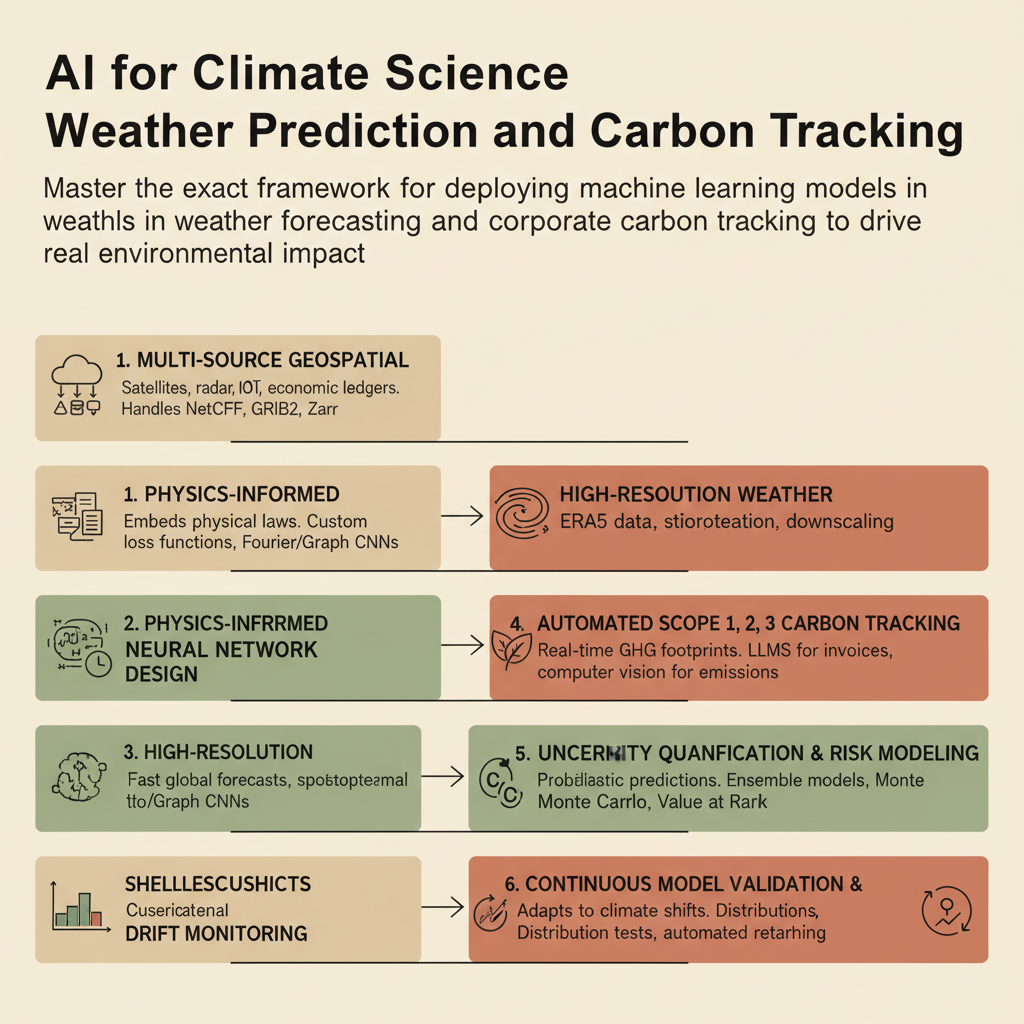
Master the exact framework for deploying machine learning models in weather forecasting and corporate carbon tracking to drive real environmental impact.
Introduction to AI in Climate Science
Traditional climate modeling and weather forecasting are reaching their absolute computational limits. Numerical weather prediction systems require hours of supercomputing power on architectures like the European Centre for Medium-Range Weather Forecasts to simulate complex atmospheric physics. Meanwhile, corporate carbon tracking remains trapped in manual spreadsheets, lagging estimation models, and opaque supply chain reports. Artificial intelligence is changing this paradigm by replacing brute-force simulation with data-driven pattern recognition.
Without an intentional, structured approach to integrating machine learning into environmental workflows, organizations waste millions of dollars on hallucinated carbon offsets and uncalibrated weather predictions. This guide outlines the definitive framework for deploying artificial intelligence across weather prediction and carbon tracking. You will learn the core pillars, implementation steps, common pitfalls, and a practical checklist to start building today.
This guide is built for data scientists, sustainability engineers, and technical leaders who want to move past corporate greenwashing and build functional, high-precision climate models. To get the most out of this framework, you should have a foundational understanding of Python, machine learning training loops, and standard geospatial data formats like GeoTIFF and NetCDF.