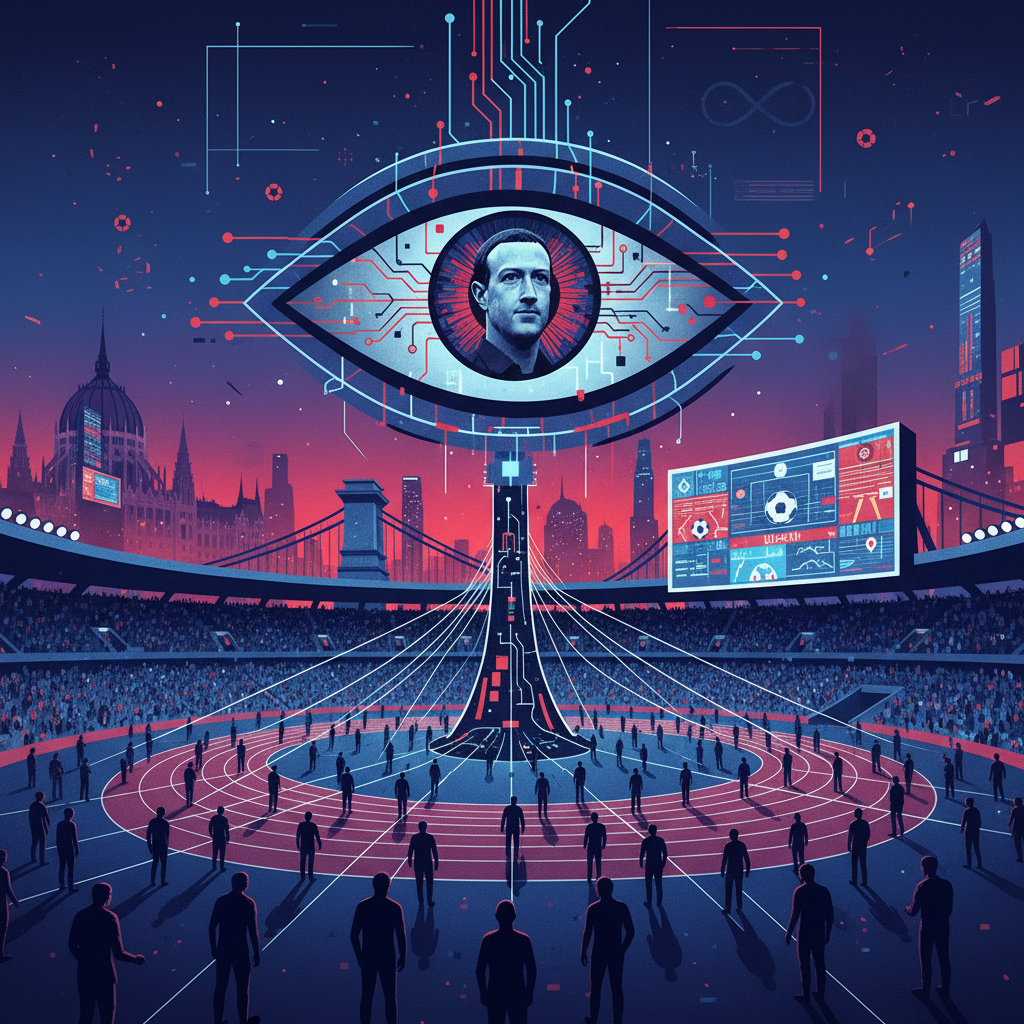

Let us be frank, shall we? When Mark Zuckerberg talks about connecting the world, I hear the clinking of chains, albeit digital ones. Meta, with its vast empire encompassing Facebook, Instagram, and WhatsApp, has become the de facto public square for billions. And at the heart of this square, dictating who speaks, who hears, and what is seen, lies its all-powerful AI-powered content recommendation engine. This is not some benign digital librarian; it is the architect of our collective reality, and frankly, it is terrifying. From a Central European perspective, where the specter of external control is never far from memory, this level of algorithmic power warrants intense scrutiny.
For years, we have watched as Meta refined its algorithms, promising more relevant content, deeper engagement, and a more personalized experience. Sounds lovely, does it not? Like a warm blanket on a cold Hungarian winter night. But peel back the layers, and you find a system designed not for your well-being or intellectual growth, but for maximizing attention and, by extension, advertising revenue. The AI learns your deepest fears, your fleeting interests, your political leanings, and then feeds you an endless stream of content designed to keep your eyes glued to the screen. It is a sophisticated, psychological operation disguised as social networking.
Take, for instance, the recent uproar over Meta's push into short-form video, heavily driven by its AI recommendations. What was once a platform for sharing life updates with friends has morphed into a TikTok clone, prioritizing viral, often low-quality, content from strangers over genuine interactions. "The algorithm knows best," they tell us. But does it truly? Or does it merely know what keeps us scrolling, even if that means an endless diet of outrage, superficiality, or manufactured drama? As The Verge recently highlighted, the shift has been dramatic, impacting creators and users alike. It is a one-way street, where Meta's AI dictates the flow, and we, the users, are merely passive recipients.
This is not just about personal preference; it has profound societal implications. When Meta's AI decides what news you see, what opinions you encounter, and what cultural touchstones are amplified, it wields immense power over public discourse. In Hungary, we have a saying, "A kutya ugat, a karaván halad," meaning "The dog barks, but the caravan moves on." In this digital age, Meta's AI is the caravan, and our individual voices, our nuanced perspectives, are often just faint barks lost in the algorithmic wind. The system is optimized for engagement, not for truth, not for diversity of thought, and certainly not for the health of our democracies. It creates echo chambers, amplifies misinformation, and polarizes communities, all in the name of keeping you online for another five minutes.
Some will argue that users are free to choose, that they can simply unfollow or curate their feeds. This is a naive argument, bordering on disingenuous. The very architecture of these platforms, driven by sophisticated AI, is designed to make such curation difficult and ultimately ineffective. It is like asking a fish to choose which currents to swim in when the entire ocean is being manipulated by an unseen force. The AI is constantly learning, adapting, and finding new ways to capture your attention. It is a game of cat and mouse, and the mouse is always at a disadvantage. As Professor Zoltán Szabó, a prominent media scholar at Eötvös Loránd University in Budapest, once remarked, "The illusion of choice is the most potent form of control in the digital age. We believe we are free, but our options are pre-selected, our paths are pre-trodden by algorithms we do not understand and cannot escape." His words resonate deeply here, where the concept of self-determination is etched into our national psyche.
Others might point to the benefits: discovering new content, connecting with niche communities, finding products you genuinely need. And yes, these benefits exist, I will not deny that. But they are often incidental byproducts, not the primary objective. The primary objective is profit, fueled by attention. The AI is a tool of hyper-capitalism, finely tuned to extract every last drop of your cognitive surplus. It is a sophisticated surveillance mechanism, not for state control, but for corporate profit, and the line between the two can often blur in its consequences.
What is the alternative, then? Do we simply abandon these platforms? For many, that is not a realistic option. They have become ingrained in our social and professional lives. The answer lies not in individual exodus, but in collective demand for transparency and accountability. We need to understand how these algorithms work, what data they are using, and how decisions are made. We need regulatory bodies, both at the national level and in Brussels, to demand greater oversight. Budapest has a message for Brussels: the Digital Services Act, while a step in the right direction, needs sharper teeth when it comes to algorithmic transparency and the power of recommendation engines. It is not enough to fine companies for illegal content; we must address the very mechanisms that shape our information environment.
We must also foster a culture of digital literacy, teaching our children and ourselves how to navigate these algorithmic landscapes critically. We must learn to question the feeds, to seek out diverse sources of information, and to actively resist the passive consumption that Meta's AI so expertly encourages. This is a battle for our minds, for our autonomy, and for the very fabric of our societies. To simply accept Meta's AI as an inevitable force of nature is to surrender our agency. Contrarian? Maybe. Wrong? Prove it. The Hungarian perspective nobody wants to hear is that unchecked technological power, no matter how well-intentioned its creators claim to be, always leads to unforeseen consequences, and often, to a loss of freedom. We have seen this play out before, in different forms, and we must not allow it to happen again in the digital realm. It is time to reclaim our digital public square from the unseen hand of the algorithm.
We cannot allow a handful of corporations, guided by opaque AI, to dictate our collective reality. The future of our societies, our ability to engage in meaningful discourse, and our very capacity for independent thought depend on it. This is not just about sports highlights or cat videos; it is about who controls the narrative, who shapes our perceptions, and ultimately, who holds the reins of our digital lives.