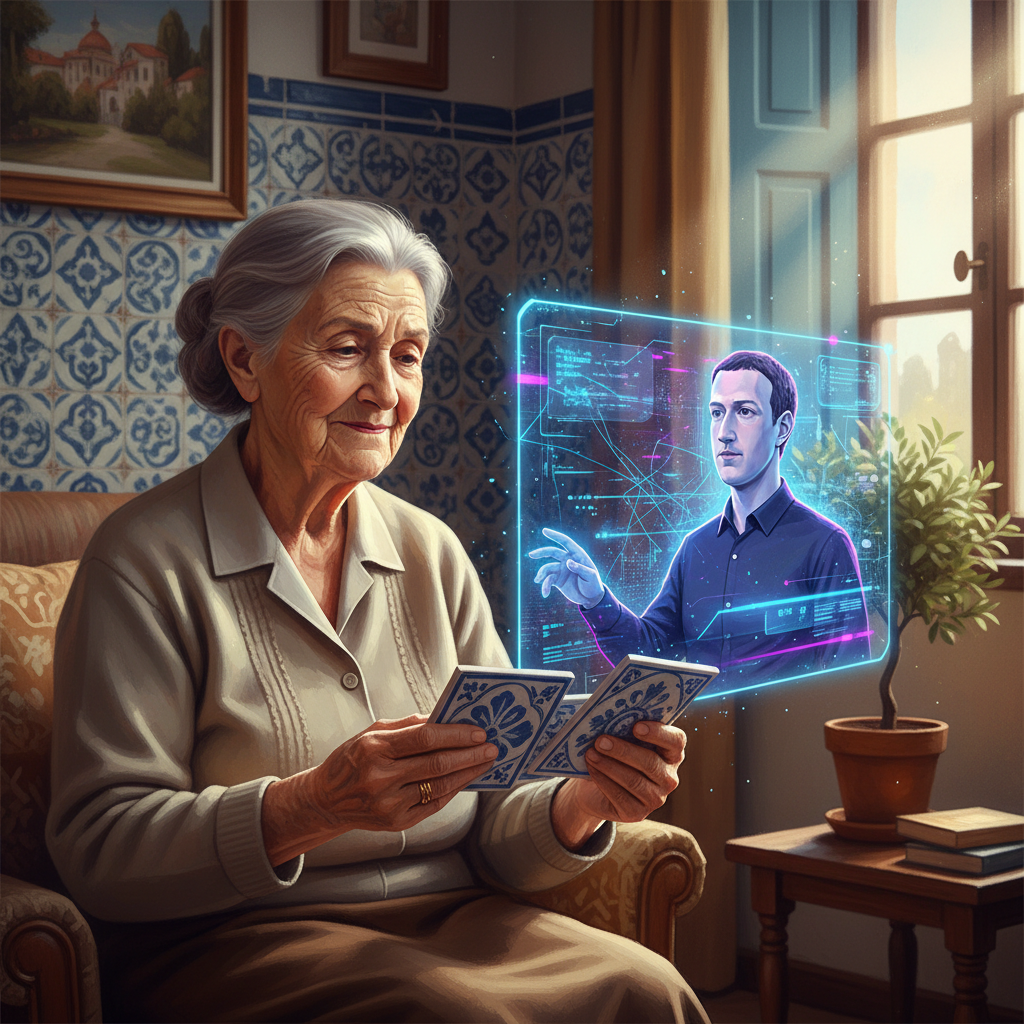

Ah, the grand pronouncements from Silicon Valley, they arrive here in Portugal like a gust of wind from the Atlantic, full of bluster and promises of a new world. This time, it is Mark Zuckerberg, the man who once promised us a digital utopia where we would all wear goggles and attend virtual meetings as legless avatars. Now, he has pivoted, with the grace of a seasoned footballer, from the metaverse to artificial intelligence. It seems the future, as envisioned by Meta, will be less about digital legs and more about digital brains. But what does this strategic calculus mean for us, for our minds, our relationships, and our very Portuguese way of life?
Let us be honest, the metaverse never quite landed here with the same fervor as it did in some other corners of the world. While analysts debated its multi-trillion dollar potential, many of us were more concerned with the price of bacalhau or the latest Benfica match. The idea of donning a VR headset to 'connect' felt, to many, like a solution to a problem we did not have, especially when a good conversation over a bica and a pastel de nata was always just around the corner. Our social fabric, woven tightly with family, community, and the simple pleasure of human presence, proved remarkably resilient to the siren call of virtual worlds.
Now, AI is the new darling, the shiny object demanding our attention. Zuckerberg, through Meta, is pouring billions into AI research, developing large language models like Llama, and integrating AI into everything from content moderation to personalized recommendations. The promise is efficiency, creativity, and a new era of digital interaction. But for a country like Portugal, where human connection is paramount, where the art of conversation is practically a national sport, this shift raises fascinating questions about our cognitive landscape.
Consider the subtle ways AI is already reshaping our daily interactions. We ask our phones for directions, not our neighbors. We get news curated by algorithms, not by the morning paper and a chat with the kiosk owner. Now, Meta wants to supercharge this. Imagine an AI companion, a digital confidante, always available, always agreeable. For some, particularly those in isolation, this could be a lifeline. But for many, especially here, it might just be another barrier to genuine human engagement.
Dr. Sofia Almeida, a cognitive psychologist at the University of Lisbon, notes this cultural nuance. “In Portugal, our social cognition is deeply rooted in direct interaction, in reading subtle cues, in the shared experience of being present,” she explained to me over a coffee near the university. “When AI mediates more of our communication, there is a risk of atrophy in these very human skills. We might become less adept at navigating the complexities and ambiguities of real human relationships, because AI tends to simplify and optimize.” She is not wrong. The delightful messiness of human interaction, the misunderstandings, the laughter, the shared silences, these are the ingredients of our social stew. Can an algorithm truly replicate that?
Meta's push into AI is undeniably strategic. After reportedly investing over $36 billion in its Reality Labs division since 2020, with significant losses, the pivot to AI is a pragmatic move to align with current tech trends and investor expectations. The company is now positioning AI as the underlying technology that will enhance all its products, from Instagram to WhatsApp. This means more sophisticated content feeds, more personalized ads, and eventually, AI assistants embedded deeply into our digital lives. Bloomberg Technology has reported extensively on this reorientation, highlighting the intense competition with other tech giants like Google and OpenAI.
But the human cost, or rather, the human change, is what truly interests me. We are already seeing a subtle shift in how people process information. With AI-driven feeds, our exposure to diverse viewpoints can narrow, creating echo chambers that reinforce existing biases. This is not new, but AI amplifies it. Our attention spans, already fractured by constant notifications, might become even more fragmented as AI optimizes for engagement above all else. “The algorithms are designed to keep us scrolling, to keep us interacting, and that often means feeding us what we already agree with, or what elicits a strong emotional response,” says Professor João Silva, a media studies expert at the Catholic University of Portugal. “This can lead to a less nuanced understanding of the world, and a greater difficulty in empathizing with those who hold different views.”
The impact on relationships is perhaps the most intriguing. Imagine an AI that can mimic your loved ones, or an AI that helps you craft the perfect message to resolve a conflict. While seemingly helpful, it could erode the very effort and vulnerability required for authentic connection. If an AI can always give you the 'right' thing to say, do you ever learn how to stumble through a difficult conversation yourself? Do you learn the value of imperfection in human bonding? I think not. We might become more reliant on these digital crutches, forgetting how to walk on our own two feet in the intricate dance of human relationships.
This is not to say AI is inherently evil, far from it. AI offers incredible potential for good, in healthcare, in education, in solving complex global challenges. But like a good port wine, complex and improving with age, we must understand its nuances. We must approach its integration into our lives with a healthy dose of Portuguese skepticism and a keen eye for its psychological implications. The sardine can of European tech is actually a treasure chest, and we have a knack for finding the humanity in the machine, not just the efficiency.
What can we do then, as individuals navigating this brave new world? Firstly, cultivate digital literacy. Understand how these algorithms work, how they shape your information diet. Secondly, prioritize real-world interactions. Make time for those coffees, for those family dinners, for the simple act of looking another human being in the eye. Thirdly, be mindful of your own cognitive load. Do not let AI do all your thinking for you. Engage critically with information, question what you see, and seek out diverse perspectives. As The Verge often reports, the conversation around AI's societal impact is ongoing and requires active participation from all of us.
Portugal punches above its weight when it comes to human resilience and community spirit. We have seen fads come and go, from the latest dance craze to the most convoluted tax reform. Zuckerberg's pivot to AI is another chapter in the ever-unfolding story of technology and humanity. It is a powerful tool, capable of great things, but it is up to us, the users, the citizens, the humans, to ensure it serves our best interests, not just the bottom line of a distant tech giant. We must remember that true connection, the kind that nourishes the soul, still requires two beating hearts, not just clever algorithms. Perhaps it is time to put down the phone, look up, and simply say 'olá' to the person next to you. That, I believe, is a connection even the most advanced AI cannot replicate. For now, at least. You can read more about the broader ethical considerations of AI and human interaction in articles like this one: Zuckerberg's Digital Panopticon: Meta's AI Recommendations Are Not About Connection, They Are About Control [blocked].