
For years, the tech world, particularly Meta Platforms, was captivated by the metaverse. We heard grand pronouncements about digital twins, virtual economies, and immersive experiences that would redefine human interaction. Here in Costa Rica, we watched with a mix of curiosity and a healthy dose of skepticism. While the vision was certainly ambitious, the practical applications, especially for a nation focused on sustainable development and tangible progress, often felt distant.
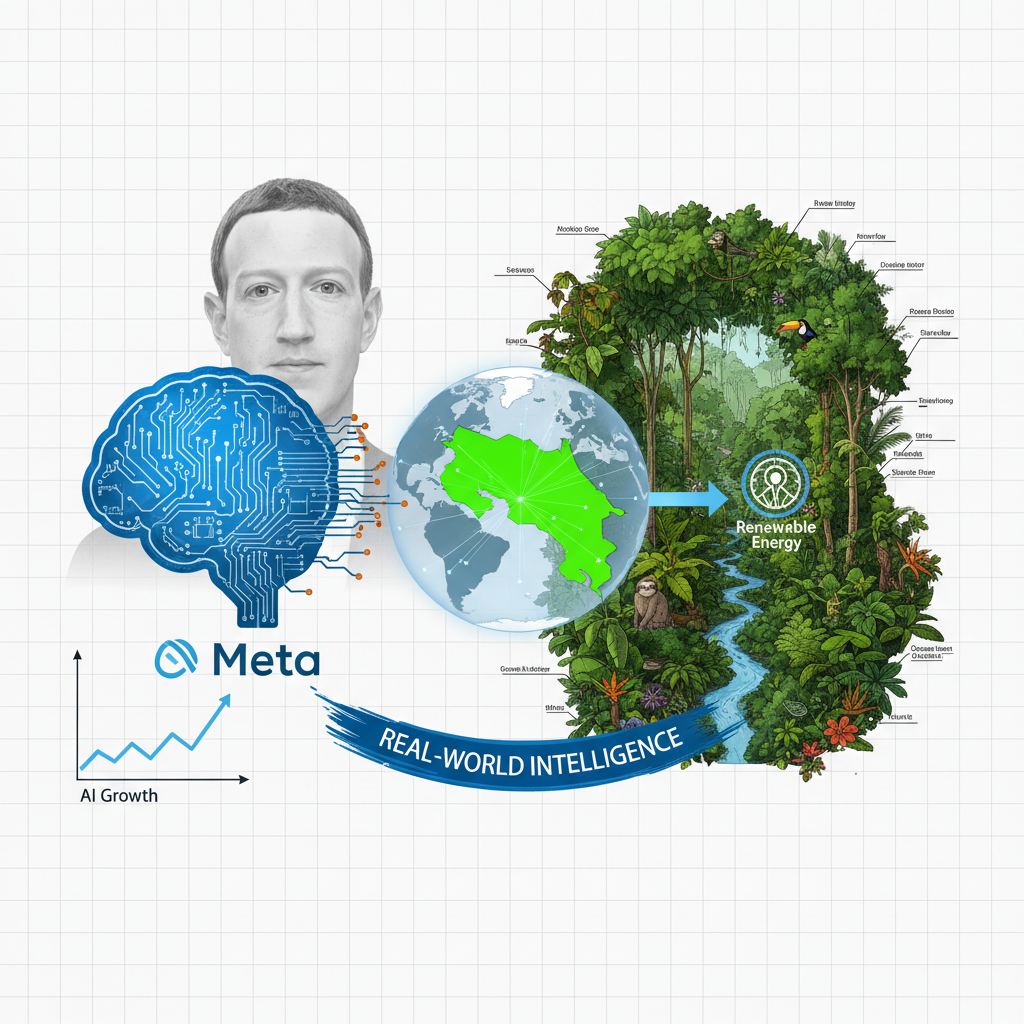
Then came the pivot. Mark Zuckerberg, Meta's CEO, made it clear: AI was the new frontier, the company's central focus. This wasn't just a slight adjustment, it was a fundamental reorientation, a strategic calculus that has sent ripples through the entire technology industry. For many, it felt like a sudden shift, but looking closely, it was a data-driven response to market realities, research breakthroughs, and the undeniable momentum of generative AI. It is a move that, surprisingly, holds lessons for how even smaller nations like ours approach technological advancement.
The Breakthrough in Plain Language: From Pixels to Prediction
The core of Meta's shift lies in its commitment to foundational AI models, particularly large language models (LLMs) and multimodal AI. While the metaverse demanded a future where we lived inside digital worlds, AI promises to enhance our existing world. The breakthrough isn't a single invention, but rather the rapid maturation of AI capabilities, particularly in areas like natural language understanding, image generation, and complex reasoning. Meta's Llama series, for instance, has demonstrated that powerful, open source models can rival proprietary ones, democratizing access to advanced AI. This open approach, championed by Meta AI, allows for rapid iteration and community-driven improvement, a model that aligns well with the collaborative spirit often found in smaller, agile tech ecosystems.
Consider the recent advancements in Meta's multimodal AI research, often published through their Fundamental AI Research (fair) division. Researchers are not just building models that can understand text, but ones that can seamlessly integrate text, images, video, and even audio. This means an AI could, for example, watch a video of a hummingbird in a garden, understand the species, describe its behavior, and even generate a new image of it flying through a different Costa Rican forest. This level of comprehensive understanding moves beyond mere pattern recognition, venturing into a form of digital comprehension that was once the stuff of science fiction. The implications for scientific research, environmental monitoring, and even educational tools are profound.
Why It Matters: Real Problems, Real Solutions
This pivot matters because it shifts focus from a speculative, resource-intensive virtual reality to practical tools that can address real-world problems. The metaverse, while intriguing, required immense computational power and a significant cultural shift to adopt. AI, particularly the kind Meta is pursuing, offers immediate utility. From improving content moderation on its platforms to powering new creative tools for artists and developers, the applications are tangible.
For Costa Rica, a country deeply committed to sustainability and biodiversity, this shift is particularly relevant. Imagine AI models trained on vast datasets of local flora and fauna, capable of identifying invasive species, monitoring deforestation patterns, or even predicting climate impacts on our delicate ecosystems. "The pura vida approach to AI" isn't about chasing the flashiest tech, it is about leveraging intelligence to protect our natural heritage and improve lives. As Dr. Ana María Hernández, a leading conservation biologist at the University of Costa Rica, often says, "Technology must serve life, not dominate it. AI has the potential to be a powerful ally in our fight to preserve biodiversity, if we direct its power wisely." This sentiment perfectly captures the pragmatic spirit we value.
Meta's investment in open source AI, particularly with models like Llama, further amplifies its importance. It means that researchers and developers in places like San José or Liberia are not solely reliant on proprietary, expensive tools. They can access, modify, and build upon these foundational models, fostering local innovation. This democratizing effect is crucial for leveling the playing field in the global tech landscape. It proves that you do not need to be in Silicon Valley to make significant contributions to AI, a point we often emphasize here in Costa Rica.
The Technical Details: More Than Just Bigger Models
While the sheer size of Meta's models often grabs headlines, the real technical advancements lie in their architectures and training methodologies. Researchers at Meta AI, for example, have been exploring techniques like self-supervised learning, where models learn from unlabeled data by finding patterns and relationships on their own. This is particularly valuable when dealing with vast amounts of diverse data, such as the multimodal data Meta collects from its various platforms.
Another key area is the development of more efficient training algorithms and specialized hardware. Training these massive models requires immense computational resources, often hundreds or thousands of NVIDIA GPUs working in parallel. Meta's investment in its own AI infrastructure, including custom chips and supercomputers, underscores its long-term commitment. This infrastructure allows for experimentation with novel architectures, such as mixture-of-experts (MoE) models, which can activate only relevant parts of a neural network for a given task, making them more efficient for inference. This focus on efficiency is not just about cost savings, it is about pushing the boundaries of what is computationally feasible for complex AI tasks.
Recent papers from Meta AI's Fair team, often published on platforms like arXiv, detail breakthroughs in areas like long-context understanding, where models can process and reason over much larger blocks of text or sequences of data. This is critical for applications ranging from summarizing lengthy scientific papers to understanding complex legal documents. Their work in robust AI, focusing on making models less susceptible to adversarial attacks or biased inputs, is also paramount for deploying these systems responsibly in sensitive areas.
Who Did the Research: A Global Effort Led by Meta
The research driving Meta's AI pivot is primarily conducted by its dedicated Meta AI division, encompassing teams like Fair (Fundamental AI Research) and Applied AI. Led by figures such as Yann LeCun, Meta's Chief AI Scientist and a Turing Award laureate, these teams comprise thousands of researchers and engineers globally. LeCun has been a vocal proponent of open science in AI, advocating for the release of models and research findings to accelerate progress across the board. "Openness is not just a philosophy, it is a strategic imperative for AI," LeCun stated in a recent interview, emphasizing how shared knowledge fosters innovation and helps identify potential risks more quickly.
Beyond internal teams, Meta collaborates with academic institutions worldwide. While specific paper citations are too numerous to list here, their research often appears at top-tier conferences like NeurIPS, Icml, and Iclr, involving collaborations with universities such as Stanford, Carnegie Mellon, and MIT. This collaborative ecosystem ensures a constant influx of new ideas and rigorous peer review, pushing the boundaries of what is possible in AI.
Implications and Next Steps: A Future Grounded in Utility
The implications of Meta's AI pivot are vast. For consumers, it means more intelligent interactions across Meta's family of apps, from personalized content feeds to advanced creative tools. For businesses, it opens up new avenues for automation, customer service, and data analysis. For developers, especially those in emerging tech hubs, the open source nature of models like Llama provides a powerful foundation for building novel applications tailored to local needs.
Here in Costa Rica, we see this as an opportunity. Our small nation, known for its commitment to environmental protection and sustainable tourism, can leverage these powerful, accessible AI tools for specific, impactful projects. Imagine AI-powered systems assisting park rangers in monitoring wildlife, or helping farmers optimize crop yields with minimal environmental impact. The Costa Rican Investment Promotion Agency (cinde) has actively been promoting the country as a hub for green tech and sustainable innovation, and AI, particularly open source AI, fits perfectly into that vision. As Jorge Monge, a Cinde representative, recently noted, "Practical innovation in paradise means using cutting-edge tools to solve our unique challenges, not just replicating Silicon Valley trends. Meta's open AI models give us a powerful new lever." We are not just spectators, we are potential participants in this new AI-driven future.
The next steps for Meta will involve refining these foundational models, making them more efficient, more robust, and more capable of complex, multimodal reasoning. The race for AI dominance is far from over, with companies like OpenAI, Google, and Anthropic all pushing the envelope. However, Meta's strategy of combining massive investment with an open science approach presents a compelling alternative, one that could foster a more distributed and diverse AI ecosystem globally. This is a future where AI isn't just about building virtual worlds, but about intelligently enhancing the real one, a vision that resonates deeply with our values in Costa Rica. It is a reminder that while hype cycles come and go, true progress is always rooted in practical utility and a clear understanding of real-world needs. For more on how AI is shaping global tech, you can always check out TechCrunch's AI section.