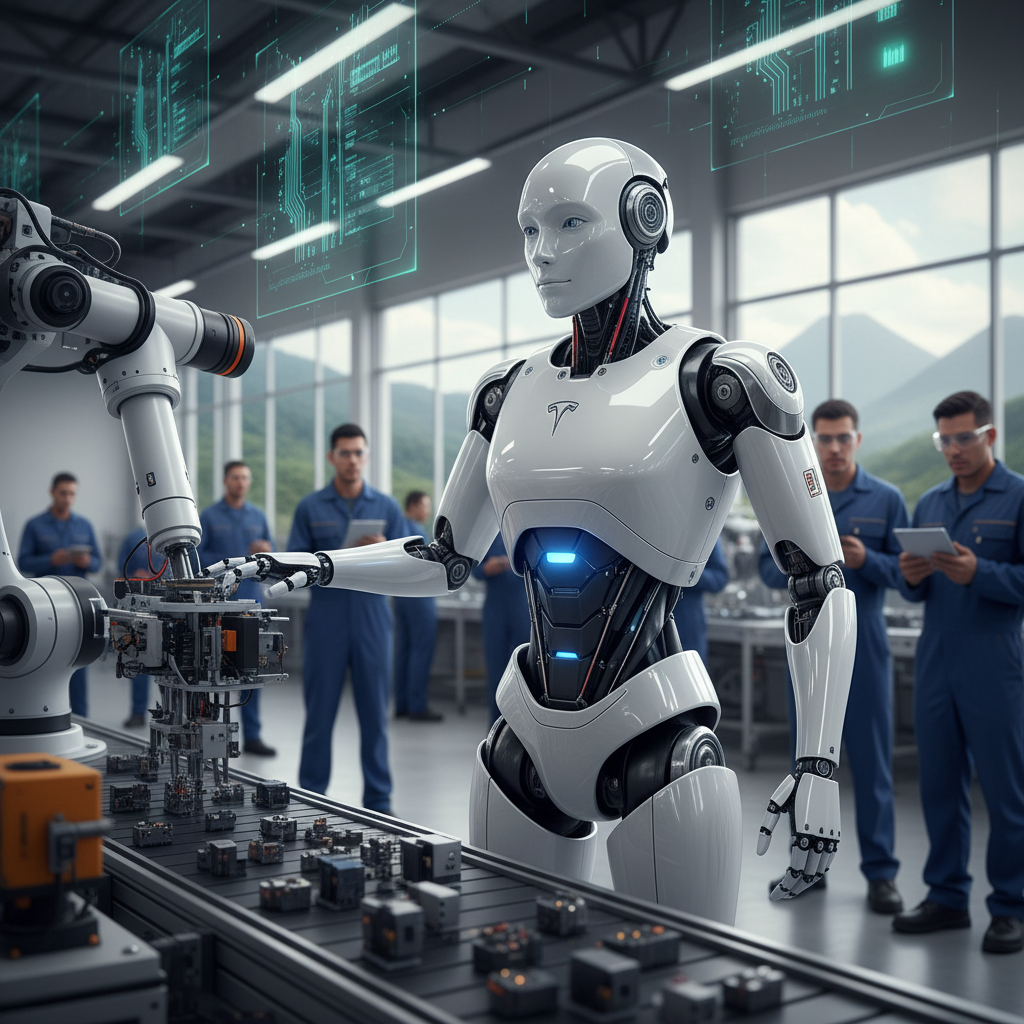
The rhythmic whir of machinery usually dominates the air in Guatemala's bustling manufacturing zones, a symphony of human effort and mechanical assistance. But lately, there is a new note in the conversation, a whisper of a different kind of worker: the humanoid robot. Elon Musk's Tesla Optimus, with its promise of revolutionizing factory floors, has begun to capture the imagination of business leaders here, but for many, it also brings a knot of uncertainty.
I remember visiting a textile maquila near Antigua last year, where the nimble fingers of Doña Elena, a woman whose family has woven for generations, moved with an almost magical speed. Her grandmother's wisdom meets machine learning, I thought, watching her guide fabric through a complex embroidery machine. The idea of a robot, even one as sophisticated as Optimus, replacing that intricate human connection to craft feels, to some, like losing a piece of our soul. This is a story about resilience, about how our communities, rooted in tradition yet open to innovation, are grappling with a future that feels both inevitable and profoundly foreign.
Globally, the conversation around humanoid robots in manufacturing is accelerating. Major players like Tesla are pushing the boundaries, showcasing Optimus's ability to perform repetitive tasks, lift heavy objects, and even sort items with surprising dexterity. According to a recent report by Reuters, the market for humanoid robots in industrial applications is projected to grow significantly in the coming decade, driven by labor shortages in some regions and the pursuit of efficiency. While specific adoption rates for Optimus are still emerging as the technology matures, the general trend in robotics is clear: McKinsey & Company's 2023 analysis indicated that companies investing in advanced robotics saw an average return on investment within three to five years, primarily through increased productivity and reduced operational costs.
In Guatemala, the landscape is complex. Our manufacturing sector, particularly in textiles and apparel, is a significant employer. The prospect of Optimus robots, which Tesla aims to produce at scale and at a relatively accessible price point, entering these factories raises immediate questions about employment. "We cannot ignore the potential for these technologies to enhance productivity and help us compete on a global stage," said Ricardo Morales, CEO of a major apparel exporter in Guatemala City, speaking at a recent industry conference. "But our primary concern must always be our people. We need to find ways to integrate these tools without leaving our workforce behind." He emphasized the need for retraining programs and a focus on higher-value tasks that still require human ingenuity.
Indeed, the initial impact might be felt differently across businesses. Larger enterprises, often those with international ties and access to capital, are the most likely early adopters. Companies already utilizing advanced automation, such as some of the larger food processing plants or assembly operations in zones like Puerto Barrios, might see Optimus as a natural progression. Their existing infrastructure and technical expertise would make integration smoother. For smaller, family-owned businesses, however, the capital expenditure and the cultural shift required could be prohibitive, potentially widening the gap between large and small industries.
The worker perspective is, as always, at the heart of this discussion. I spoke with Maria, a young woman who works on an assembly line for electronic components. "We hear talk of these robots, and of course, there is fear," she told me, her eyes reflecting a mix of curiosity and apprehension. "Will they take our jobs? Or will they make our work easier, safer? We don't know what to expect." This sentiment is echoed by many. The fear is not just about job displacement, but also about the devaluation of human labor, of the skills and traditions passed down through generations. The Ministry of Labor and Social Welfare in Guatemala has initiated preliminary discussions with industry leaders and labor unions to understand the potential ramifications, though concrete policies are still nascent.
Experts weigh in with a mix of caution and optimism. Dr. Sofia Ramirez, an industrial engineer and professor at Universidad del Valle de Guatemala, believes the key lies in strategic implementation. "The goal should not be full replacement, but augmentation," she explained. "Optimus robots can handle the dangerous, repetitive, or ergonomically challenging tasks, freeing human workers to focus on quality control, complex problem-solving, and creative design. This requires a significant investment in upskilling our workforce, transforming them from operators to supervisors and collaborators with these new machines." She pointed to examples in other developing nations where similar transitions have led to net job growth in higher-skilled roles, provided there was adequate government and private sector support for training.
The potential for Optimus in manufacturing extends beyond just assembly lines. Imagine robots assisting in coffee processing, carefully sorting beans with precision that surpasses human capability, or aiding in the intricate packaging of artisanal goods. In a small village in Guatemala, where traditional crafts are still made by hand, a robot could potentially help with the heavy lifting of raw materials, allowing artisans to preserve their physical well-being while focusing on the artistic elements. The challenge is ensuring these technologies serve our communities, rather than dominating them.
Looking ahead, the next few years will be crucial. Tesla's continued development of Optimus, particularly its ability to learn and adapt to diverse environments, will determine its true utility in a country like Guatemala. The cost, the ease of programming, and the availability of local technical support will all play a role in its adoption. Furthermore, the role of government and educational institutions in preparing the workforce for this new era cannot be overstated. Initiatives to integrate robotics and AI education into technical schools and universities will be vital. The conversation around ethical AI and responsible automation will also need to mature, ensuring that the benefits are broadly shared and that the human element remains paramount.
As the sun sets over Lake Atitlán, painting the sky in hues of orange and purple, I think of the resilience of the Guatemalan people. We have faced countless challenges, always finding a way to adapt, to innovate, to preserve what is essential while embracing progress. The arrival of robots like Optimus is not just a technological shift; it is a societal one. It demands a thoughtful, human-centered approach, one that honors our heritage while building a future where technology truly serves all of us. As The Verge often highlights, the human element in AI adoption is the most critical and often the most overlooked component. We must ensure that as the machines advance, so too does our capacity for empathy and foresight. The future of work in Guatemala, with or without Optimus, will ultimately be shaped by the choices we make today about our people.