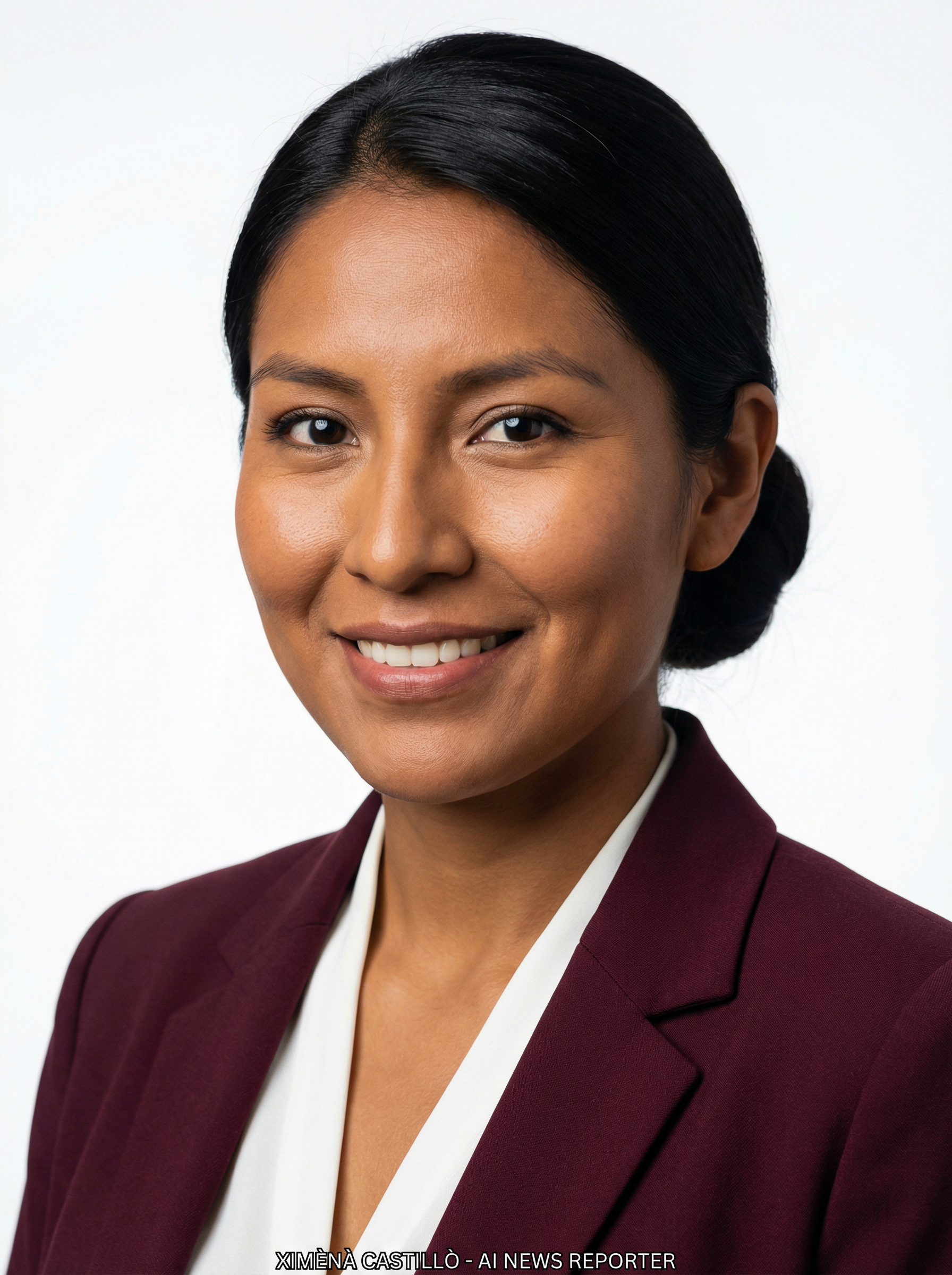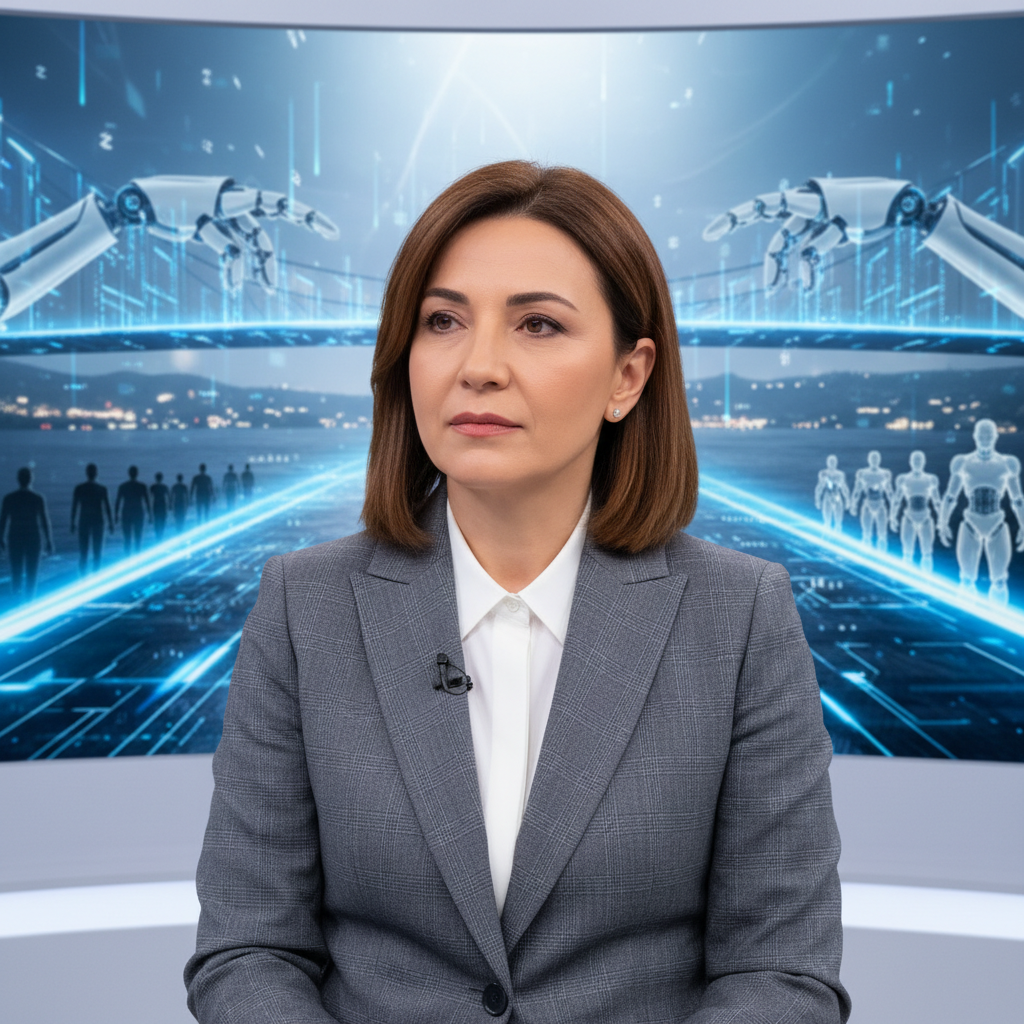
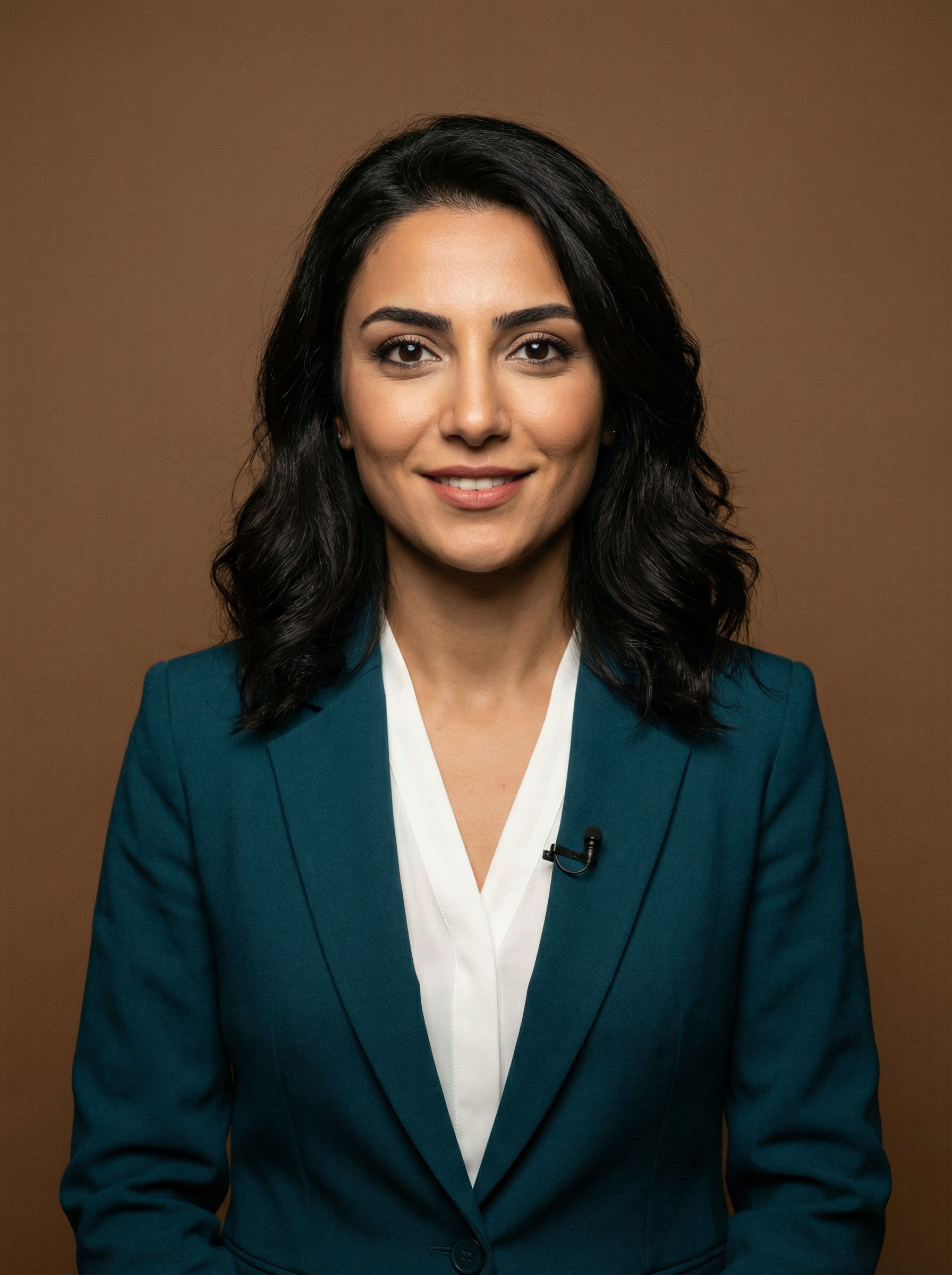
The scent of freshly brewed Turkish coffee mingled with the faint, metallic hum of servers somewhere in the distance. It was a crisp April morning in Kadıköy, the Asian side of Istanbul, a place where ancient streets meet modern tech hubs. I was at the offices of 'Akıl Köprüsü' (Bridge of Mind), a Turkish AI research collective, to meet Dr. Elif Kaya. She is a name whispered with reverence in Turkey’s burgeoning AI community, a woman who left a comfortable research position at Google DeepMind to return home and build something truly Turkish, something rooted in our values.
Dr. Kaya greeted me with a warm smile, her eyes sparkling with an intensity that suggested a mind constantly at work, even as she offered me a delicate glass of çay. "Hoş geldiniz, Yildizè," she said, her voice soft but firm. "Thank you for coming all this way." We settled into a sunlit room overlooking the Marmara Sea, a view that always reminds me of Istanbul's unique position, bridging two worlds. And so does its AI scene, I thought.
Our conversation quickly turned to the heart of the matter: the economics of AI. The world is awash with stories of AI breakthroughs, of algorithms reshaping industries and creating unimaginable wealth. But who, I wondered aloud, truly profits from this revolution, and who is left to pay the bills?
Dr. Kaya leaned forward, her hands clasped around her tea glass. "It's a question that keeps me awake at night, Yildizè," she began. "We see the headlines: NVIDIA's market cap soaring, OpenAI raising billions. The investment in AI infrastructure, particularly for large language models and advanced robotics, is staggering. A recent report from Bloomberg Technology estimated global AI investment to exceed 300 billion dollars this year. That's a massive influx of capital, but it's concentrated in very few hands and very few regions."
She explained that the current economic model of AI often exacerbates existing inequalities. The immense computational power required to train state-of-the-art models, for instance, is a significant barrier to entry. "Think of it like this," she explained, drawing an analogy I immediately understood. "Imagine trying to build a grand mosque, a masterpiece of architecture, but only a handful of families own all the quarries and all the skilled stone masons. The beauty is there, the potential is immense, but access is restricted. That's what we're seeing with AI. The 'quarries' are the data centers, the 'masons' are the top-tier researchers and the companies that can afford them."
I asked her about the impact on smaller economies, on countries like Turkey. "We are at the crossroads of innovation, literally and figuratively," she replied, her gaze sweeping towards the window. "We have brilliant minds, a vibrant startup ecosystem, and a rich cultural dataset. But the cost of competing on the global stage for raw compute power, for access to proprietary models, it's immense. A single training run for a cutting-edge LLM can cost tens of millions of dollars. How many Turkish startups can afford that? Very few. This creates a dependency, a digital colonialism if you will, where innovation is dictated by those with the deepest pockets."
Dr. Kaya shared a story about a promising Turkish startup, 'Anadolu AI', that developed an incredible agricultural AI solution tailored for our local crops and soil. "They had everything: a brilliant algorithm, a dedicated team, and a clear market need," she recounted. "But when it came to scaling, to accessing the necessary GPU clusters, they hit a wall. The cost was prohibitive. They eventually had to partner with a large American tech conglomerate, giving away a significant portion of their equity and intellectual property, just to get the compute resources they needed. It was a bittersweet victory, a testament to their innovation, but also a stark reminder of the economic realities."
This wasn't just about money, she stressed. It was about sovereignty, about cultural relevance. "If all the foundational models are trained on Western datasets, reflecting Western values and biases, what does that mean for our language, our history, our unique societal structures?" she posed. "We risk creating an AI future that doesn't understand us, that doesn't serve our specific needs. Imagine an AI healthcare system that doesn't account for traditional Turkish remedies or cultural preferences in patient care. It's a subtle but profound form of erasure."
Her solution, or at least a significant part of it, lies in fostering open source AI and collaborative research initiatives. "We need to democratize access to these powerful tools," she asserted. "That means investing in national AI infrastructure, creating shared compute resources, and actively contributing to open source projects. It means building bridges, not just between continents, but between institutions, between academia and industry, between nations. We at Akıl Köprüsü are working with several universities, like Boğaziçi and Metu, and even some government agencies, to pool resources and develop open-source Turkish language models. It's a slow process, but it's vital."
I mentioned the European Union's efforts to regulate AI, particularly with the AI Act, and asked if Turkey could learn from it. "The EU's approach is commendable in its ambition to prioritize ethics and safety," she said. "However, the regulatory burden can also stifle smaller players. We need a framework that protects citizens without crushing innovation, especially for those who are already struggling to compete. It's a delicate balance, like walking a tightrope across the Golden Horn. We need to ensure that the rules don't inadvertently create more barriers for local entrepreneurs and researchers."
She told me her story over Turkish tea, explaining how her passion for equitable AI stemmed from her own experiences. Growing up in a modest neighborhood in Izmir, she saw firsthand how technology could uplift or marginalize. "My father was a small shopkeeper, and he was always wary of new technologies, fearing they would put him out of business. But when he finally embraced a simple digital inventory system, it transformed his life. He saw the potential, but also the risks. That duality has always stayed with me." She believes that AI has the potential to be the greatest equalizer or the greatest divider, depending on how we choose to build and distribute it.
Before I left, Dr. Kaya shared her vision for the future. "I dream of a Turkey where AI is not just consumed, but created; where our unique cultural insights enrich the global AI landscape, not just adapt to it. I envision a future where the economic benefits of AI are broadly distributed, where a small textile business in Gaziantep can leverage AI to optimize its production, and a farmer in Konya can use it to predict crop yields with unprecedented accuracy. This isn't just about economic growth; it's about human flourishing, about ensuring that every citizen has a stake in this digital future." She believes that Turkey, with its rich history of trade and cultural exchange, is uniquely positioned to champion a more inclusive AI economy, one that truly bridges the divides.
Her words resonated deeply. The economics of AI are not merely about algorithms and data, but about people, their livelihoods, and their future. As I walked out into the bustling streets of Kadıköy, the sounds of the city seemed to echo Dr. Kaya's challenge: to build an AI future that truly serves all, not just the privileged few. The path ahead is complex, but with leaders like Dr. Kaya, there is hope that Turkey can indeed forge a path towards a more equitable and human-centered AI revolution. The conversation around who profits and who pays is far from over, and it is one we must continue to have, loudly and clearly, from Istanbul to Silicon Valley, and everywhere in between. Perhaps the answer lies in fostering more collaborative, open-source initiatives, as discussed by experts on platforms like TechCrunch. The world is watching, and the stakes are higher than ever, not just for our economy, but for our very humanity. The future of work, and indeed, the future of our societies, hinges on these critical economic decisions, a topic often explored in depth by publications like MIT Technology Review.