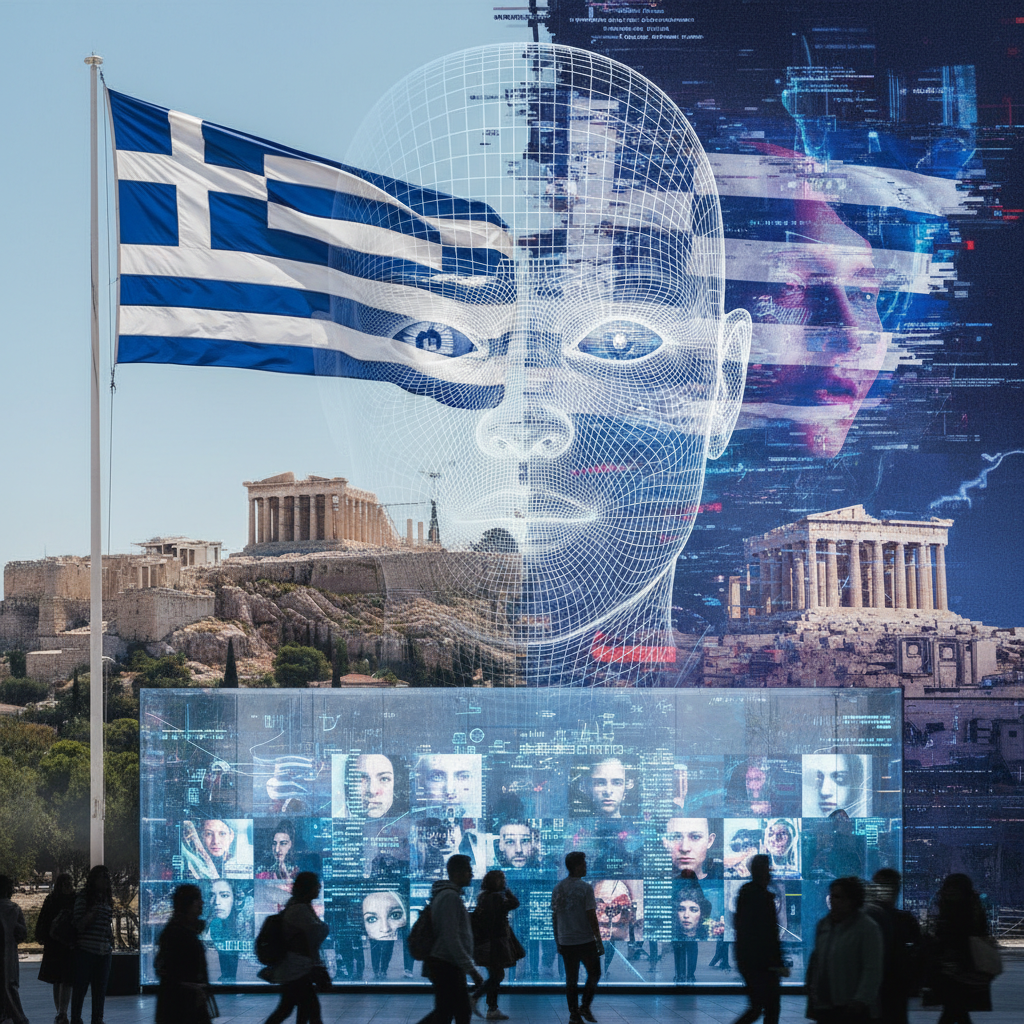

The gods of Olympus would have loved this AI drama, truly. Imagine Zeus, not just shape-shifting into a swan or a golden shower, but creating an utterly convincing digital replica of himself, complete with his booming voice and a perfectly rendered beard, to address the mortals. He would probably use it to endorse a new brand of ambrosia or perhaps to settle a divine dispute without actually showing up. Today, we call that a deepfake, and while it might not be quite as mythological, its implications for our very sense of self are just as profound, especially here in Greece.
We are living through an identity crisis, not just for individuals but for society at large. Digital identity, once a somewhat abstract concept, has become the bedrock of our online existence. From banking to social media, from e-governance to simply proving you are who you say you are, our digital selves are everywhere. But what happens when that digital self can be perfectly mimicked, twisted, or outright fabricated by artificial intelligence? Pass the ouzo, this tech news requires it.
The explosion of generative AI models in the last 18 months has been nothing short of breathtaking. Tools that can create hyper-realistic images, videos, and audio from simple text prompts are now widely accessible. What began as a novelty, a way to put your face on a movie star's body or generate quirky animal pictures, has rapidly evolved into a sophisticated weapon for misinformation, fraud, and reputational damage. The problem is no longer hypothetical; it is here, and it is impacting real people and real systems.
Consider the recent incident involving a prominent Greek politician, whose deepfake video, seemingly endorsing a dubious cryptocurrency scheme, circulated widely on social media just last month. The video was so convincing, complete with local dialect nuances and familiar mannerisms, that it took days for official channels to debunk it effectively. By then, thousands had already seen it, and some had even fallen victim to the scam. This wasn't some amateur job; it was a sophisticated piece of digital deception, highlighting the terrifying potential of these technologies.
“We are seeing an exponential increase in the sophistication of deepfake attacks,” explains Dr. Eleni Stavropoulou, head of digital forensics at the Hellenic Police Cybercrime Unit. “In 2023, we recorded 12 major incidents involving deepfakes targeting public figures or financial institutions. This year, we are already at 25, and it’s only April. The technology is advancing faster than our ability to regulate or even detect it reliably.” She points out that the average person is now 83 percent more likely to encounter a deepfake online compared to two years ago, according to internal police data.
This isn't just a Greek problem, of course. Globally, the numbers are staggering. A report by the AI security firm Sensity AI indicated a 900 percent increase in deepfake incidents between 2020 and 2023. The financial sector alone lost an estimated 4.2 billion dollars globally to deepfake-enabled fraud in 2025, a figure that is projected to double by the end of this year if current trends continue. We are talking about an industrial scale of deception, and our digital identities are the primary targets.
What makes this particularly thorny for a country like Greece, and indeed for Europe, is our foundational commitment to privacy and individual rights. The General Data Protection Regulation, or GDPR, has set a high bar for data protection. But how do you protect an individual's identity when their very likeness and voice can be stolen and manipulated without their consent, often without leaving a trace? It’s a philosophical conundrum that would make Aristotle scratch his head.
“The current legal frameworks, even robust ones like GDPR, were not designed for a world where your face can be weaponized against you,” states Professor Nikos Petrakis, a leading expert in AI ethics at the National and Kapodistrian University of Athens. “We need to move beyond just data protection to identity protection in a much broader sense. This means exploring digital watermarking, robust authentication protocols, and perhaps even a legally recognized ‘right to digital likeness’ that can be enforced against AI misuse.” His team is currently researching new methods for deepfake detection, but he admits it’s a constant arms race.
The European Union is attempting to tackle this through its AI Act, which aims to regulate high-risk AI systems. While a step in the right direction, many argue it doesn't go far enough to address the specific threat of deepfakes to digital identity. The Act focuses heavily on transparency, requiring AI-generated content to be labeled. But as anyone who has spent five minutes online knows, labels are easily stripped, ignored, or even fabricated themselves. It’s a bit like putting a 'handle with care' sticker on a bomb.
So, what are the solutions? Greece to Silicon Valley: we invented logic, remember? Perhaps it’s time for some of that ancient wisdom. One promising avenue is the development of robust, decentralized digital identity systems. Imagine a system where your identity is not stored in one central database, vulnerable to a single breach, but rather cryptographically secured across a network, verifiable without revealing all your underlying personal data. Blockchain technology, for all its hype and occasional absurdity, offers some interesting possibilities here.
Companies like Worldcoin, controversial as they may be, are attempting to create global identity solutions based on biometric scans, though the privacy implications are still hotly debated. Other initiatives, often less flashy but perhaps more practical, are exploring federated identity systems where different trusted entities can verify aspects of your identity without any one entity holding the master key. This distributed trust model could make it much harder for deepfakes to gain traction, as multiple layers of verification would be required.
Then there is the technological arms race in detection. Researchers globally, including those at the Demokritos National Centre for Scientific Research in Athens, are working on AI models specifically designed to spot deepfakes. These models look for subtle inconsistencies, digital artifacts, and even physiological anomalies that are difficult for current generative AI to replicate perfectly. However, it's a cat-and-mouse game; as detection methods improve, so do the deepfake generation techniques. It’s a never-ending cycle of innovation and counter-innovation.
Ultimately, the fight against deepfakes and the protection of digital identity will require a multi-pronged approach. It needs better technology, stronger legislation, and crucially, greater public awareness. We, the users, need to be more skeptical, more vigilant, and more educated about the digital content we consume. We need to question what we see and hear, especially when it seems too good, or too bad, to be true.
As the digital world increasingly mirrors our physical one, the concept of identity becomes ever more fluid and vulnerable. The challenge for Greece, and indeed for the global community, is to ensure that our digital selves remain authentic, that the reflections we see in the algorithmic mirror are truly our own, and not some clever, malicious fabrication. Otherwise, we risk losing not just our privacy, but a fundamental aspect of our humanity. For more on the evolving landscape of AI security, you can always check out what's happening at TechCrunch or Wired. The future of identity is not just a tech problem, it is a human one, and it demands our full attention.