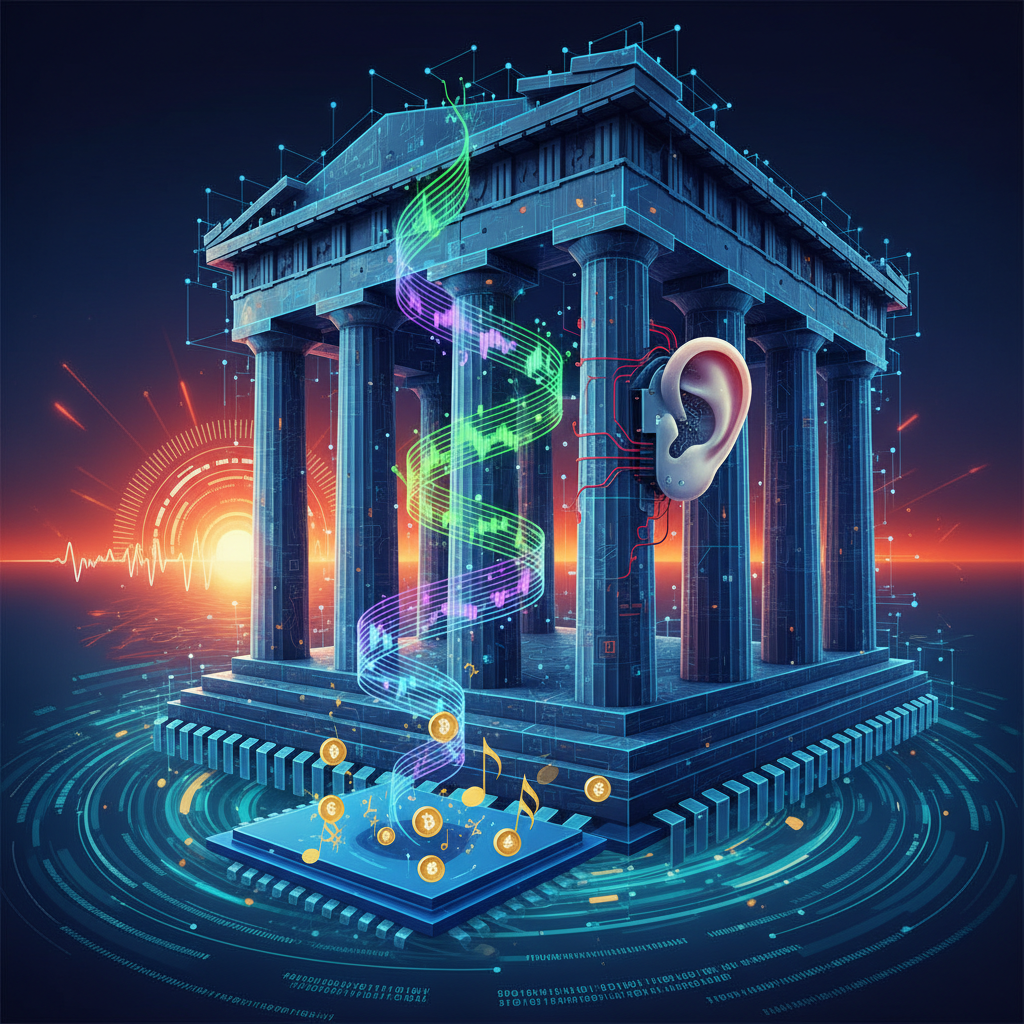

Is the music industry facing an existential crisis, or merely a very loud, very algorithmic evolution? This is the question echoing through studios and boardrooms, from Nashville to Nea Smyrni, as AI-generated music not only infiltrates but now tops global charts. It is a phenomenon that makes one wonder if the gods of Olympus would have loved this AI drama, perhaps even commissioning a digital lyre for Apollo.
For centuries, music has been the soul's expression, a deeply human endeavor. From the ancient Greek kithara to the modern synthesizer, instruments changed, but the essence remained: a human hand, a human heart, a human story. Now, we have algorithms like Google's MusicLM and OpenAI's Jukebox, not just mimicking but creating melodies, harmonies, and even lyrics with a disconcerting proficiency. The latest data from industry tracker SoundScan Europe reveals that AI-composed tracks accounted for nearly 18% of new releases in the first quarter of 2026, with two tracks hitting the top 10 in multiple European markets. This is not just background noise; it is a full-blown orchestral assault on tradition.
The historical context here is crucial. Every technological leap in music, from the phonograph to digital sampling, has been met with a mix of awe and apprehension. When synthesizers first appeared, purists scoffed. When Auto-Tune became ubiquitous, critics decried the death of vocal authenticity. Yet, each innovation eventually found its place, expanding the sonic palette and democratizing creation to some extent. But AI is different. It is not just a tool; it is a creator, or at least, a highly sophisticated mimic of one. This distinction is what truly rattles the cages.
Consider the recent success of 'Echoes of Elysium,' a track entirely composed and performed by 'MuseAIk,' an AI developed by a small startup in Berlin. It hit number one on the Greek digital charts last month, a feat that would have been unthinkable even two years ago. The track, a blend of traditional Greek folk elements with modern electronic beats, was praised for its 'haunting melodies' and 'emotional depth' by critics who were initially unaware of its artificial origins. When the truth emerged, the backlash was swift and fierce, particularly from the Panhellenic Union of Musicians.
“This is not art, it is data processing,” declared Eleni Karagianni, president of the Union, her voice crackling with indignation during a recent press conference in Athens. “Where is the struggle, the pain, the joy, the life experience that makes music meaningful? An algorithm has no soul. It merely rearranges existing patterns. This undermines the very foundation of human creativity and livelihood.” Her sentiment resonates with many artists who see their craft devalued and their income streams threatened. The fear is palpable, especially in a country like Greece, where artistic expression is deeply intertwined with cultural identity and often, a struggle for survival.
Yet, not everyone views the rise of AI music with such alarm. Dr. Andreas Stavrou, a leading ethnomusicologist at the University of Crete, offers a more nuanced perspective. “We must remember that human creativity has always been influenced by existing works. Composers study, adapt, and build upon the past. AI does this at an unprecedented scale, yes, but it is still a form of influence. The question is not if it is art, but how we define art in this new paradigm. Perhaps it is a new form of collaborative art, where human intention guides the AI’s generative power.” He suggests that AI could become a powerful tool for artists, allowing them to explore new sonic territories and overcome creative blocks, much like a digital muse. He even envisions AI helping to revive forgotten traditional Greek musical forms by generating variations that resonate with modern audiences.
Indeed, some tech companies are already pushing this collaborative vision. Spotify, for instance, has been quietly experimenting with AI-driven personalization features that not only recommend music but also generate unique ambient tracks based on user mood and activity. While not yet topping charts, these personalized soundscapes hint at a future where music is less about universal hits and more about individual, algorithmically tailored experiences. Bloomberg Technology recently reported on Spotify's internal projections, which suggest that by 2030, over 40% of all streamed audio could be AI-generated, either fully or in part.
The financial implications are staggering. The global music industry, valued at over $26 billion in 2023, is now grappling with how to monetize AI-generated content and, more importantly, how to fairly compensate the human artists whose work often serves as the training data for these algorithms. This is where the legal battles are heating up. Companies like Universal Music Group and Sony Music are already exploring new licensing models and pushing for stricter copyright protections for their artists' catalogs against AI ingestion. The argument is simple: if an AI learns from human creations, then those human creators deserve a cut of the AI’s output. This echoes the broader copyright debates raging across other creative industries, as we've seen with visual art and literature, where even the legal systems in places like La Paz are trying to catch up to Silicon Valley's rapid advancements. For more on that, you might want to read about when Silicon Valley's copyright wars reach La Paz [blocked].
My verdict? This is no mere fad. The genie, or perhaps the digital daemon, is out of the bottle. AI music is here to stay, and it will fundamentally reshape the industry. The question is not if but how we integrate it. Will it lead to a soulless, algorithmic monoculture, or will it unlock new avenues for human creativity? I lean towards the latter, but with a healthy dose of Greek skepticism. Greece to Silicon Valley: we invented logic, remember? We understand that true innovation requires not just technological prowess but also ethical foresight and a deep respect for human endeavor.
The challenge lies in finding a balance. We need robust legal frameworks that protect human artists and ensure fair compensation. We need platforms that prioritize transparency, clearly labeling AI-generated content. And perhaps most importantly, we need to foster a culture that values human artistry even more fiercely in the face of algorithmic abundance. The human touch, the raw emotion, the imperfect beauty that defines our greatest songs, these are qualities an algorithm can simulate but can never truly possess. As long as there are human hearts to sing and human ears to listen, there will always be a place for music born of flesh and blood.
The future of music will likely be a complex tapestry, woven with both human ingenuity and algorithmic precision. It will be messy, controversial, and at times, utterly bewildering. But if history is any guide, humanity will adapt, innovate, and continue to find new ways to make beautiful noise. Perhaps the algorithms will even help us discover new sounds we never imagined, pushing the boundaries of what music can be. We just need to make sure we are still the conductors of this grand, evolving symphony, not just passive listeners to a machine's endless loop. The stage is set, the algorithms are humming, and the audience, for now, is captivated. What happens next is up to us, the humans, to compose. For further insights into the broader implications of AI in creative fields, Wired's Artificial Intelligence section often provides excellent analysis. It is a brave new world, indeed.