
Let's be honest, the tech world has always had a bit of a Messiah complex, hasn't it? Every new gadget, every shiny algorithm, is presented as the next great leap for mankind, destined to solve all our woes and probably make us all richer in the bargain. Then along comes AI, promising to automate everything from customer service to complex coding, and suddenly, the workers, bless their cotton socks, are starting to wonder if they're not just being automated out of a job. And here in Ireland, where the tech giants have set up shop with all the enthusiasm of a flock of seagulls descending on a dropped chip, that question is getting louder.
Is this pushback against AI-driven automation just a bit of a kerfuffle, a temporary blip before we all happily embrace our robot overlords? Or are we seeing the first tremors of a genuine, sustained resistance, a new normal where the human element demands its due? My money's on the latter, and frankly, it's about bloody time.
Historically, every industrial revolution has had its Luddites, hasn't it? From the weaving machines that put skilled artisans out of work in the 19th century to the rise of personal computers that transformed office work, there's always been a period of upheaval and resistance. The difference now, it seems, is the sheer speed and breadth of AI's potential impact. It's not just blue-collar jobs on the line anymore. Even the fella in the fancy suit, tapping away at his keyboard, is starting to eye Google's Gemini or Microsoft's Copilot with a healthy dose of suspicion. The narrative used to be 'AI will augment, not replace'. Now, it feels more like 'AI will augment, then replace, then probably take over your lunch break too'.
Take the example of the Writers Guild of America strike in 2023. While not solely about AI, the fear of generative AI being used to churn out scripts and devalue human creativity was a massive sticking point. It was a clear signal: creatives, often seen as the last bastion against full automation, were drawing a line in the sand. And they won concessions, mind you. That's not a fad, that's a precedent. More recently, we've seen similar rumblings in the gaming industry, where artists and developers are worried about tools like Midjourney and OpenAI's Sora being used to cut corners and reduce headcounts. The craic is mighty in Irish AI, but the laughter can quickly turn to grumbling when livelihoods are at stake.
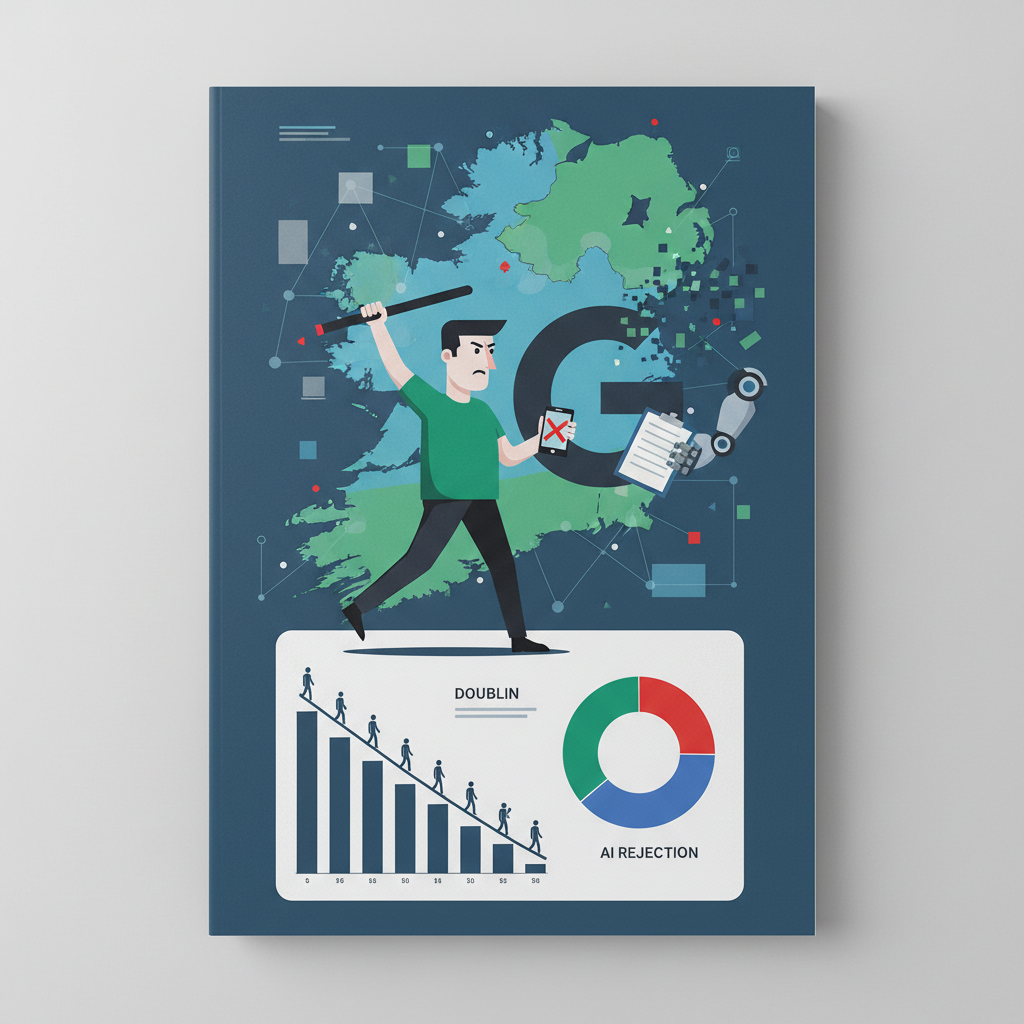
Here in Ireland, Dublin's Silicon Docks have a story to tell, a tale of economic boom thanks to the likes of Google, Meta, and Apple. But this symbiotic relationship is getting a bit more complicated. We've seen a surge in discussions within Irish trade unions, particularly Siptu and Fórsa, about the implications of AI. A recent report from the Irish Congress of Trade Unions (ictu) indicated that nearly 60 percent of their members expressed concerns about job displacement due due to AI within the next five years. That's not a small number, is it? It's a significant chunk of the workforce looking at their future with a furrowed brow.
I spoke with Maeve O'Connell, a senior researcher at the National Economic and Social Council, about this growing unease. "The initial approach from many tech companies was to present AI as a tool for efficiency, a way to free up workers for more 'creative' tasks," she told me, a hint of skepticism in her voice. "But what we're seeing on the ground is a different reality. Companies are looking at the bottom line, and if a large language model can handle 80 percent of customer queries, that's 80 percent fewer human agents they need. The 're-skilling' narrative often falls short when the new 'creative' jobs simply don't materialise at the same rate, or at the same pay scale." It's the old trick, isn't it, promising a pot of gold at the end of the rainbow, only to find it's just another pot of stew, and you're still doing the washing up.
This isn't just about job losses, mind you. It's also about the nature of work itself. AI is increasingly being used for surveillance, performance monitoring, and even hiring decisions, leading to a feeling of dehumanisation. "We're seeing a push for 'algorithmic transparency' from unions," explained Liam Gallagher, a Fórsa representative who's been actively engaging with tech companies in Dublin. "Workers want to understand how these systems make decisions that affect their jobs, their promotions, their very livelihoods. It's not enough to say 'the algorithm decided'. We need accountability. What if the algorithm is biased? What if it's just plain wrong? Who's responsible then?" He makes a fair point. We wouldn't let a dodgy calculator run the country, so why let a black box algorithm run our careers?
The European Union, ever keen to regulate everything from the curvature of a banana to the privacy of your data, is also wading into this. The AI Act, which is slowly but surely making its way through the legislative process, aims to set guardrails for AI development and deployment. While it focuses heavily on safety and fundamental rights, the employment aspect is gaining more traction. "The European Trade Union Confederation is pushing hard for stronger protections for workers within the AI Act," according to Dr. Anya Sharma, a legal expert specializing in AI ethics at University College Dublin. "They're advocating for mandatory human oversight, consultation with workers' representatives before AI deployment, and robust impact assessments. This isn't just a local Irish phenomenon; it's a continent-wide conversation." You can read more about these broader discussions on MIT Technology Review.
Some tech leaders, of course, are trying to assuage these fears. Sundar Pichai, Google's CEO, has often spoken about the need for a 'human-centered' approach to AI, but the reality on the ground, for many, feels less like partnership and more like displacement. Meanwhile, companies like Anthropic, with their focus on 'constitutional AI' and safety, are trying to build trust, but even they can't escape the economic pressures that drive automation. The bottom line always seems to win out, doesn't it?
So, is this a fad or the new normal? I'd wager my last euro that this is the new normal, and it's only going to intensify. The genie's out of the bottle, as they say, and AI isn't going anywhere. But neither are the workers. What we're witnessing is a critical juncture, a moment where the balance of power between capital and labor is being renegotiated in the age of intelligent machines. It's not about stopping progress, it's about shaping it, about ensuring that the benefits of AI are shared broadly, not just hoarded by a select few. The days of tech companies rolling into town, setting up shop, and expecting everyone to just be grateful are well and truly over. Only in Ireland would you find this blend of welcome and skepticism, a willingness to embrace innovation but a fierce determination to protect our own.
This isn't just a battle over jobs; it's a battle over dignity, over the value of human contribution in an increasingly automated world. Unions are not just reacting; they're proactively demanding a seat at the table, pushing for collective bargaining agreements that include clauses on AI deployment, re-skilling provisions, and fair compensation for those whose roles are fundamentally altered. They're even looking at potential 'AI dividends' or universal basic income schemes, ideas that would have been laughed out of the room a few years ago but are now gaining serious traction. For more on the global union perspective, you might find articles on Reuters Technology insightful.
My verdict then? This isn't a fad. This is the beginning of a long, complex, and absolutely necessary conversation. The tech giants, with their shiny new toys, are going to have to learn to listen, and the workers, with their collective voice, are going to have to learn to speak even louder. The future of work, it seems, won't be written by algorithms alone, but by the messy, human process of negotiation, protest, and, dare I say it, a bit of good old-fashioned Irish stubbornness. And that, my friends, is a story worth following. You can keep up with the latest developments in AI and labor on TechCrunch AI.