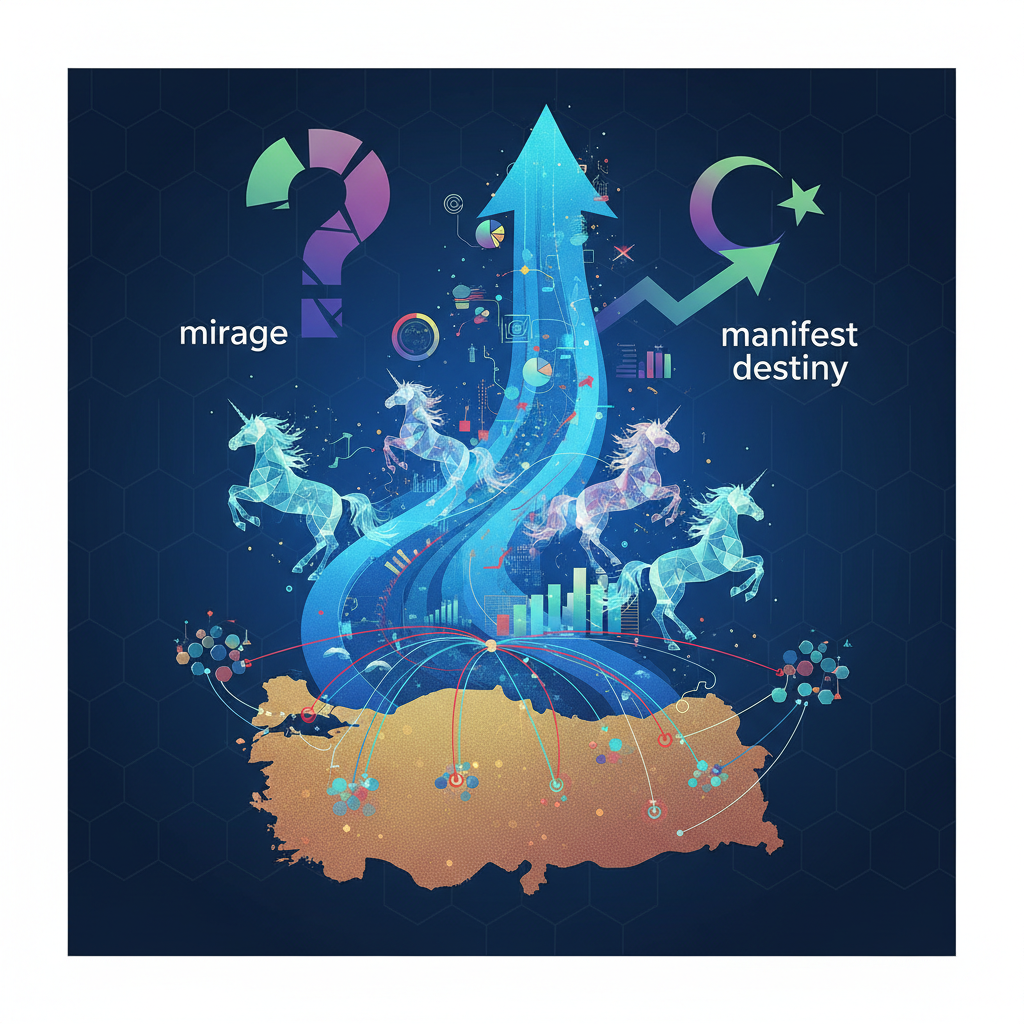

Is this a new tulip mania, or the dawn of an industrial revolution that will redefine wealth for centuries? That is the question echoing through the marble halls of venture capital firms and the bustling co-working spaces of Istanbul alike, as AI unicorns gallop into existence with dizzying valuations. We are in April 2026, and the pace of capital flowing into artificial intelligence startups is not just fast, it is a torrential flood, reshaping economies and challenging our very understanding of value. For a long time, the tech world looked westward, but now, the currents are shifting, and nations like Turkey are not merely observers, they are active participants, building the future at the crossroads.
Let us cast our minds back, not to a distant century, but just a few years. The early 2020s saw AI as a promising, yet often abstract, field. There were breakthroughs, certainly, but the commercial applications, the tangible products that could command billions, were still nascent. Then came the generative AI explosion, a Cambrian moment for algorithms. Suddenly, large language models, image generators, and sophisticated automation tools were not just academic curiosities, they were products with immediate, transformative potential. This shift, from research to revenue, ignited the venture capital world. Previously, a company might take a decade to reach a billion-dollar valuation, a unicorn status. Now, some AI startups are achieving it in mere months, sometimes even before a fully commercialized product hits the market.
Consider the raw numbers, which are truly staggering. In 2025 alone, global AI venture funding surpassed 150 billion dollars, a 40 percent increase from the previous year. This is not just about a few big players like OpenAI or Anthropic, though their multi-billion dollar rounds certainly set the tone. It is about a proliferation of specialized AI firms across sectors, from healthcare diagnostics to advanced materials design, each promising to disrupt established industries. Data from PitchBook shows that the average seed-stage AI round has jumped 30 percent in the last 18 months, indicating an aggressive land grab for early-stage innovation. The competition for talent, for unique datasets, and for proprietary models is fierce, driving up prices and expectations.
"What we are seeing is a fundamental re-evaluation of what a 'technology company' means," explains Dr. Ayşe Demir, a leading economist at Boğaziçi University in Istanbul. "An AI company is not just selling software, it is selling intelligence, a scalable asset that can generate exponential returns. The valuations reflect this potential, not just current revenue." She cautions, however, that not all potential translates into profit. "There will be consolidation, there will be failures, but the underlying technological shift is real and profound." Her words resonate with the pragmatic optimism I often encounter in Turkey's tech circles.
Indeed, the global giants are not sitting idle. NVIDIA, the chipmaker that has become the de facto infrastructure provider for this AI boom, saw its market capitalization soar past two trillion dollars, largely on the back of demand for its specialized GPUs. Companies like Google DeepMind and Meta AI are pouring billions into research and development, acquiring promising startups, and integrating AI deeply into their product ecosystems. This creates a powerful feedback loop: the success of foundational models fuels demand for hardware, which in turn enables more sophisticated AI, attracting more investment. You can track some of these developments on sites like TechCrunch or Reuters Technology.
But is this sustainable? Is every AI startup truly worth its lofty price tag? "There is an undeniable element of Fomo, fear of missing out, driving some of these deals," admits Cemil Kaya, a partner at Anatolian Ventures, a prominent Istanbul-based fund. "Investors saw the returns from early bets on generative AI and are now scrambling to find the next big thing. Some of these valuations are based more on hype and future speculation than on proven business models or clear paths to profitability." He points to instances where companies with minimal revenue but groundbreaking research have secured nine-figure funding rounds. "The market is betting on the future, and sometimes, the future is a mirage." Kaya's perspective is grounded in the hard realities of venture capital, a world where even the most brilliant ideas can falter without solid execution.
Yet, for nations like Turkey, this AI gold rush presents an unprecedented opportunity. Istanbul's tech ambitions are massive and realistic. We have a young, highly educated population, a robust engineering talent pool, and a strategic geographic position that connects East and West. Turkish startups are not just copying Western models, they are innovating with a unique regional perspective. Take, for example, companies developing AI solutions for logistics, leveraging Turkey's role as a global trade hub, or those creating localized language models for Turkic languages, an underserved market. This is not about being a follower, it is about carving out a distinct niche, a modern interpretation of the Ottoman approach to AI empire-building.
"We are seeing a 'brain gain' in Turkey, with many talented individuals returning from abroad, drawn by the vibrant startup ecosystem and the sheer ambition here," says Elif Sönmez, CEO of VeriZeka, a Turkish AI firm specializing in predictive analytics for smart cities. "The government's support for R&D, the growing number of incubators, and the increasing availability of local capital are creating a fertile ground for AI innovation. We are not just building products for Turkey, we are building for the world from Turkey." Her company recently closed a significant Series B round, valuing it at over 800 million dollars, a testament to the growing maturity of the Turkish AI market. For more on how geopolitics influences our tech landscape, you might find this article insightful: The Digital Bosphorus: How Geopolitics is Rewiring Turkish Minds, One Algorithm at a Time [blocked].
Of course, challenges remain. Access to cutting-edge computing infrastructure, particularly advanced GPU clusters, can be a bottleneck. The regulatory landscape, while evolving, still needs to provide clearer guidelines for AI development and deployment. And the global competition for top-tier AI talent is relentless. Yet, the momentum is undeniable. The Turkish government, through initiatives like Tübi̇tak and the Digital Transformation Office, is actively investing in AI research and infrastructure, recognizing its strategic importance for national competitiveness and security.
My verdict? This is not a mere fad. The underlying technological advancements in AI are too fundamental, too transformative, to be dismissed as a transient bubble. We are witnessing a paradigm shift, akin to the internet revolution of the late 1990s, but perhaps even more profound in its potential to reshape every facet of human endeavor. Yes, there will be irrational exuberance, some companies will inevitably fail to live up to their valuations, and market corrections are always a possibility. However, the core truth remains: artificial intelligence is the engine of the next global economy, and the companies that master it will command immense value. For Turkey, this is not just about participating, it is about leading, about leveraging our unique strengths to build an AI future that is both prosperous and distinctly ours. The billions flowing into AI are not just numbers, they are votes of confidence in a future that is already here, and it is thrilling to watch it unfold from this ancient, yet ever-forward-looking, land.