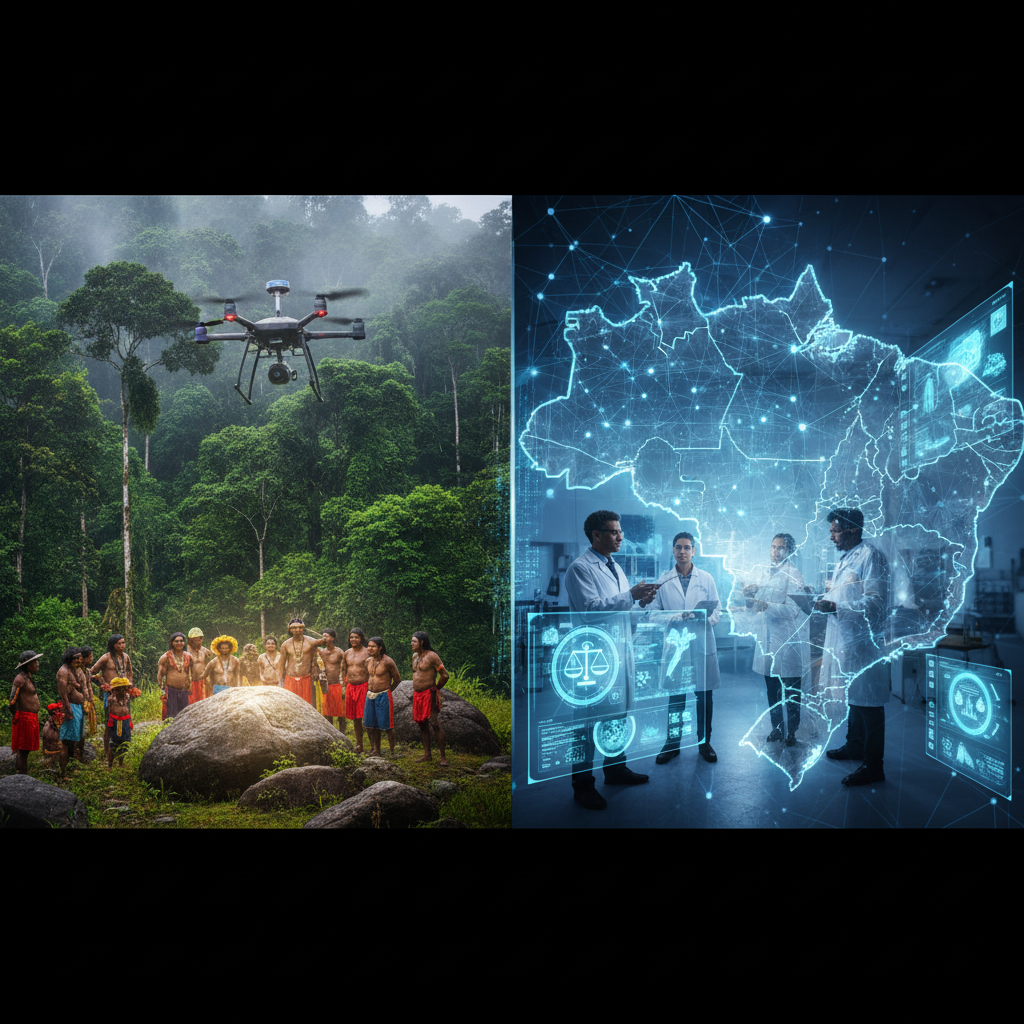
The hum of servers in São Paulo and the whir of algorithms in Rio de Janeiro are now as crucial to scientific discovery as the microscopes and centrifuges of old. We are living through a scientific renaissance, powered by artificial intelligence, and it is electrifying. From predicting protein structures to synthesizing new materials, AI is acting like a super-powered magnifying glass, allowing us to see patterns and connections that were previously invisible. But here in Brazil, a nation blessed with unparalleled biodiversity and a rich tapestry of indigenous knowledge, this acceleration comes with a profound ethical weight, like a heavy rain cloud gathering over the rainforest. Who owns the discoveries made by AI when the data originates from our natural heritage, from the very breath of the Amazon?
For decades, scientific progress often felt like a slow, deliberate samba, one step at a time. Now, with AI, it is more like a frenetic frevo, a whirlwind of rapid insights. Consider the pharmaceutical industry. Drug discovery, traditionally a decade-long, multi-billion dollar endeavor, is being compressed. Companies like DeepMind, with its AlphaFold system, have revolutionized structural biology, predicting protein shapes with unprecedented accuracy. This is not just a technical marvel; it is a fundamental shift. As Dr. Sofia Carvalho, lead AI researcher at the Oswaldo Cruz Foundation in Rio de Janeiro, told me last week, "AlphaFold has given us a shortcut, a atalho, to understanding life's building blocks. Before, it was like trying to assemble a complex Lego set without instructions. Now, AI provides the blueprint, accelerating our understanding of diseases like dengue and Zika, which are so prevalent here."
Indeed, the data tells the real story. A recent report by McKinsey suggested that AI could unlock an additional $13 trillion in global economic value by 2030, with a significant portion attributed to scientific and R&D acceleration. In medicine alone, AI is projected to reduce drug discovery timelines by 25% and costs by 30% within the next five years, according to a study published in Nature Machine Intelligence [https://www.nature.com/natmachintell/]. These are not small numbers; they represent a seismic shift in how we approach some of humanity's most pressing challenges.
However, the ethical implications, particularly for countries like Brazil, are complex and multifaceted. Our Amazon rainforest, a global treasure, is a living library of biodiversity, home to countless species and traditional remedies. Indigenous communities have safeguarded this knowledge for generations. When AI systems ingest vast datasets, including genomic sequences from Amazonian flora and fauna, or even ethnobotanical information, who holds the intellectual property rights to the resulting AI-driven discoveries? Is it the company that developed the algorithm, the researchers who collected the data, or the communities whose ancestral lands and knowledge provided the raw material?
"This is not just about data privacy; it is about digital sovereignty and equitable benefit sharing," explains Professor Marcos Almeida, a legal scholar specializing in AI ethics at the University of São Paulo. "We need robust legal frameworks, perhaps inspired by the Nagoya Protocol on Access and Benefit-sharing, but adapted for the digital age. Without them, we risk a new form of bio-colonialism, where the benefits of our natural wealth are extracted by algorithms based thousands of kilometers away, leaving local communities with little more than a thank you, or worse, nothing at all." This sentiment resonates deeply within Brazil's developer community, which is massive and talented, but also acutely aware of global power imbalances.
Let me explain the architecture of this ethical dilemma. AI models, particularly large language models and advanced machine learning systems, thrive on data. The more data, the better the model. When this data includes genetic material, chemical compounds, or even traditional ecological knowledge from biodiverse regions, the line between raw information and intellectual property becomes blurred. Imagine an AI discovering a novel anti-cancer compound from a plant found only in the Amazon, a plant whose medicinal properties were known to a specific indigenous tribe for centuries. If a multinational pharmaceutical company, using an AI trained on publicly available genomic data and scientific literature, patents this compound, where does the credit, and more importantly, the profit, go?
This is not a hypothetical scenario. Researchers are already exploring the vast chemical diversity of the Amazon. For example, a recent project at the Federal University of Minas Gerais is using AI to screen natural compounds for antiviral properties, a direct response to our experiences with pandemics. While promising, the ethical framework for such endeavors is still nascent. "We are building the plane while flying it," says Dr. Almeida, "and we must ensure that the flight path is just and inclusive."
Brazil has a chance to lead in this space. Our unique position, with immense biodiversity and a growing tech sector, means we can champion ethical AI development that respects both scientific progress and traditional knowledge. Initiatives like the Brazilian AI Strategy, which emphasizes ethical principles and human-centric AI, are a good start. We need to invest more in local AI research, ensuring that our own scientists and developers are at the forefront of these discoveries, not just consumers of foreign technology. We need to foster collaborations between universities, indigenous communities, and tech companies, creating models where benefit sharing is baked into the very foundation of the research project.
The challenge is immense, but so is the opportunity. We cannot afford to let the rapid pace of AI-driven discovery overshadow our responsibility to protect our heritage and ensure equity. The code tells the real story, and right now, that story is still being written. We must ensure it is a story of shared prosperity, not just accelerated extraction. The world is watching, and the Amazon, with its silent wisdom, is waiting for us to choose the right path. This is not merely an academic debate; it is about the future of our nation, our planet, and the very definition of progress. For more insights into the broader implications of AI, I often find valuable perspectives on Wired and TechCrunch. Our journey with AI is just beginning, and for Brazil, the stakes could not be higher.